Chapter One Famous Last Words All children grow up, all except one.
Wendy learned this when she was playing in the garden one day at the age of two.
She brought her mother a flower, and Mrs. Darling hugged her and said, "'Oh, why can't you stay like this forever and ever?'
Before that day, Wendy didn't realize she wouldn't stay the same.
Wendy had two younger brothers, John and Michael.
They were growing, too.
Mrs. Darling stayed home with the children while Mr. Darling went to work in stocks.
His stocks didn't always work for him, however, and so the family had to scrimp and save.
They still had a nanny, of course, because all the other families in the neighborhood had one, and Mr Darling cared very much about keeping up with the neighbors.
But the Darlings were poor, and so their nanny was actually just a giant Newfoundland dog named Nanny.
Nana was an interesting nanny, to say the least.
She didn't believe in all this newfangled talk about germs.
Sometimes she would lovingly lick the children right after she licked her own foot.
Mr. Darling was ashamed of Nana, and sometimes he was cold to her as a result.
He shouldn't have been.
She was actually quite a treasure.
If the children wandered or dilly-dallied on their way to school, she would bump them with her big head to get them back on track.
She never once forgot John's soccer uniform, and she usually carried an umbrella in her mouth instead of a bone in case of rain and it did rain quite often in England.
All in all, the Darlings were a normal, happy English family.
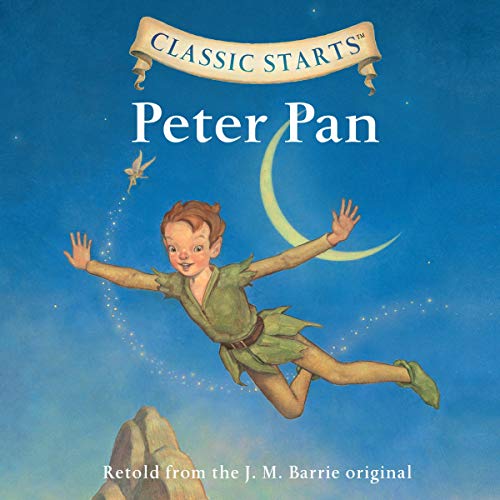
Until, that is, the arrival of a boy named Peter Pan.
Mrs Darling had never heard of Peter Pan until one day when she was tidying up her children's minds.
Most good mothers do this after their children are asleep, as if minds are drawers and children's memories are underwear and socks that need to be neatly folded and put away.
Oh how Mrs Darling would wrinkle her forehead sometimes at the sweet things she found in her children's minds, wondering where on earth they had picked them up.
These things she would lay out and lovingly smooth on the bed for the children to slip on first thing in the morning.
Other times, however, she found mean or ugly thoughts in her children's sleepy heads.
These she would shake out and quickly hide like something pushed under the bed.
Children's minds are a curious place.
If someone could draw a map, it would be full of zigzag lines and squiggles.
Eventually, however, all the lines and squiggles would lead to Neverland.
"'Is Neverland?' you ask.
"'It is the magical island in the middle of every child's mind.
"'It is a place children go to mainly in their imaginations, "'unless, of course, they have an invitation and a very special guide.
"'Every child's Neverland is slightly different.
"'Some are in color and others are in black and white.'
Some have ragged coral reefs with tiny smashed up boats, lonely caves, and tiny huts on the beach.
Others have hunchbacked little old ladies, turtles laying eggs, or gnomes who like to sew.
Others still have scary first days at school, trying not to laugh at church.
Pop quizzes on grammar that you haven't studied for.
Money from the tooth fairy and chocolate pudding.
There are no rules to what one's Neverland should be.
John's Neverland had a lagoon with flamingos flying over it, while Michael, who tried hard to be like his older brother, had a flamingo with lagoons flying over it.
Wendy, meanwhile, had a pet wolf and a boat.
The island doesn't appear on any map because it never stands still.
If you can find it.
Neverland is a very fun place to visit during the day, when it's sunny, but in the two minutes before children go to bed it becomes scary and full of shadows.
That is why nightlights were invented.
Mrs Darling didn't know anything about Neverland, or rather she did from her own childhood, but she had long since forgotten and was so confused when she bumped into the island in her travels through her children's minds.
There were other things that confused her, too.
For starters, there was the name Peter, which came up again and again, in bolder letters than any other word, in all of her children's minds, especially Wendy's.
"'Who is this Peter?' she asked her daughter.
"'Is he a friend of yours?'
"'Well?'
Wendy admitted.
"'Not always.'
"'You know I don't like you talking to strangers,' Mrs. Darling said.
"'But he isn't a stranger, Mother.
Don't you remember him?'
"'Why, I've never heard of him in my life,' Mrs. Darling insisted, but as soon as she said this, she knew it was not quite true.'
She could not remember meeting Peter or ever knowing him.
No, she was too old for that.
But in the back of her mind she recalled a story about a boy who kept children company so that they would not be scared.
She was sure that she had believed in him when she was Wendy's age.
Anyway, even if I did remember him by now, he would be grown up just like me, she said, and tucked Wendy in for the night.
I'm worried about this Peter person, Mrs. Darling told her husband later that evening.
Oh, don't be, he said.
It's probably just some nonsense put into their heads by that no-good nanny.
It will all blow over, wait and see.
These are what are sometimes referred to as famous last words.