Hi, Squeaks!
Oh, you look like you're deep in thought.
What are you thinking about?
Oh, that's cool!
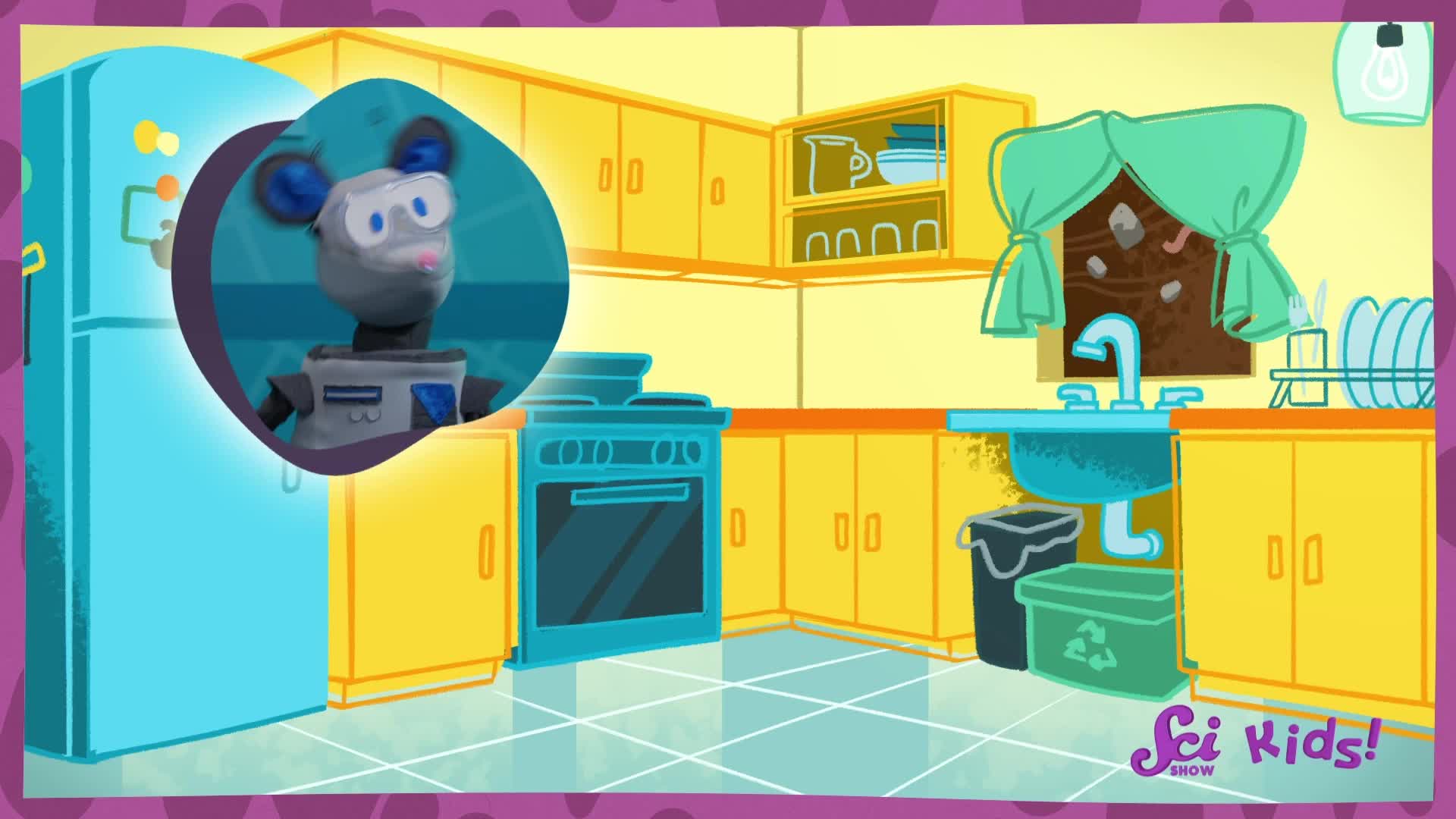
Squeaks says he's trying to figure out how the water faucet in the fort's kitchen works.
He has a hypothesis, or idea, about where the water comes from when you turn on the faucet.
Nice!
What's your hypothesis?
Squeaks thinks maybe there's a tiny person in there taking a nice bath and sharing their bath water with us.
I'm afraid that's not it, though.
A little dragon who's crying?
That would be funny, but I don't think so.
See, the water in the faucet doesn't come from inside it.
It comes from somewhere else.
Well, some people's drinking water comes from underground.
It's true!
When we water our garden from the well in the backyard, we're using groundwater water that comes from rain and snow, that soak into the ground and is stored inside the earth.
In North America, where we live, a lot of people's running water also comes from rivers.
Here, check this out, Squeaks.
We're here in North America.
If you live over here in Minneapolis or St.
Paul, you get water from the Mississippi River.
That's this big, long river here.
There are rivers all over the world, like this one.
The Congo River in Africa is the deepest river in the world, and it's also one of the longest.
It runs through five different countries, and lots of animals live in it.
Turtles, African manatees, and dwarf crocodiles live there.
And so do more than 300 different species of fish, like the giant tigerfish and the squeaker catfish.
I don't think squeaker catfish, chase robot rats named Squeaks, but they're very far away from us, so you don't need to worry.
And rivers are always flowing to somewhere.
Look where the Congo River in Africa empties into, Squeaks, the Atlantic Ocean.
Yeah, this whole blue area here is the Atlantic Ocean, and over here is the Pacific Ocean.
Oceans are the largest type of body of water on Earth, and they are gigantic.
We're still exploring the oceans and making discoveries about all the kinds of animals that live there.
Exactly!
Like sharks and whales and octopuses!
Oceans are made of salt water, which people can't drink.
And neither can robot rats.
Almost all of the world's water is found in the oceans.
That leaves only a teeny tiny amount of fresh water that we can drink.
But we can find that fresh water in lots of different places.
Yep.
Like rivers and streams and lakes or ponds, which are bodies of water that are surrounded by land.
See this big blue area here in Siberia?
This is Lake Baikal, and it's one of the biggest freshwater lakes on Earth.
Everything blue on this map is water.
Yes, over 70% of the land on Earth is covered in water.
Rivers and streams and lakes and ponds and oceans and seas.
But sometimes water isn't a flowing liquid, like what comes out of our faucet.
Sometimes it's...
That's right!
Sometimes liquid water becomes solid ice.
Some parts of the Earth are covered with ice, like the snow on top of mountains.
Or glaciers!
A glacier is a giant buildup of ice and snow that slowly moves over land.
Most of the world's glaciers are in Antarctica, but almost every continent has glaciers.
In fact, Squeaks and I could go visit one if we wanted to.
There's a place near the fort called Glacier National Park, where we could go see a glacier!
You're right!
I think we should plan a trip.
Look at this, though.
Do you see these white parts at the top and the bottom of the map?
The Arctic Ocean at the top and Antarctica at the bottom are so cold that they're covered in ice all the time.
Uh, yeah, I think that's too cold for us to visit.
There sure are a lot of places that we can find water, and a lot of ways we can show where water is.
Water really is everywhere.
And talking about it has sure made me thirsty.
I think it's time for a nice glass of water.
Do you want to come to the kitchen and get some from the faucet?
Thanks for joining us on SciShow Kids today.
If you want to have more fun learning with me, Squeaks and all our friends, be sure to subscribe and we'll see you next time here at the Fort.