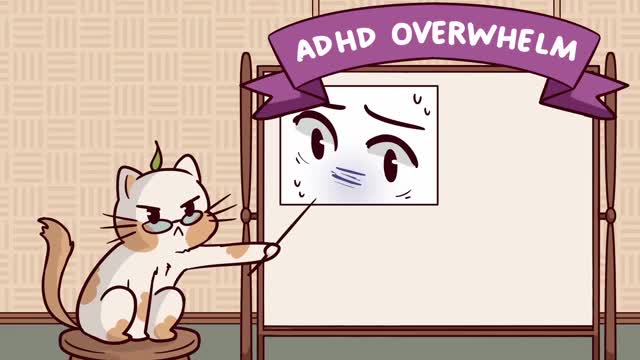
You know those moments when you sit down to do one simple thing and suddenly your brain feels like a browser with like 50 tabs open.
Obviously you're not doing it on purpose.
You're not avoiding the task.
Your mind just won't lock in.
And the harder you push yourself to start, the heavier everything feels.
If that sounds familiar, you are not alone.
This experience has a name.
ADHD overwhelm.
And today we are going to break down what's actually happening in your brain, why it feels so paralyzing, and how to work with your mind instead of fighting against it.
The control panel metaphor.
Imagine a big switch.
One switch, one task.
Flip it on, and the brain knows exactly what to do.
That's how a neurotypical brain handles the moment before starting something.
Now, look at this instead.
A control panel covered in little blinking buttons.
None of them blink in order, none of them stand out, they all flash at the same time.
That's the ADHD experience.
Each little button represents something that needs your attention.
Start the laundry, open that email, eat something.
Real text someone back.
Finish that thing from yesterday.
And sometimes the buttons aren't even big things.
One of them is literally, I need to drink water.
And even that shows up with the same urgency as everything else.
I mean, it is pretty important.
I should probably go drink some water.
Anyways, this is why ADHD isn't really a deficit of attention.
It's more like everything has my attention and I don't know what to do first.
It's not lack of motivation and it's not laziness.
It's a prioritization system that doesn't automatically sort things into important now and later.
So what's happening in the brain?
People often think ADHD is about distraction, but it's actually about regulation regulating focus motivation, priority and emotional response.
The prefrontal cortex, the part of the brain that helps you organize and initiate tasks, relies heavily on dopamine to sort information.
In ADHD brains, the dopamine signal is inconsistent.
So instead of the brain automatically saying, start here, this matters most, everything shows up at the same volume.
It's not that your brain doesn't know what needs to be done, it's that it can't tell where to begin.
So your mental to-do list doesn't arrive as a neat line.
It arrives like a cluster of alarms all going off at once.
And when your system gets flooded with too many signals, Something happens that most people misunderstand.
Your brain freezes.
Not because you're giving up, but because it is overloaded.
Real life freeze mode.
Anyone with ADHD has lived through this.
You get up to clean your room and the next thing you know you're sitting in your bed staring at your phone in the exact same spot you started
Or you open your inbox to reply to one message and suddenly your chest tightens because you see six more waiting.
And one of the most common moments, you lie in bed scrolling your phone.
Not so much to procrastinate but to give your brain a hit of quick dopamine so it can calm down for a moment.
But as soon as you scroll, another feeling creeps in.
The guilt that you're not doing anything productive.
And that mix of relief and guilt, that is ADHD overwhelm happening in real time.
Your brain isn't breaking, it's freezing.
Like a computer with too many programs running at once.
The emotional weight of overwhelm.
When overwhelm hits, it brings thoughts like, why can't I just do it?
Everyone else seems fine.
I am so behind.
I should be able to handle this.
What is wrong with me?
On the outside, you might look calm or still.
But on the inside, it feels like everything is happening at once.
For many people with ADHD, this moment also includes masking, pretending you're fine, performing like everything is normal, even while your brain quietly shuts down.
And shame is one of the strongest emotional breaks the brain can experience.
It stops motivation.
It stops clarity.
It stops the ability to choose.
So now your brain isn't just dealing with a blinking control panel, it's dealing with expectations and guilt and pressures layered on top.
This is why ADHD overwhelm feels so heavy.
It's the combination of too many tasks and too many emotions trying to happen all at the same time.
Here's what actually helps ADHD brains.
Your brain isn't trying to make your life harder.
It's actually trying to protect you, as usual.
When everything feels like too much, it pauses.
When there are too many choices, your brain freezes.
Not because you're bad at life, but because the system is simply overloaded.
So pushing harder usually doesn't help.
What helps is making things simpler.
Start with fewer choices.
You don't need 20 options.
You don't even need five.
Pick one or two and let the rest wait.
Then make the task smaller than you think it needs to be.
For example, clean the kitchen sounds difficult to an overwhelmed brain.
Change it to pick up one item and throw it away or recycle it.
Now that feels possible.
And once you start, it's easier to keep going.
You can also let things outside your brain do some of the work.
Timers, short lists.
When there's structure around you, your mind can finally relax.
You don't have to finish.
You don't have to do it perfectly.
You just have to begin, even if it's only for 30 seconds.
And emotionally, it works the same way.
You don't need to trust the whole task.
Just trust the next two minutes.
That's enough.
Your control panel isn't broken, it's overloaded, and overload doesn't make you any less capable.
It simply means your brain works differently faster, louder and with a level of intensity others don't always see.
Take a moment after this video to breathe and choose just one button for today.
One task, one button, one small step at a time.
That's how you move through ADHD overwhelm.
And if this helped you feel understood.
Feel free to share your experiences in the comments or pass it along to someone who might need this reminder.
Also check out ADHD's hidden battles and why stigma makes them worse.