
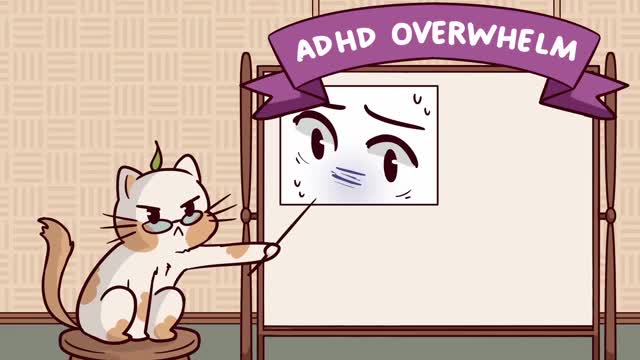
[Understanding ADHD Overwhelm: Why Your Brain Freezes and How to Move Forward]-[What Does ADHD Overwhelm Really Feels Like]
📋 Summary
Decoding ADHD Overwhelm: From Paralysis to Productive Action
For many individuals, the experience of sitting down to complete a simple task often results in a mental state akin to a browser with "50 tabs open." This sensation, frequently mislabeled as laziness or a lack of motivation, is officially recognized as ADHD overwhelm. By understanding the neurological mechanics behind this phenomenon, we can move from fighting our minds to working in harmony with them.
The Control Panel Metaphor: Why Everything Feels Urgent
To understand the ADHD brain, one must distinguish it from the neurotypical experience. A neurotypical brain operates with a clear "control panel" where a single switch corresponds to a single task, allowing for focused initiation. Conversely, the ADHD brain faces a control panel covered in "little blinking buttons" that all flash simultaneously.
Whether it is starting laundry, answering an email, or simply remembering to drink water, every task hits the brain with the same level of urgency. This reveals the core truth about the condition: ADHD is not a "deficit of attention"; rather, it is a state where "everything has my attention" and the internal prioritization system fails to sort tasks into "important now" versus "later."
The Neuroscience of the Freeze Response
Contrary to popular belief, ADHD is not merely about distraction; it is about the regulation of focus, motivation, and emotional response. The prefrontal cortex, which governs task initiation, relies on consistent dopamine signals to process information. In an ADHD brain, these signals are inconsistent, causing all incoming information to be processed at the same volume.
When the system is flooded with these competing signals, the brain initiates a "freeze mode." This is not a choice to give up, but a biological response to being "overloaded." As the podcast notes, this is akin to "a computer with too many programs running at once." The resulting behavior—such as doom-scrolling—is often a desperate attempt to gain a "hit of quick dopamine" to calm the nervous system, which unfortunately leads to a cycle of guilt and productivity paralysis.
The Emotional Toll: Shame and Masking
Overwhelm is rarely just cognitive; it is deeply emotional. The internal dialogue often spirals into self-criticism: "Why can't I just do it?" or "What is wrong with me?" This shame acts as an "emotional break," further inhibiting motivation and clarity. Many individuals engage in "masking," performing the role of a functional person while internally the brain is shutting down. This layer of guilt and societal expectation only adds to the "emotional weight" of the situation, making the paralysis feel significantly heavier.
Strategies for Working with Your Brain
To overcome this state, one must stop pushing harder and start simplifying. The brain is not "broken"; it is simply overloaded. Effective strategies include:
- Reduce Choices: An overwhelmed brain cannot handle multiple options. Narrow your focus to one or two tasks.
- Micro-tasks: Break tasks down until they feel trivial. Instead of "clean the kitchen," aim to "pick up one item." This makes the initiation process manageable.
- Externalize Structure: Use timers and short lists to offload the cognitive burden from your mind to your environment.
- Focus on Initiation: You do not need to finish or be perfect. The goal is simply to begin, even if only for "30 seconds."
Ultimately, ADHD overwhelm is a sign that your brain operates with a level of intensity that others may not perceive. By trusting the "next two minutes" rather than the entire project, you can navigate the blinking buttons of your control panel one step at a time.
Deep Learning with ListenLeap


