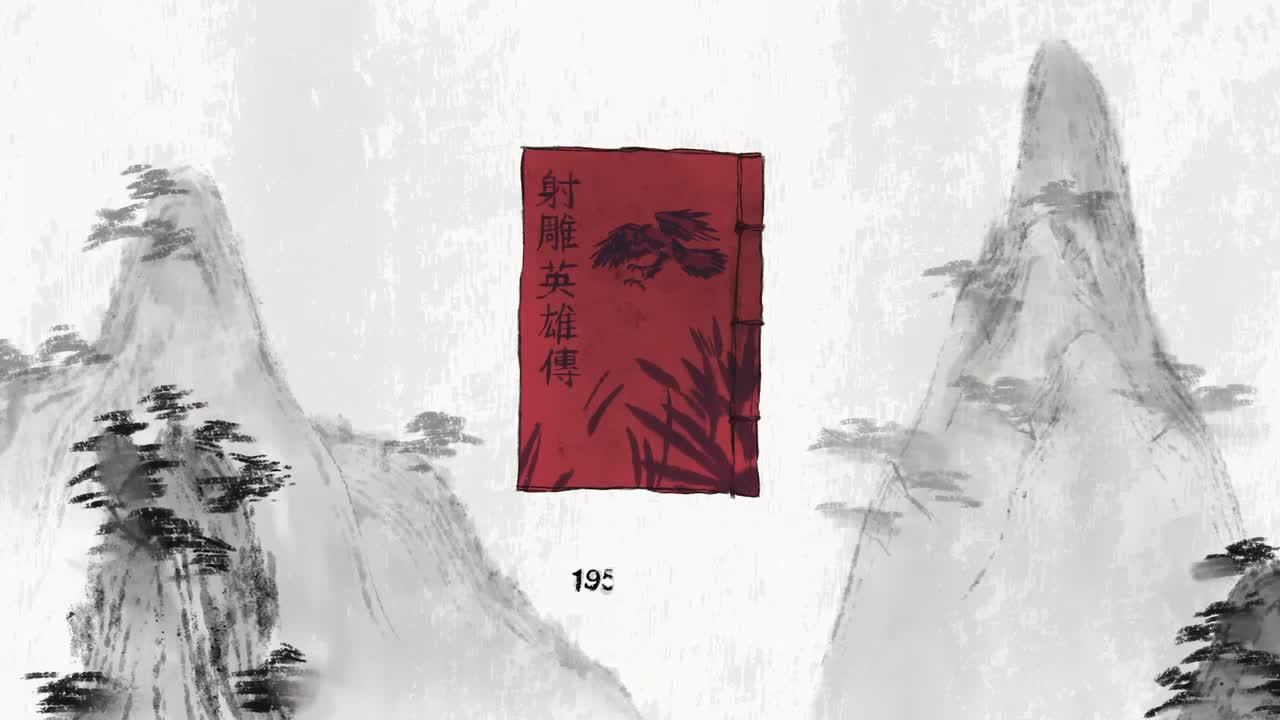
In the late 1950s, Hong Kong citizens flocked to newsstands to pick up the latest edition of the commercial daily.
But not all readers were looking for timely news.
Many were following a story set hundreds of years from the past.
A tale of adventure and war, romance and intrigue, brotherhood and betrayal.
Serialized from 1957 to 1959.
Jing Yong's Legend of the Condor Heroes is the first book in Jing's beloved Condor trilogy.
This multi-generational epic is considered one of the most important works of Chinese fiction and one of the finest wuxia stories ever written.
Wuxia, roughly translated as martial hero, is a popular genre of Chinese fiction with roots in folktales over 1500 years old.
Wuxia stories generally focus on nomadic martial artists bound to an honorable code of chivalry.
These heroes travel through a mythologized version of ancient China called Jianghu, full of powerful leaders, roaming bandits and mystical artifacts.
To face these challenges, wuxia heroes must learn superhuman feats of martial arts from ancient scrolls and reclusive immortal masters.
Legend of the Condor Heroes blends this martial arts action with pivotal Chinese history.
The book is set in the 13th century, amidst a century-long war between the Zhejin Jin Dynasty and the Han Chinese Song Dynasty.
Roughly 70 years into the conflict, a new enemy has joined the fray Genghis Khan.
The Mongols threaten to topple both empires, and raids by all parties wreak havoc across the continent.
The novel begins in a Han village where two expecting fathers are binding their unborn children as blood brothers.
The children's names, Guo Jing and Yang Kang, were engraved on a pair of daggers.
But a sudden zhirchin raid scatters the families.
Guo Jing grows up amongst the Mongols, yet remains loyal to his Han heritage.
Meanwhile, Jurchen royalty raise Yang Kang as a scheming prince, setting the stage for the brothers' tragic conflict.
Jing's novel follows the naive but kind-hearted Guo Jing and his clever lover Huang Rong.
Their journey takes them to the bustling Song capital of Hangzhou, the harsh Mongol steppes and the fabled market city of Samarkand.
Our heroes traverse through Jianghu, encountering colorful characters and witnessing key historical events.
As they battle enemies, discover treasure and help solve local crimes.
Their martial arts skills grow more legendary, preparing Guo Jing for his fated confrontation.
The novel showcases over 80 unique styles of martial arts, ranging from realistic techniques to almost mystical maneuvers.
But even seemingly simple moves have surprising depth.
To master a technique that will allow him to perform two attacks at once, Guo Jing must first learn to simultaneously draw a circle with one hand and a square with the other.
This kind of deceptively difficult tutelage torments wuxia students and readers alike.
Jin Yong was the pen name of Louis Cha, a journalist and founder of Mingbao Daily News.
In the 1960s and 70s, Wu Xia was banned for its feudal associations.
But in Hong Kong, a British colony at the time, Cha could write fiction and cover news about the Cultural Revolution freely.
He even worked to add depth and complexity to a genre often considered formulaic and lowbrow.
Legend of the Condor Heroes celebrates Chinese identity by exploring China's culture and history with intimate humanity.
Even though Jing's books were banned in China, his works still found Chinese readers around the globe, and bootleg versions even made their way to the mainland.
When the Chinese government relaxed its policies in the 1980s, his novels found an eager audience.
Today, Jing Yong's works have been adapted into film, television, and video games.
His novels are so beloved, it has been said.
However, this literary titan remains relatively unknown in the West due to the difficulties of translation and the high level of Chinese cultural knowledge.
His works demand.
Fortunately, recent English translations of The Legend of the Condor Heroes are helping a new generation of readers experience the sweeping saga of the rivers and lakes.
Explore more Chinese epics with The Myth of the White Snake, or learn more about one of the controversial characters featured in this lesson by watching History vs Genghis Khan.