Ted Audio Collective You're listening to Ted Talk's Daily, where we bring you new ideas to spark your curiosity every day.
I'm your host, Elise Hugh.
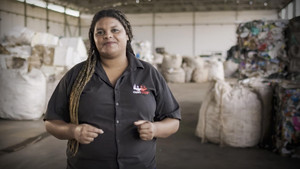
Brazil-based waste picker, Aline Soza, is part of the majority of women who do the world's trash and recycling work.
In her talk, she lays out the opportunity for sustainable impact that could be seen across the waste management system if we rethink the value of waste picker's work.
She gives her talk in her native Portuguese, and we've dubbed it for you in English.
It's coming up after the break.
Like Ted Talks, you should check out the Ted Radio Hour with NPR.
Stay tuned after this talk to Hear Sneak Peak of this week's episode.
And now our Ted Talk of the Day.
Hello, I'm Aline Soza. I'm 34 years old, and I'm a waste picker.
I'm also the third generation of pickers in my family and have seven children.
I've been helping my grandmother with recycling work since I was 14, picking the waste or sorting it at the cooperative.
I know that recycling is a life-changing tool, not only for my family, but for every picker who works with me at the cooperative.
The improper handling of waste is the third largest source of methane in the world, and the second largest in Brazil.
Historically, trash is a huge problem in global South countries, and we are always there, regardless of service assistance, collecting and selecting where there's not an efficient and formal service.
We are leading the effort to reduce methane emissions in our sector.
I represent Brazilian pickers in the national movement of pickers, or NMP.
I am also the president of SENT COOP, which is the second largest cooperative central for waste pickers in Brazil.
We have approximately 20 cooperatives and about 1,000 members associated with them, and here in Brazil, 72% are women.
The national movement of pickers estimates that there are between 300,000 and 1 million workers, and from that number, 72% are black, like me, and 56% are women, and those women are also in leadership and decision-making positions in their cooperatives.
Globally, we estimate about 20 million workers recycling throughout the world.
Although the development process of waste management and society tries to marginalize us, we are the ones who make the difference in recycling.
Without us, this system would collapse.
In Brazil, only about 30% of the cities have selective collection.
To show you the work and competence of the pickers, we are responsible for 35% of the total mass collected.
Also, 40% of the cities exclusively rely on the work of waste pickers to carry out this activity.
And now back to the episode.
Globally, we are responsible for recycling 58% of plastic, and Brazil claims to lead aluminum cans recycling.
How is that possible if only 30% of Brazilian cities implemented selective collection?
I'll tell you why. It's because of the waste pickers who are on the streets doing this work.
The world is not doing its part in waste management, and in the climatic emergency, at the speed that we need.
As pickers, we are working intertwined in a socio-environmental system, developing solutions to optimize the impact in our society.
Soly relying on selling recyclables is not sustainable for the cooperatives.
It doesn't support our families and does not maintain our waste management structures.
So we should be paid for the services we provide to society.
Organic waste in Brazilian cities accounts for half of the total waste, but only 0.5% of it is recycled in composting.
Note that the majority of it is edible food, which is still good for consumption, but ends up in landfills and dumps, releasing about 2 megatons of methane in the environment.
That can be extrapolated to other countries in the global south, where organic waste equals half the waste generated by the population.
For decades, we considered organic waste as a contaminant, which is not true, because what we need is an organic waste collection system to properly treat this fraction.
This will minimize the contamination of dry recyclables and prevent them from going to landfills and generating greenhouse gases, essentially working against international agreements to reduce and neutralize emissions.
This way, we can help the world fulfill the global methane pledge to reduce at least 30% emissions by 2030.
We are very good at it. We know how to involve society.
We know how to convince people to separate waste correctly.
When it comes to environmental education, you need to involve waste pickers.
In Brazil, we have a wonderful piece of data to elevate the credibility of our sector.
The selective collection made by our cooperatives has a quality and efficiency index of over 80 percent.
While through companies, we managed to utilize less than 40 percent.
Beyond that, this would be a truly fair transition for our sector.
Us, waste pickers, leading the fight against climate change.
Composting generates three times more jobs in comparison to landfills and dumps.
When this service is made by pickers, the impact can reach 11 times more.
So, channeling climatic funds promotes the socio-economic development of an entire sector and the people who suffer the most from climate impact and environmental racism.
In fact, we're already doing this.
Here at the cooperative, we are initiating fundamental work with the organic fraction.
We're implementing the organic collecting system in the farmers' market and bringing the waste to the cooperative for composting.
That can be accelerated to match our urgent fight against climate change.
We are part of the solution.
But to do it, we need the cities and the financial system to see us as key players in this process and as protagonists, not only as beneficiaries.
We need to be paid for the service that we provide for decades benefiting society's health and the planet's health.
With that, I'm sure we can do a lot more.
Thank you very much. Thank you very much.
In 1983, NASA sent its first female astronaut into space with a bit of extra cargo.
When comedian Marsha Belsky heard the story, she just had to write a song.
Humorous. That's next time on the Ted Radio Hour from NPR.
Subscribe or listen to the Ted Radio Hour wherever you get your podcasts.