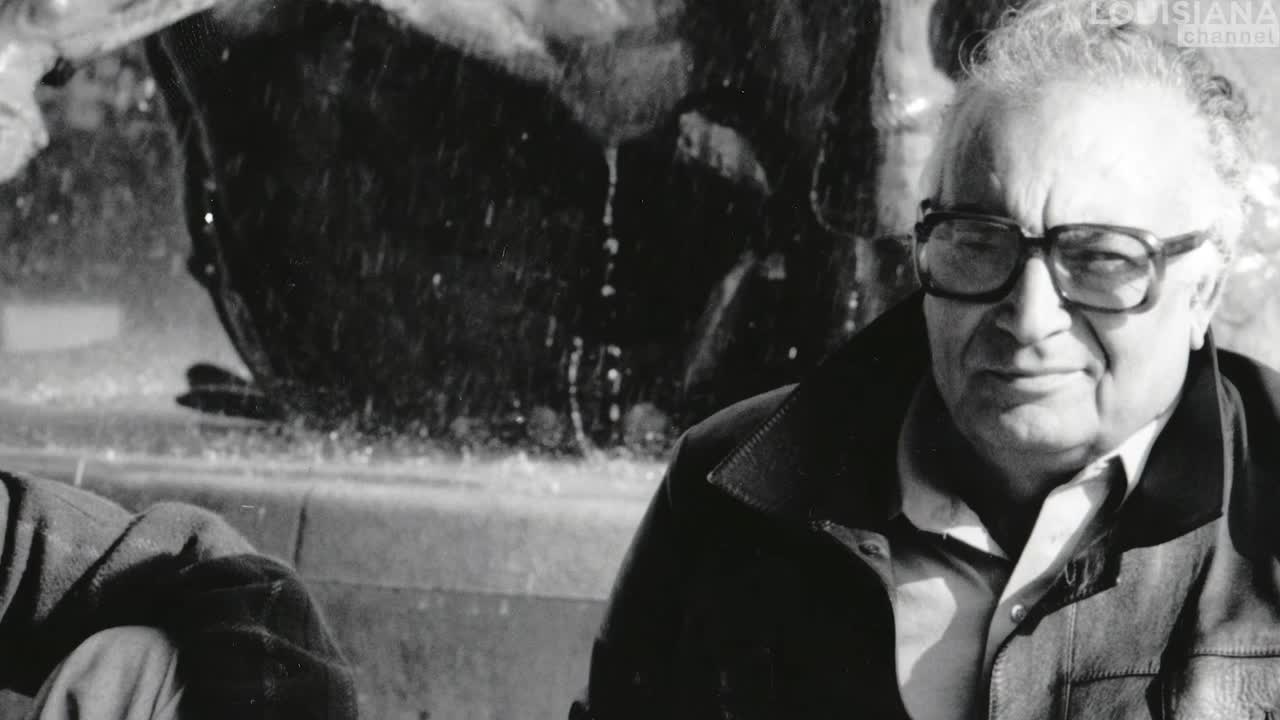
I want to talk about Yaşar Kemal.
He was my best friend for 44 years.
We were together in Turkey, in Istanbul, in Paris, in Stockholm, during the exile period.
He was older than me and he died, unfortunately, a few years ago in his 90s.
He is the greatest figure in Turkish literature.
He was like our Gogol, our Tolstoy, in a Kurdish origin.
And he was very famous.
One of his books called Mehmet My Hawk.
It became bestseller, huge bestseller in Sweden, in England, in Britain, in America, in 20th century classics.
And all of his novels became, I mean, well known.
And it was kind of a school for Turkish writers.
And he was the candidate for Nobel Literature Prize for 30 years.
30 years.
They mentioned his name so many times.
Every year he was the candidate shortlist, but never.
This is, you know, Nobel.
And he was writing with a very good language and using Anatolian language as well, which is not known by Istanbul intellectuals.
And there is a dictionary of Yaşar Kemal, dictionaries to the name of flowers, name of you know the nature, birds and you know this kind of very rich language.
And he comes from this Homeric tradition and he used to write in this epos form, epope form, which is quite different than the drama.
And he was mentioning so many tragedies, so many injustice in Anatolia, in Istanbul I mean the people so, but never wrote a drama, because there is a big difference.
I published a book on him, analyzing his art, why he became so famous in the world, and so I realized that, first of all, he has his climate, he has his own people and, like Jokna Patauha, a falconer, and he has Chukurova.
I mean the, what we say Kilikia Kilisi, Silisi.
I mean the ancient Roman time.
Cicero was the governor of that part.
So very rich area culturally.
So I inherited all this culture, the folk stories and everything made modern novel.
He wrote modern novels based on this one.
But Greek tragedies or epos never write or ask you to cry or to feel, to see.
It's to reach a kind of catharsis.
Even this Oedipus, or I mean Euripides or the other tragedy writers.
They are telling about the tragedies, but never in a in a very miserable way, or ask you to have pity, something like that.
No.
For instance, I give you an example.
This Iliad, there is a Trojan king, Priamus, a very noble king.
And he sees Achilles kill his son, Hector, in front of his eyes and humiliate him.
And then Homeros never explained this like oh, he remembered that when he was a baby, kissing his small feet and something.
No, never.
He said, okay, he saw.
Then that night he in a clandestine way changed the clothes and he went to Achilleus the murderer's tent and his son's blood are still on his body and says I beg you, please give the body of my son.
I want to give a prince funeral for him.
That's it.
So you understand his deep sorrow Much better than that melodrama way.
So the big literature always do this.
That's why I mentioned several times William Faulkner.
He does the same thing.
I mean sentimentalism is not the way of the literary tradition.
And not the folk tradition even.
And Yaşar Kemal was one of the biggest examples of this.
Telling the stories in a good style with a good language.
And he was well known.
In France he was best seller as well.
But then we talked about this before the interview.
Your real value can be understood in your own language, for your own readers.
Okay, you can be translated, you can be famous in some countries for some period.
But not all countries for all time.
Even the classics are now, I mean, read not as before.
There are so many writers.
And Yaşar Kemal is still considered to be the father of Turkish literature.
Nazım Hikmet is the father of Turkish literature, like our Pushkin. so let me tell you an anecdote to you then and we were in canfin festival because i made a movie based on one of his novels iron earth copper sky it was in can official selection we went there we were having breakfast with some turkish journalists and french journalists and cross it somewhere and carlton hotel or somewhere and it When we were having our breakfast, a clochard was approaching us.
I mean, a very bad shape and very drunk, and asking money.
And Yasha Kamal gave him two 10 francs, 20 francs, which was a big tip.
He said, oh, merci beaucoup monsieur, merci.
One of the journalists said, do you know who is the monsieur?
He is Yashar Kemal.
I said, what about this now?
I mean, he even doesn't know his own name.
And he said, think, think, think.
Mehmet Lobandi.
He said one of his characters, I mean one of the books, is it praising for yasha kemal or the french closure?
I don't know, but it happened in front of my eyes and in stockholm, when we were in stockholm, even street people were coming him, recognizing him and asking signature, and things have thousands of followers.
Yasha kemal, my my dear late friend, and i were in new york for a writer's conference and Yaşar Kemal delivered a speech and he said that we are suffering as Turkish writers.
Turkish prison is a school of Turkish writers, but from 16th century and the laters.
He gave some examples about the poets who've been executed and I mean suffered a lot from the government policies and even now and the.
When he finished his speech, Kurt Vonnegut came.
I was translating and Kurt Vonnegut, I congratulate you.
Why?
We asked, why?
He said, okay, you are very valuable.
I mean, people take care, government take care of you.
Here, they don't take care and they don't even mention.
So, you are a very serious people to be hanged, to be imprisoned and to be with his dark humor.
Yeah, it is true.
Ashar Kamal was my best friend.