Chapter 2 Animal Language One day the butcher stopped by for a visit.
He noticed that the doctor's coat had several patches.
The butcher knew that he was the doctor's only patient.
He knew Dr. Doolittle and his sister must be very poor with so little income.
The butcher looked around the kitchen and noticed all the animals.
They all looked happy and healthy.
Suddenly the butcher had an idea.
I know, he exclaimed.
Why don't you stop being a people doctor and start being an animal doctor?
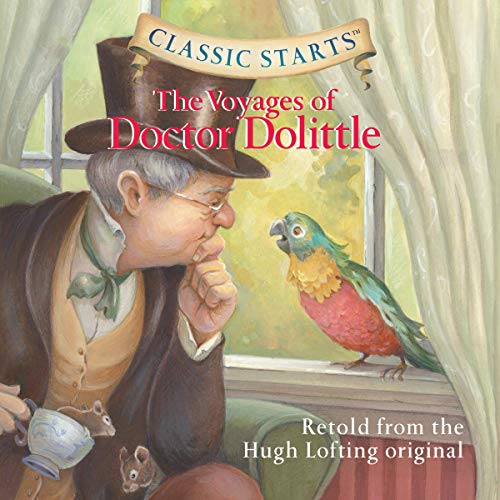
Polynesia the parrot was sitting on the windowsill singing a song to herself.
When she heard the butcher say this, she stopped to listen.
It makes perfect sense, the butcher continued.
You know everything about animals.
I'm sure you know a lot more than most animal doctors.
I've noticed that you get along with animals better than people.
I don't mean that you don't get along with people, of course.
It's just that you seem more relaxed with animals.
And they're very relaxed around you.
Look at your kitchen.
It's filled with happy animals.
It was true.
Jip the dog and Gub-Gub the pig were curled up together in a corner.
Dab-Dab, the duck sat on the counter cleaning her feathers and the hedgehog was beneath the table taking a nap.
The mice were playing in a box by the door.
Polynesia the parrot, as you know, sat on the windowsill listening to every word.
Well, I don't know, Dr. Doolittle said.
I hadn't thought of that before.
Seems like such a strange idea.
Strange, the butcher exclaimed.
Why, it makes perfect sense.
There are so many farmers around here with cows and sheep who could use your help.
Plus, there are all the cats and dogs in town.
Animals get sick just as often as people.
Trust me, he said.
You should be an animal doctor.
After the butcher left, Polynesia flew from her perch and sat beside Dr. Doolittle.
That man has a lot of sense, she said.
You should be an animal doctor.
Those people were silly to stop coming here.
You are the best doctor in the world.
The animals need you.
Oh.
There are plenty of animal doctors around, Dr. Doolittle said.
He shook his head and gave a little chuckle.
He got up from the table and started to clear the dishes.
Yes, there are plenty, said Polynesia, but you would be the best.
I'm certain that there would be no other animal doctor who could compete with you.
Polynesia flew back to the windowsill where Dr. Doolittle was now fixing some flowerpots.
I'm going to tell you something very important, so I want you to listen carefully, she said.
Dr. Doolittle put the flowerpot down and turned to look at the parrot.
Did you know that animals can talk? she asked.
I know that parrots can talk, of course, he said with a smile.
Yes, we parrots talk in two languages, human language and bird language, Polynesia said proudly.
If I say, Polly wants a cracker, you understand me.
Now listen to this.
My word, cried the doctor.
What on earth does that mean?
That means is the tea ready in bird language, she said.
She nodded a few times and bounced on the windowsill.
It was exciting to share this information with the doctor.
She wondered why she had not thought of it before.
You don't say, he exclaimed.
That is so interesting.
I've never heard you speak that way before.
Well, why would I?
Polynesia asked.
You never would have understood me.
There really isn't much point in talking like that in front of people.
That's why we usually keep it all to ourselves.
Tell me more, said the doctor.
He was excited by this news.
No, wait.
He pulled his notebook and pencil from his pocket.
Now, don't Go too fast and I'll write it all down.
He sat back down at the table.
Let's start at the beginning.
Tell me the bird's alphabet.
And so their lessons began.
That was how Dr. Doolittle learned the animals have their own language and can talk to one another.
All that afternoon, he sat in the kitchen with Polynesia, learning the words in the bird language.
He carefully wrote down each one in his notebook.
He spelled them out the way they sounded so he would remember later.
A few hours later, Jip the dog woke up.
He walked over to Polynesia and the doctor.
See, Polynesia said, he's talking to you.
I didn't hear anything, Dr. Doolittle said.
I only noticed him scratching his ear.
Animals don't always speak with sounds, she replied.
We talk with our ears, our feet, our tails.
We use every part of our bodies to talk.
Sometimes we don't want to make a noise.
Do you see how he's twitching with one side of his nose?
Why, yes, I see that, Dr. Doolittle said.
What does it mean?
He's asking if you've noticed that it stopped raining.
Polynesia said.
"'Dogs nearly always use their noses to ask questions.'
The doctor quickly wrote this information down, too.
It did not take long before Dr. Doolittle could understand and speak to the animals himself.
He still needed Polynesia's help sometimes, but he was confident he would soon be able to converse on his own.
This is when he finally decided to take the butcher's advice.'
He stopped being a human doctor and started treating animals instead.