
[The Genesis of the Animal Doctor: Unlocking the Language of Creatures]-[The Voyages of Doctor Dolittle - Part 03]
📋 Summary
The Transition from Human Physician to Animal Healer
The narrative begins with a pivotal encounter between Dr. Doolittle and his butcher. Observing the doctor’s worn coat and realizing he is the doctor's "only patient," the butcher recognizes the financial plight of Doolittle and his sister. However, the butcher notes that the doctor’s home is filled with "happy and healthy" creatures, including Jip the dog, Gub-Gub the pig, and Dab-Dab the duck. This observation leads the butcher to suggest a radical career change: "Why don't you stop being a people doctor and start being an animal doctor?" The butcher argues that Doolittle is naturally more "relaxed with animals" than with people, and because animals get sick just as often as humans, there is a clear professional void for him to fill.
The Revelation of Animal Linguistics
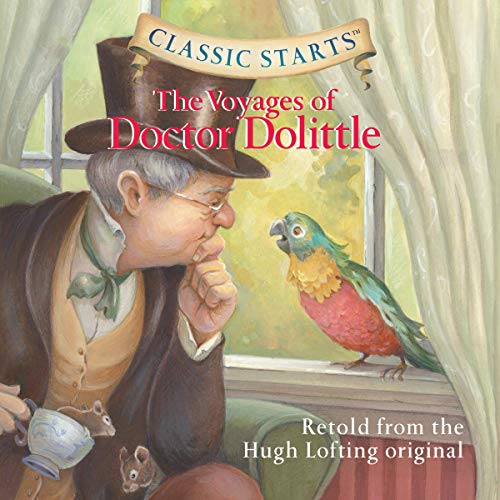
While Dr. Doolittle initially dismisses the idea as a "strange idea," Polynesia the parrot—who has been listening intently—strongly encourages him. She insists that he would be the "best doctor in the world" and that no other practitioner could "compete" with him. The turning point occurs when Polynesia decides to share a profound secret: "Did you know that animals can talk?"
Polynesia reveals that parrots are bilingual, speaking both "human language and bird language." She demonstrates this by chirping a phrase, which she translates as "is the tea ready in bird language." This revelation sparks Dr. Doolittle’s curiosity. He immediately retrieves his "notebook and pencil" to begin formal lessons, documenting the "bird's alphabet" phonetically to ensure he could "remember later."
Beyond Vocalization: A Holistic Language
As the lessons progress, the doctor learns that communication is not limited to sound. When Jip the dog approaches, Polynesia explains that "animals don't always speak with sounds." She points out that creatures utilize "their ears, our feet, our tails" and "every part of our bodies to talk."
Polynesia highlights specific non-verbal cues, such as "twitching with one side of his nose," which she interprets as Jip asking if the doctor has "noticed that it stopped raining." She further notes that "dogs nearly always use their noses to ask questions." These insights allow Dr. Doolittle to move beyond mere observation into active conversation.
Conclusion: A New Professional Path
Equipped with his notebook full of linguistic discoveries and newfound confidence, Dr. Doolittle finally embraces the butcher’s advice. By bridging the communication gap between species, he transitions from a struggling human physician to a specialized animal doctor. This transformation is rooted not just in compassion, but in the scientific realization that animals possess complex, sophisticated methods of dialogue that humans had previously failed to perceive.
Deep Learning with ListenLeap


