Welcome to Spotlight.
I'm Colin Lowther.
And I'm Katie Blake.
Spotlight uses a special English method of broadcasting.
It is easier for people to understand no matter where in the world they live.
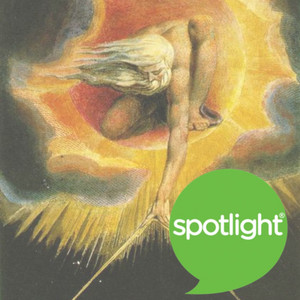
Imagine a painting of an old man.
The man is crouching on the edge of the sun.
All around him there is only darkness.
There is nothing but this man and an empty world.
In his hand, the man holds a tool called a compass.
This is a tool people use to create perfect circles on paper.
Builders use them to design buildings.
Usually, compasses are made of steel.
But this compass is made of gold.
And the man is not using it on paper.
He draws with the compass on the emptiness around him.
His long white hair blows in the wind.
This is a painting called Ancient of Days.
It is by the English poet and painter William Blake.
Blake painted it in 1794.
The painting shows Blake's version of the creation of the universe.
Here, a being like the Christian God designs the world from nothing.
Like many people of his time, Blake was a Christian.
But Blake was also very different than the people around him.
He believed he could see angels.
He said that the dead spoke to him.
These beliefs made him difficult to work with.
People did not value his poetry and art during his life.
But his beliefs also made his work some of the most beautiful and interesting of that time.
Today's Spotlight is on William Blake.
William Blake was born in 1757 in London, England.
His family was not wealthy.
His father made clothing and was not always well paid.
But he had enough money to let his children follow their interests.
It became clear early on that Blake was good at art.
He would spend hours looking at paintings in the market.
He loved them so much that he wanted to become an engraver.
Engraving was a way of cutting images into wood or metal.
Engravers would then colour these images with wet paint.
Then they could put these images onto paper.
Blake became the student of a master engraver.
It was clear even then that he had a lot of talent.
But Blake also started seeing things at an early age.
As a young child, Blake was wandering in a field.
He looked up at a tree to see angels flying in the branches.
The angels shocked Blake and filled him with wonder.
Ann Malcomson wrote about William Blake.
He ran to tell his family what he had seen.
His father decided that the time had come for the boy to learn the difference between imagination and reality.
He threatened to hit him for lying.
His mother.
However, When she questioned him about his experience, he described the angels as looking like thoughts.
He had seen them in his imagination.
But the feeling was vivid.
We do not know if Blake really saw these things.
We do not know if he only imagined them.
We do not know if he saw something he could not explain.
But Blake strongly believed he saw them.
As he grew up, he saw other religious things.
They would shape his work powerfully.
He would even develop his own version of Christian belief because of these visions.
Much of his art represented these things he saw that others could not.
Blake's odd religious beliefs made it difficult for him to find work.
This was because people found him too strange.
But mostly, Blake did not want to do work for money.
He did not like other people telling him what he could and could not make.
So Blake and his family often lived in poverty.
When he did find work, He had a hard time doing what he was asked to do.
Dr. John Trusler was a successful writer.
He was also a member of the Church of England.
Trusler asked Blake to work for him.
He asked Blake to work under a set of directions.
But Blake did not follow them.
After finishing his work, he wrote to Dr Trusler I attempted every morning for two weeks to follow your directions.
But I found all of my attempts were unsuccessful.
So I decided to show an independence that I know will please you better.
I will not follow the path of another, however wonderful that path may be.
At any rate, my excuse must be, I could not do anything else.
It was out of my power.
Dr Trusler was not happy with Blake's new direction.
He told Blake the images were not realistic.
Trusler refused to have Blake work for him again.
But though Blake was not wealthy, he continued to make his own art.
He created his own way of engraving on copper.
And he began writing poetry.
Blake created many books of poetry.
And he would make images to go along with his poems.
Some of these books were about the future as Blake imagined it.
But he also wrote poems about love and wonder.
One of Blake's best known poems is called The Tiger.
It is from his book Songs of Innocence and Experience.
Nick Page reads part of Blake's poem.
Tiger, tiger burning bright In the forests of the night.
What immortal hand or eye Could frame thy fearful symmetry?
In what distant deeps or skies Burnt the fire of thine eyes?
On what wings dare he aspire?
What the hand dare seize the fire?
When the stars threw down their spears And watered heaven with their tears, Did he smile?
His work to see.
Did he who made the Lamb make thee?
Blake's poem speaks about the creation of a tiger.
He compares the process to making steel or iron.
This process, called forging, is dangerous.
It needs a lot of heat and strength.
Blake wonders who could create such a powerful thing.
He asks who would have that kind of strength.
Blake died in 1827.
At that time, few people knew who he was.
But soon Blake's work gained wider recognition.
People saw his paintings as strange when he was alive.
But today we recognise that these works are one of a kind.
Blake's paintings are powerful markers of faith and creativity.
His poems also influenced many writers.
But Blake did not seem to care about popularity.
He believed in his art.
And he believed in the things he saw.
He felt it was important to express what he believed.
And he worked toward doing this with everything he had.
Blake saw his faith and creativity as one united thing.
His creativity built his faith.
His faith guided his creativity.
Is there a link between faith and creativity?
Are they similar?
How are they different?
The writer of this program was Dan Christman.
The producer was Michio Ozaki.
The voices you heard were from the United Kingdom and the United States.
All quotes were adapted for this program and voiced by Spotlight.
You can listen to this program again and read it on the internet. at www.radioenglish.net.
This programme is called The Divine Imagination of William Blake.
You can also get our programmes delivered directly to your Android or Apple device through our free official Spotlight English app.
We hope you can join us again for the next Spotlight program.
Goodbye.