Let's discuss about something.
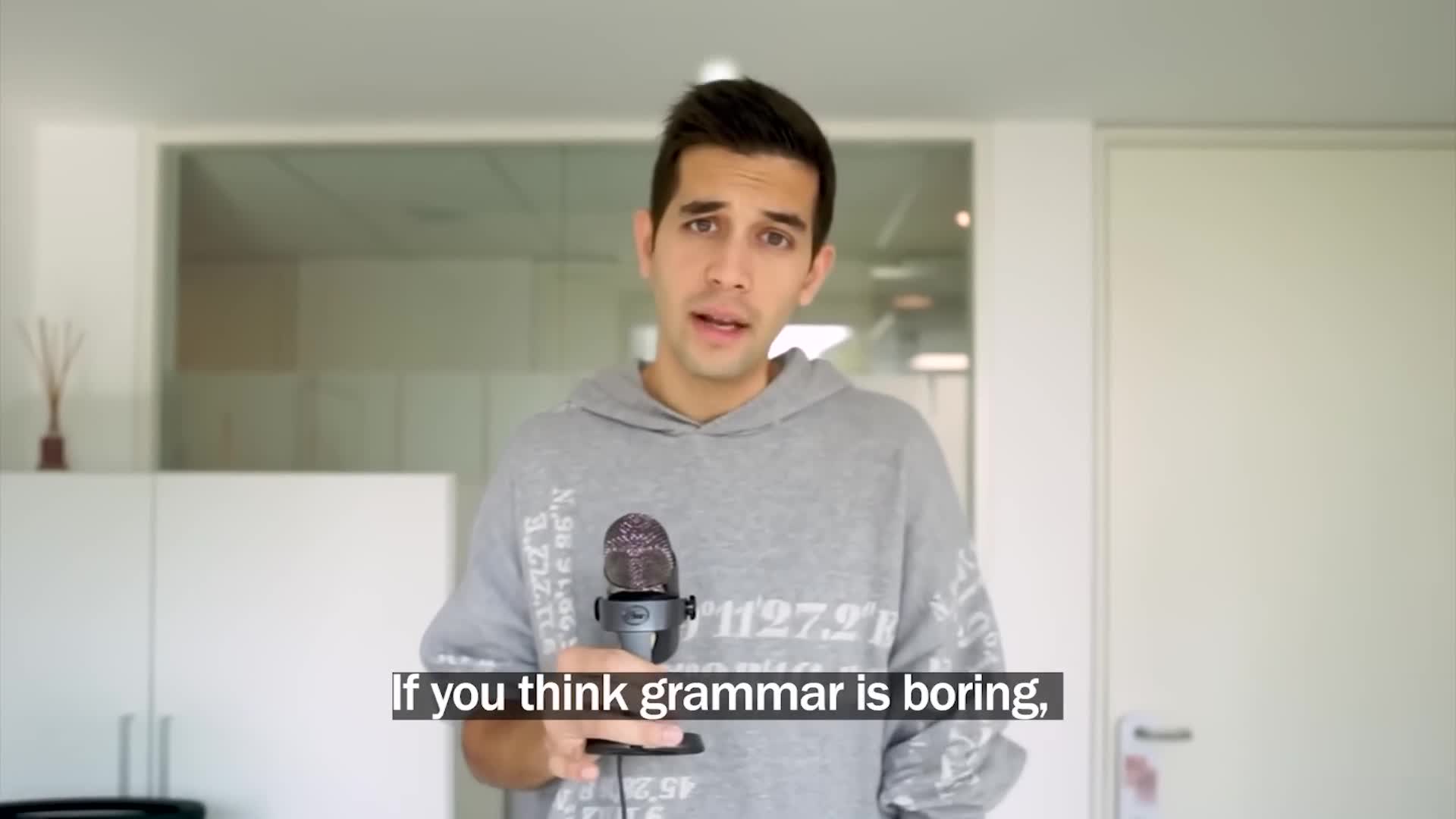
If you think grammar is boring, I am agree with you.
I mean, why do we need to learn grammar anyways?
Speaking is more better.
I prefer speaking than grammar.
And I suggest you to stop learning grammar.
In this short monologue, I made five terrible mistakes.
Did you notice any of them?
Let's have another look.
Let's discuss about something.
If you think grammar is boring, I am agree with you.
I mean, why do we need to learn grammar anyways?
Speaking is more better.
I prefer speaking than grammar.
And I suggest you to stop learning grammar.
Good grammar is crucial.
And if you think you can speak English without knowing grammar, you're going to be disappointed.
Grammar is the foundation of English.
And without the foundation, there is no building.
So let's work on that foundation.
What we're going to do in this lesson is to talk about five very common grammar mistakes that I've seen students make over and over and over again, whether they are beginner or advanced.
Here's the first one.
We need to discuss about the problem.
What's wrong with this?
This is actually very common.
Discuss about the problem.
That's the mistake.
We discuss something.
We don't discuss about something.
You don't need a preposition with discuss.
Discuss something.
We need to discuss the problem.
Here's another example.
Let's discuss your progress tomorrow.
Discuss your progress.
No prepositions.
But do you know why students make this mistake?
It's probably because discuss involves talking and speaking.
When you discuss something with someone, you speak about it, you talk about it.
And in English, with speak and talk, we use the preposition about.
Talk about something, speak about something, discuss something.
Probably.
That's why discuss is kind of confusing for students and they use about with it.
Don't do it.
Here's another one.
I've seen this a lot.
I know that if you see it on paper you know it's wrong.
But students make this mistake.
I am agree with you.
I am agree with you.
What's wrong with it?
I agree with you.
You don't need a to be verb.
I agree with you.
Agree itself is a verb.
You don't need m is r, for example.
I say poc english is the best youtube channel and you say I agree with you.
You don't say, I am agree.
You say, I agree.
Or here's another one.
Maddie is the best English teacher.
I agree with you.
Excellent.
Here's a note.
You agree with somebody, but you agree about something.
I agree with you about POC English being the best YouTube channel.
Or another way to use agree is to agree to do something.
I agree to watch this video again and again and again.
So agree with someone, agree about something, and agree to do something.
Now, look at this.
This one is more better than that one.
Seems correct, but it's a very common grammar mistake.
What's wrong?
More better?
I mean better comes from good.
The comparative form of good is better.
Now if you want to say that one thing is more good than the other thing, you say it's better.
But if you say more better, Doesn't make sense.
You're putting two comparatives together.
But here's the question.
Sometimes you want to add emphasis and say that it's not just better, it's better.
That case, you can say much, not more, much.
It's much better.
So, instead of this one is more better than that one, you can say this one is better, better than that one, or this one is much better than that one.
Now, I suggest you to study more.
Perfectly fine, isn't it?
But it's a common mistake.
What's wrong with it?
I suggest you to study more.
It's correct.
No, it's not.
The correct use of suggest is not like this.
Here's the thing.
After suggest, we don't use to.
I suggest you to.
Completely wrong.
So what should we do?
After suggest, you need to use a that clause.
I suggest that you.
You study more.
Now, pay attention.
You can delete that and it still makes sense.
I suggest you study more.
Note two, another way is to use a gerund.
I suggest studying more.
Or here's another example.
She suggested that I arrive early.
You can also delete that.
She suggested I arrive early.
Or she suggested arriving early, but not she suggested me to arrive. completely wrong.
So after suggest, either use a that clause with or without that or a gerund.
Never an infinitive.
And one last very common mistake.
Before we continue and finish this lesson.
If you want to have the full list of all these common mistakes with their explanations so you can review later, go ahead.
Click on the link above this video on my website.
You can download this for free.
Highly recommend it.
Go ahead.
Do it now.
Do it now.
Have you done it?
Okay, let's continue.
I prefer tea than coffee.
What's wrong with this?
Well, there are two mistakes here.
One is that I do not prefer tea.
I prefer coffee.
But that's not a grammar mistake.
The grammar mistake here is with than.
Prefer than?
No, no, no, no, no.
Prefer to.
I prefer something to something.
I prefer tea to coffee.
I prefer reading to watching TV.
So I hope you've enjoyed this lesson and I hope you've downloaded the PDF file.
The link is also in the description of this lesson.
Now here's your homework.
Go to the comment section and tell me something.
Do you agree that grammar is very important?
Yes or no?
Go ahead.
Leave a comment.
I'll have a look.
See ya.