We're in the storage room at the National Museum of Asian Art.
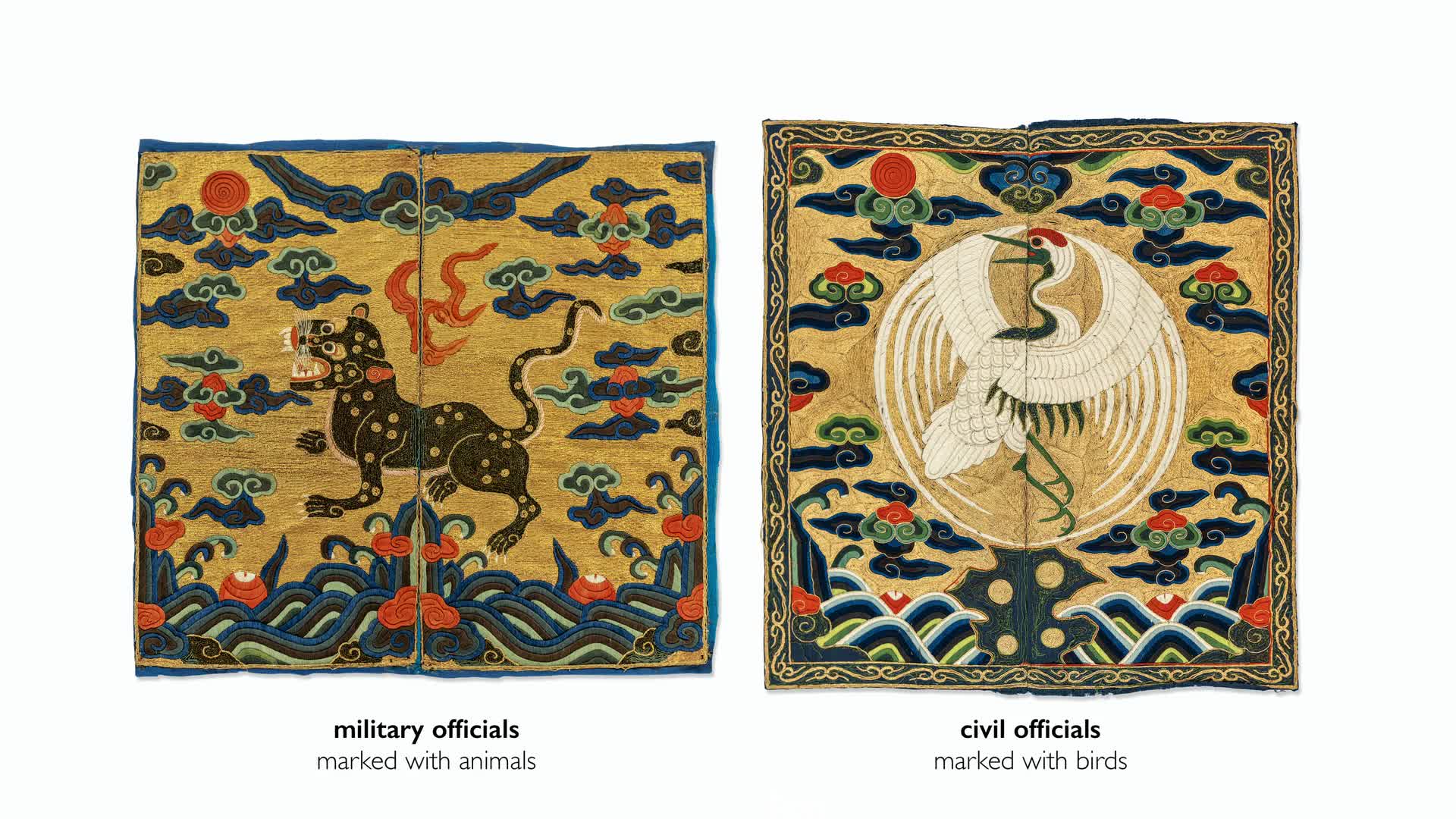
We have in front of us three rank badges, these beautiful embroidered insignia that signified one's rank.
In the Qing Dynasty when these were made, there were military officials and civil officials.
Civil officials were marked with birds, and both military and civil had nine ranks to climb.
The crane is the top, and each rank has its own bird or its own animal.
These immediately communicated one's status.
When a person is captured in an official commemorative portrait or one that could be used for ancestral worship, they will be wearing the clothing of their highest rank.
People were very proud of the rank that they had achieved, since it meant passing very competitive exams.
And successive exams to get to the top.
And then they get awarded a degree and they get a rank, but they have to pay for their own rank badge.
And these do not look inexpensive.
They have gold thread, and when I say gold thread, you take very thin gold foil and you wrap it around a silk core and then you sew that by laying it down and couching it to the background.
They have another secret thread.
And I say secret because now we don't see it so much.
But areas such as the neck of the crane, some of these little areas in the water, the entire perforated rock.
And you might wonder, why are these stray threads lying on the top?
It's because the entire rock had peacock feather filament threads.
They would take the peacock feather.
They would pull off the iridescent filaments, hand wrap a silk thread with that filament and then they would couch it in place.
So you have these brilliant colors, the gold thread, the iridescence from the peacock feathers.
I'm imagining an assembly at the court.
It would have been dazzling.
It's making me realize that these are for an individual's robe, but they also have this very powerful cumulative effect when seen in groups.
And each one represents the emperor.
So there is a red circle in all of the badges, and that is the sun.
The sun is always red in Chinese culture.
Red is a very auspicious color.
So then that becomes the emperor.
The civil official is represented by his insignia, his crane, and the crane is looking at and paying respect to the emperor here.
Then when he's standing in court, he's also physically paying attention to the emperor.
And since you had to make your own batch, there are certain things that have to be there, such as mountains and, in this case, a perforated scholar's rock standing for the middle peak.
So that's a convention that there are going to be water and mountains which are representing the terrestrial world.
It's the Chinese empire, but it's beyond.
It's the world.
There's always going to be then the insignia bird or animal.
There will be the sun for the emperor.
There usually are lots of clouds, which we have here.
And the clouds often look a lot like the spume on the water.
That's an auspicious shape.
The shape resembles what is called the fungus of immortality.
So there is a woody fungus that was used in elixirs of immortality, but it was also used to wish for longevity.
That real fungus has a kind of cloud-like top.
So in art, it got turned into a cloud-like symbol.
And we have other auspicious symbols.
We have two wish-granting pearls.
But with your crane there is sort of a symbolism by making the wings turn the crane's body into a circle.
In China, a circle stands for heaven.
A square stands for earth.
So you have this kind of square, rectangular-shaped badge for earth.
You have the crane as the circle.
And then you have man, the wearer of the robe.
So in a way you have the entire universe and we could say that of the Scholar's Rock as well.
So there's a whole cosmic dimension to Scholar's Rocks.
There are limestone boulders in China that come from a tidal lake.
The sand in the lake over time just erodes holes into the rock.
Those are the rocks that were dredged up and placed in scholars' gardens.
These rocks then become a microcosm of the world, which is mountains and water.
Any of these badges could be made by a man's wife.
Using some kind of woodblock print template, some kind of list of what are the essential features you have to have.
But then they have a little bit of latitude and that's why no two rank badges are ever identical.
There also were workshops.
So maybe it's a good moment to look closely.
If you get very close you can see that the gold thread for the background has little tiny stitches that hold it in place.
And then if you look, say, at the cloud up here, you see a little bit of iridescence.
And maybe even down here you can see little tiny bits of green that stand up straight.
Those are little bits of the feather that are left.
So this was entirely solid with iridescent peacock feather.
Let's talk about the satin stitch that forms the feathers of the bird.
So the satin stitch is packed so densely, and I'm not even sure how they did it, but then, with these little bits of outlining of each feather, they've managed to create a sculptural feeling.
And we're noticing too that as we look at the gold thread, that constitutes the background, that that thread moves and weaves in and out around the shapes of the clouds.
In addition, there's this lovely knotting on the head of the crane.
The knotting technique was used a lot in China.
And then here you can even look into his little red mouth.
And his tongue.
And then the way the beak overlaps the feathers.
So you have the sense that he's preening.
And then, of course, the circle for the sense of heaven with the square badge for the earth.
Then the wearer is man.
So you really are reinforcing so many times this cosmic dimension and your quart dimension with the sun.
So we have a hierarchy, a cosmology.
We have the Qing Empire in microcosm.
In microcosm, we do.