All right, we are going to practice some English phrases so that you can speak naturally like a native speaker, right?
All right, let's increase your vocabulary.
Let's look at this.
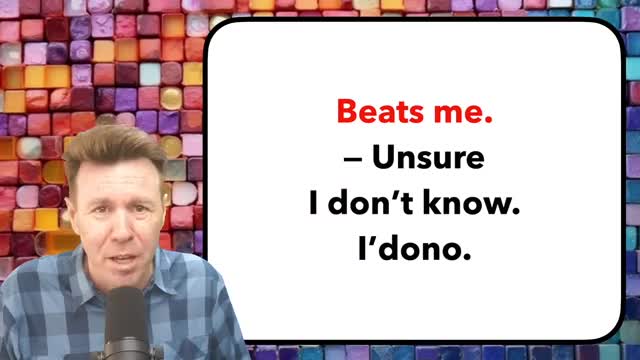
Beats me.
Beats me.
That just means you're unsure and you just don't know.
I don't know.
I don't know.
I don't know.
We often say, I don't know.
I don't know.
Beats me.
I don't know.
Beats me.
I am unsure.
Okay, where's everyone meeting?
So somebody says, where's everyone meeting?
And then you respond, do you remember?
I don't know, it beats me.
That means I have no idea.
I have no idea.
I don't know, it beats me.
I don't know where people are meeting.
I'm just saying.
I'm just saying.
Okay, so this phrase is used to soften a critical, controversial, or unrequested opinion.
That's kind of complicated.
By making it sound less harsh and more like a simple observation.
So you just want it to feel like I'm just making an observation.
I'm just saying.
I'm just, it's just what I see.
That's what I see.
I'm just saying.
All right.
You could have called.
I'm just saying.
You could have called me before coming or for whatever reason.
I'm just saying.
So they add this, I'm just saying.
They're adding that comment to maybe soften it up, not be so harsh on, Or they're just making an observation.
Hey, you could have called me.
You could have called, but you didn't.
I'm just saying.
You catch the nuance there?
The new project plan seems overly complicated.
I'm just saying.
Okay.
So you're at work and you say hey man, this new plan we have, it just seems overly complicated.
It doesn't need to be so complicated.
I'm just saying.
So you're just softening up your observation by adding at the end.
I'm just saying.
Do you get it?
It's a difficult one to use.
Let's get this over with.
So you're doing a tough task, a difficult task, and you say, let's get this over with.
Let's get this over with so we can go home.
No pain, no gain.
So maybe if you're encouraging someone, then you can say, no pain, no gain.
Come on.
One more lap.
No pain, no gain.
You can do it.
All right.
Let's keep in touch.
So you use this when you are departing with someone.
And it means let's continue to communicate and stay in contact with each other.
That's long and complicated.
Let's continue to communicate and stay in contact with each other.
No, I don't say that.
Just say, let's keep in touch.
It was nice seeing you.
Let's keep in touch.
All right, speak your mind.
Speak your mind.
So you're encouraging someone to be honest with you.
Tell me, tell me, speak your mind.
Tell me what you really think.
Speak your mind.
Don't hold back.
Speak your mind.
I can handle it.
Don't worry about me.
All right, cut to the chase.
Cut to the chase.
So you're wanting someone to get to the point.
Get to the point, cut to the chase.
Can we cut to the chase and talk about what's important?
Yeah, let's stop talking about all these other things and just cut to the chase and talk about what's important.
Out of the blue, out of the, out of the, out of the, out of the blue.
So if something happens unexpectedly, it happens out of the blue.
He called me out of the blue last night.
He just called me unexpectedly.
He called me out of the blue last night.
You made my day.
You made my day.
You can use this when you are receiving a gift.
Someone gives you something and you say, oh, you made my day.
Or they do something for you and you can say, oh, you made my day.
That means you made me happy.
You made this day special today.
Maybe it was not a good day, but all of a sudden they did that for you or they gave you that.
And now it's a special day and you say, you made my day.
Thanks for remembering my birthday.
You made my day.
Don't jinx it.
Don't jinx it.
Now, don't say something that might bring bad luck.
Or ruin a good situation.
Don't jinx it.
Don't ruin it.
This is often used when things are going well.
Things are going well.
Things are good.
Don't say anything that might change that.
Don't jinx it.
We're on a winning streak.
I hope I don't jinx it.
We're on a winning streak.
That means we've won many in a row.
We're on a winning streak.
We're continuing to win.
I hope I don't jinx it by saying that.
I don't want to jinx it, but the project is going incredibly smoothly so far.
Don't you think?
The project is going incredibly smoothly so far.
Oh no, I think I may have jinxed it.
Now everything's going to fall apart because I said that.
But I don't want to jinx it.
I'm trying to get you to understand how it's used, the feelings.
Okay, I'm all ears.
I'm ready to listen.
I'm all ears.
You have news?
I'm all ears.
Let me hear it.
Let's hear it.
Let me hear it.
Let's hear it.
That means say it, say it, tell us.
I'm all ears.
I am listening.
I'm listening.
You had me worried.
You had me worried.
So after a friend arrives late, you could say, you had me worried.
For example, you had me worried for a second.
I was waiting and waiting and you weren't coming and I thought maybe you were in an accident.
You had me worried for a second.
It's not the end of the world.
So you're trying to calm someone down and you say, it's not the end of the world.
This problem isn't as bad as you think.
It's not the end of the world.
This problem isn't as bad as you think.
It's not the end of the world.
Everything's going to be okay.
Okay.
Your team lost, but hey, it's not the end of the world.
Losing your job isn't ideal, but it's not the end of the world.
You'll find another opportunity.
All right, let's bounce.
Let's bounce.
So when you're leaving a place, you say let's bounce and that just means let's go.
Let's go.
Let's leave here.
Let's bounce.
Let's get out of here.
It's getting late.
Let's bounce.
Cross your fingers.
So you're hoping for luck when you say cross your fingers.
I'm hoping for luck.
My exam results come out tomorrow.
Cross your fingers for me.
Better late than never.
So you're apologizing for being late.
I'm late, but hey, better late than never, right?
Sorry I'm late.
Better late than never, right?
You've got to be kidding.
You're in disbelief.
I can't believe it.
You've got to be kidding.
You got backstage.
Oh, wait, sorry.
Sorry.
You got backstage passes?
You've got to be kidding.
So you're excited for your friend who just got backstage passes, a pass to go backstage and meet the band maybe.
You got backstage passes?
You've got to be kidding.
It turns out So you're sharing new information.
It turns out that something happened, that this, and then you share new information.
It turns out we were at the same concert and didn't know.
We were at the same concert, but we didn't know that we were at the same concert.
It turns out we were at the same concert and didn't know.
You say it.
I heard it through the grapevine.
So you're sharing rumors, sharing rumors.
I heard it through the grapevine that you're moving.
Are you moving?
Is that true?
I heard it through the grapevine that you're moving.
All right, that's it.
We did it.
Boom, good workout.
Keep moving forward.
We'll just keep practicing these English phrases until many of them become natural.
All right, one step at a time, and I'll see you in the next video.