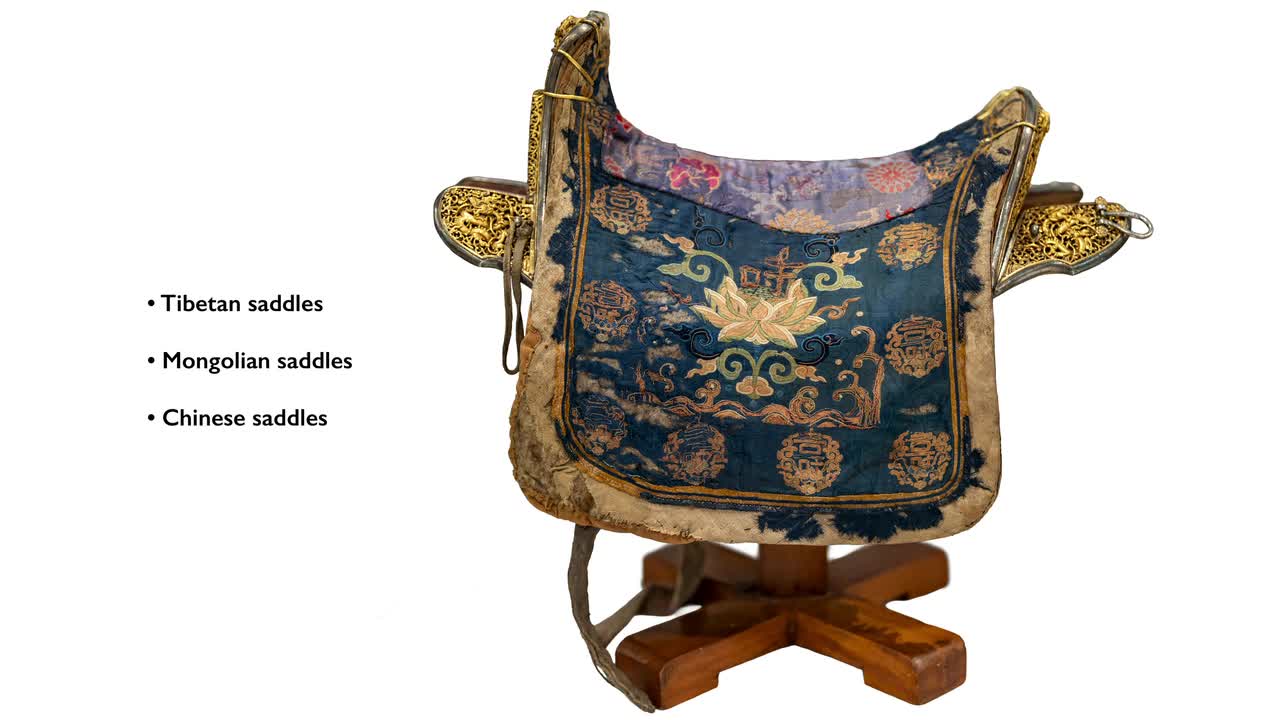
We're looking at a magnificent horse's saddle in the collection of the Rubin Museum of Himalayan Art.
Tibetans and Mongolians have large populations of nomadic pastoralists, so horses were critical to their way of life.
This is part of a very old, continuous tradition.
Tibetans recognize three different kinds of saddles traditionally Tibetan saddles, Mongolian saddles and Chinese saddles and they all follow the same structure and they were common objects of gift and trade.
However, distinguishing between these three kinds can be quite difficult.
But in a way that's perfect because the saddle is by definition something that travels.
So the visual language of this saddle is one that could be read in these three countries.
The most dramatic part of the saddle are the saddle plates that you see on the pommel, the naru and the cantle, the chiru, which are wonderful displays of chiseled ironwork, thickly gilded using a technique known in the West as damascene.
And in fact, if you look very carefully, because the relief is especially high, you can just make out some areas of wear where the iron is visible, and you can see a very precise crosshatching which is allowing the gold to adhere.
So you can see how deep the ironwork is.
And as you reach to the top of the cantle you see the dragon's heads and the wish-fulfilling jewel rising off the surface.
These are actually landscapes with these enormous powerful dragons.
If you look at the extreme lower corners, you can just make out stylized versions of mountains.
And you can see that the dragon rises up in and amongst the clouds.
Dragons are the most common form of ornamentation for Tibetan saddles, and they carry with them associations of the sky, the heavens and power.
They're considered to be very auspicious.
They seem very powerful in part because they're so twisted.
They double back on themselves as they wind in and out amongst those clouds, so that they feel as if they have this ability to spring forward.
These intricately worked and gilt faceplates would have been the only part of the saddle visible when Its owner was riding, because there would be two saddle carpets one underneath the saddle for the horse's comfort and one over the saddle for the riders.
This would have been a magnificent show of the status of the rider, whoever that was.
Before the time of Lamborghinis and Mercedes, the saddle was one of the conspicuous ways to display your status.
I can just imagine this gold glinting in the sunlight as the horse was moving forward.
So the blue color of the embroidered silk cover on the saddle seat suggests that the owner of this saddle or the recipient was originally a member of the lay nobility, because blue is associated with them, and if it had been say, a lama, it would have been yellow.
I find it fascinating that, although this seat cover would have been completely covered when it was being ridden, it's still covered with incredibly delicate embroidery.
This is part of the opulence of the saddle.
You have the lotus flower at the center, which is a very common auspicious symbol, and then you see in small rondels around it the Chinese character for long life shou.
I love how the heavily embroidered lotus blossom seems to rise up out of this lovely abstracted water motif.
The saddle itself, but also the cloth covering the seat is clearly worn.
It's obvious that this was not simply a showpiece.
This was a saddle that was used.
You can see the bunting coming through where the silk has been worn away.
Now, all of this golden iron metalwork is attached to four wooden boards.
The wooden frame or the saddle tree.
The galak is made of four pieces of wood tied together with leather laces.
When you turn it over, you can find a few details that give us a more specific sense of the context for the saddle.
In the center is a Tibetan letter Ka, branded into the wood, and this likely served as a kind of inventory number.
But this saddle actually has a second mark as well.
So just above that brand is a vertical Mongolian word, which means gap or space, written in black ink.
And Tibetan letters are sometimes used as brands on Mongolian horses.
So, together with this Mongolian script suggests the possibility of Mongolian ownership at some point in this object's history.
That doesn't mean that the saddle was necessarily in Mongolia, because there were plenty of Mongolian warriors in Tibet.
In fact, Mongolian was used as a lingua franca among these elites in inner Asia, between Mongols, Tibetans and Manchus.
It creates a wide range of possibilities of the history of this object.
There's a very close comparison to this saddle in the Metropolitan Museum of Art, which they attribute to Chinese for the Tibetan market.
And if we look at that saddle, we notice many similarities.
It also has a blue silk cover, which suggests it was made for a late nobleman.
And, even more interesting, both saddles even have the same letter Ka, branded into the wood of the saddle tree.
And the curators at the Met have noticed that their saddle is extremely similar to some of the best examples of imperial Chinese saddles, such as one owned by the Qianlong Emperor himself.
And there are comparable pieces in the Palace Museum in Beijing.
So the fact that they both have this same brand in the same place suggests an alternate reading that perhaps The Ka is actually a brand of ranking of quality.
And since Ka is the first letter in the Tibetan alphabet, this suggests that these saddles are of the highest quality.
And that is clearly evident when we look at the saddle.