
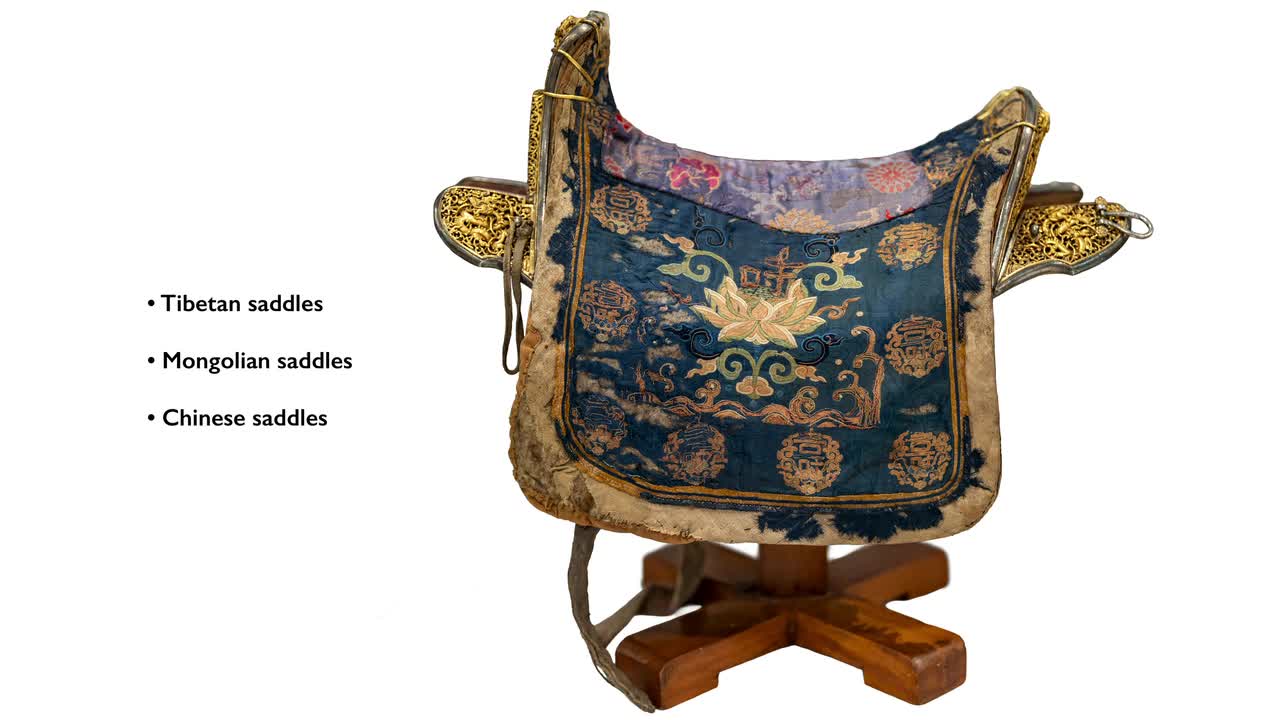
[The Art and Symbolism of the Himalayan Nomad: A Study of the Tibetan Saddle]-[Saddle, Tibetan or Mongolian]
📋 Summary
The Himalayan Saddle: A Masterpiece of Nomadic Art and Status
In the collection of the Rubin Museum of Himalayan Art lies a magnificent horse's saddle, an object that serves as a profound window into the nomadic pastoralist traditions of Tibet, Mongolia, and China. More than just a functional tool, this saddle represents a "continuous tradition" where visual language transcends borders, reflecting the interconnectedness of inner Asian cultures.
The Art of Damascene and Symbolic Ornamentation
The most striking features of the saddle are the "saddle plates" adorning the pommel (naru) and cantle (chiru). These are crafted through "chiseled ironwork" and "thickly gilded" using the "damascene" technique. The craftsmanship is so precise that the "crosshatching" used to allow the gold to adhere remains visible in areas of wear, revealing the extraordinary depth of the relief.
Central to the design are the "dragons," which are the "most common form of ornamentation for Tibetan saddles." These dragons, depicted rising among clouds and "stylized versions of mountains," are not merely decorative; they carry deep associations with the "sky, the heavens and power." Their dynamic, "twisted" forms suggest a latent energy, as if the creatures have the "ability to spring forward."
A Conspicuous Display of Status
Before the advent of modern luxury vehicles, the saddle served as the primary indicator of social standing. When in use, the owner would employ two "saddle carpets"—one for the horse's comfort and one for the rider. The "blue color of the embroidered silk cover" specifically signifies that the owner was a member of the "lay nobility," whereas a yellow cover would have denoted a lama.
This opulence is further reflected in the "delicate embroidery" featuring a "lotus flower," an "auspicious symbol," surrounded by small rondels containing the "Chinese character for long life, shou." Despite this luxury, the saddle was not merely a "showpiece"; signs of wear, such as "bunting coming through where the silk has been worn away," prove that it was a functional object used by its owner.
Provenance and the Lingua Franca of Elite Objects
The physical structure of the saddle, the "galak" or wooden saddle tree, provides clues to its complex history. A Tibetan letter "Ka" is branded into the wood, likely serving as an "inventory number" or, as recent research suggests, a "brand of ranking of quality." Given that Ka is the first letter of the Tibetan alphabet, it likely denotes that these saddles represent the "highest quality."
Furthermore, the presence of a "vertical Mongolian word" written in black ink suggests "Mongolian ownership at some point in this object's history." This layering of linguistic and cultural markers highlights that Mongolian functioned as a "lingua franca among these elites in inner Asia." By comparing this piece to similar saddles in the Metropolitan Museum of Art—some of which are linked to the "Qianlong Emperor"—we see that this saddle is not an isolated artifact, but part of a sophisticated network of imperial Chinese production intended for the Tibetan market. Ultimately, this saddle is a testament to a shared heritage, where the "visual language" of the object was recognized and respected across the diverse landscapes of the Himalayas and the steppes.

Deep Learning with ListenLeap


