Hello, welcome to Chinese Folk Tales.
I'm Paul Osborne, and I've got another amazing story to tell you.
I hope you enjoy it.
These days we take it for granted that if we have a headache or a stomach upset, we will go to a drugstore to buy some pills or potions to make us feel much better.
If the problem is more serious, well then we will see the doctor, who will give us something to ease the pain.
But in China there is the very well-established system of traditional Chinese medicine, with tried and tested herbal remedies that have been used for thousands of years.
You might think that makes things easy.
If I feel ill, I'll just go into the garden and pick a herb or two, make some tea and everything will be okay.
But of course, it's certainly not that simple.
For example, can you tell the difference between a blueberry and a berry from Deadly Nightshade?
And what about foxgloves, primroses and burdock?
Which are friendly, which is deadly?
Go on, choose.
How confident do you feel now?
Would you bet your life on it?
In today's world, pharmaceutical companies spend millions and millions testing out new drugs to make sure they're safe before unleashing them on the public.
But that hasn't always been so.
Someone somewhere, had to be the first person to try out a plant remedy to see if it was efficacious or downright deadly.
So who was it?
If you have a little time, we'll find the answer in my story.
More often than not, progress and inventions come about through need.
There was a dark time, more than 5,000 years ago in fact, when the people of China went hungry.
The crops had failed.
There wasn't enough food to eat and people became sick.
They were forced to forage to find new things to eat.
There were certainly no 24-hour shops in those days.
But the problem was what was safe to eat and what was not.
Wife, why don't you try this root?
Perhaps it's edible.
Hmm, maybe you should try it yourself.
It might be poisonous.
Well, if you give it a little nibble, we'll soon see.
No way.
If you're so sure, you take a bite.
So, basically, no one was willing to take the risk until one day a man stood up.
This is ridiculous.
We're all going to starve unless someone finds something new to eat, and the sick will die without new medicines.
So, okay.
I'm going to have to do something about it.
Someone, that's to say me, will have to take a risk.
Maybe it will kill me, maybe it won't.
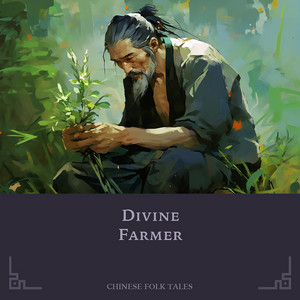
But unless we try... This is Shen Nong.
Some say that he was a great ruler in ancient China more than 5,000 years ago.
According to legend, he was the son of a princess and a heavenly dragon.
Maybe that made him special, made him able to resist the worst poisons.
Or maybe he was an ordinary man who was either very stupid... Oi, I heard that.
...or very, very lucky.
Anyhow, Shen Nong soon set about tasting just about every plant he could get his hands on.
Okay, so for breakfast I'll eat some heartbreak grass.
For brunch, some Chinese lantern.
At lunchtime, I'll nibble a little castor oil plant.
And for afternoon tea.
I'll try some tea days on end.
Indeed, it's said that on one day alone he ate more than 70 different kinds of plants roots stems, leaves and took notes to describe the effects they had on him, although those near him sometimes had a good idea about those effects.
How do you feel, sir Okay?
No, hang on.
Excuse me.
I have to go.
Oh, nasty.
No, it's okay.
Write down that this one makes you feel nauseous and this one makes you feel very happy.
That one there makes you feel like you are flying through the air.
That one's okay.
But that one is fantastic.
And that one, well, that's my afternoon cup of tea.
I know what you're thinking.
Did he really have a cup of tea?
Actually, yes.
I invented it.
No way.
It's true.
I had a busy morning tasting plants in the woods, and I definitely had something that wasn't good for me.
My mouth was dry, my tongue was numb, so I decided to boil up some water.
As I rested under a tree, a few green leaves from the wood fluttered into the pot.
They tasted pretty good and made me feel refreshed in mind and body, so I thought, bring it on!
Turns out.
It's very good for you, settles the stomach, it's an anti-inflammatory, protects your bones and can even ward off cancer, and even makes you smile while you are savouring the flavour.
Really?
Oh yes!
But you know, I wasn't just a taste tester.
I invented a load of other things too.
The hoe, the plough, the axe.
I taught people to dig wells, to create many uses of horse urine, including how to preserve seeds.
Eww, too much information.
I came up with the idea of farmers markets, the Chinese calendar.
Now you're just making things up.
I'm really not.
You know, I worked out how to take a person's pulse acupuncture was one of mine and, of course, Moxibustion.
Moxy what?
Bustion.
Moxibustion.
You know, cupping.
The drawing out of poisons through the skin.
Stop!
But I could go on.
I haven't told you all about the musical instruments I invented yet.
Safe to say that pretty soon he had come up with a very very, very long list of things that were not only safe to eat but actually made you well too.
Soon, all the people of the land were planting new crops, reaping handsome harvests and leading much healthier lives.
Shen Nong became a hero for his selfless actions.
It was nothing, really, all in a day's work.
Over his lifetime, Shen Long is credited with radically changing the eating habits of the people of China from one of mainly meat, seasonal fruits and seafood to include more grains and vegetables.
Yes, much easier on the digestion, I found.
He's also said to have discovered one species of herbs and medicinal plants for every day of the year.
He wrote it all down in a book called Shen Nong's Herbal Classic.
And so, with some justification, he is known as the god of Chinese herbal medicine.
Shen Nong's wisdom has been passed down through the ages from father to son and mother to daughter.
Along the way, he has become a legendary figure with even more wild, wild tales told about him.
One even claims he had a see-through stomach.
Yes, of course.
It's so I could see the effects of the herbs on my internal organs.
Makes so much sense, don't you think?
A claim that clearly wasn't true.
Or was it?
But it doesn't matter really, because even without a window in his tummy, Shen Long was a pretty amazing fellow anyhow.
We owe him a debt of gratitude for the selfless gift of knowledge that he gave to future generations.
He has surely inspired so many doctors to follow his path by saving people and serving society selflessly.
And what's not to love about that?
And with that, we conclude this episode of Chinese Folk Tales.
Thanks for listening.
If you like our stories, do give this podcast a five-star rating, leave your comment and share with your friends.
To hear more, please subscribe to Chinese Folk Tales on all major podcast platforms.
We'll see you next time.
Bye for now.