
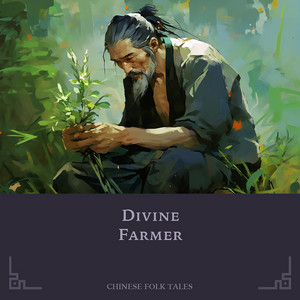
[Shen Nong: The Legendary Pioneer of Chinese Herbal Medicine]-[S3E14: Divine farmer]
📋 Summary
The Origins of Traditional Chinese Medicine: The Legend of Shen Nong
In the modern era, the convenience of visiting a drugstore for "pills or potions" to treat ailments has become a standard expectation. However, this ease of access masks the arduous journey of discovery that characterizes the ancient system of traditional Chinese medicine. As the podcast explores, distinguishing between "friendly" and "deadly" plants—such as the difference between a blueberry and "Deadly Nightshade"—was not always a science, but a dangerous gamble. This narrative introduces Shen Nong, the legendary figure whose selfless experimentation laid the foundation for herbal medicine.
The Necessity of Foraging and the Risk of Discovery
More than 5,000 years ago, China faced a period of extreme hardship where "crops had failed" and widespread hunger and sickness plagued the population. With no "24-hour shops" available, the survival of the people depended on their ability to forage. The primary dilemma was determining what was safe to eat; the podcast highlights the tension of this era, where individuals were often too afraid to test unknown roots, fearing they might be "poisonous." It was this existential crisis that prompted Shen Nong to step forward, declaring that someone had to "take a risk" to ensure the survival of the hungry and the healing of the sick.
Shen Nong’s Method: Trial and Error
Shen Nong is depicted as an extraordinary figure, described by legend as the "son of a princess and a heavenly dragon." Whether he possessed supernatural resilience or was simply a man of immense courage, he began the systematic process of "tasting just about every plant he could get his hands on." His methodology was rigorous yet perilous; he would consume various stems, leaves, and roots—including "heartbreak grass" and "castor oil plant"—to document their physiological effects. He famously noted which plants made him feel "nauseous," which induced happiness, and which made him feel as if he were "flying through the air."
The Accidental Discovery of Tea
One of the most enduring legacies attributed to Shen Nong is the discovery of tea. During a long day of testing plants, he experienced symptoms of poisoning—a dry mouth and a numb tongue. While boiling water to recover, leaves from a nearby tree fluttered into his pot. Upon drinking the infusion, he felt "refreshed in mind and body." Modern understanding confirms his findings, as tea is recognized for its ability to "settle the stomach," act as an "anti-inflammatory," and protect the body, proving that his accidental discovery was indeed a profound contribution to human health.
Beyond Medicine: A Polymath of Ancient China
Shen Nong’s contributions extended far beyond herbalism. He is credited with the invention of essential agricultural tools such as "the hoe, the plough, [and] the axe," and he reportedly instructed people on how to "dig wells." Furthermore, he is said to have pioneered foundational medical practices, including "acupuncture" and "Moxibustion," the latter being a technique for "drawing out of poisons through the skin." Through his selfless efforts, he revolutionized the diet of ancient China, shifting the population from a reliance on meat and seafood to a more sustainable consumption of "grains and vegetables."
A Lasting Legacy
Shen Nong documented his findings in the "Shen Nong's Herbal Classic," establishing him as the "god of Chinese herbal medicine." While myths suggest he possessed a "see-through stomach" to observe the internal effects of the herbs he ingested, the true significance of his story lies in his "selfless actions." He serves as an enduring inspiration for those in the medical profession who strive to "save people and serve society selflessly," leaving future generations with a profound "debt of gratitude" for the knowledge he sacrificed so much to acquire.

Deep Learning with ListenLeap


