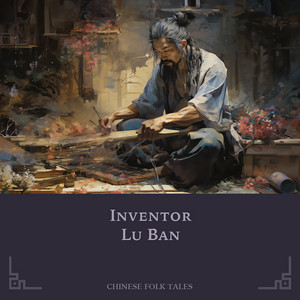
Hello, welcome to Chinese Folk Tales.
I'm Victoria Meakin, and I've got another amazing story to tell you.
I hope you enjoy it.
There's a phrase in Chinese which says you shouldn't brandish your axe at Lu Ban's door.
But what does it mean?
And while we are at it, who was Lu Ban?
Basically, the interpretation is that you shouldn't show off in front of those who have already set the bar high, because you'll only make a fool of yourself.
So, the big question remains, who was Lou Bang?
He's someone whose name should be right up there with Archimedes, Leonardo da Vinci, Benjamin Franklin and Nikola Tesla.
But because his achievements were made so very long ago we're talking around 2000 years ago his name sometimes gets forgotten.
But not by builders in China, who see him as the god of their trade, and not just constructors.
Who invented the kite?
Lou Ban.
The carpenter's saw?
Lou Ban.
And the bicycle?
Lou Ban, probably.
Oh, and his wife got in on the act too.
She invented the umbrella so that he could carry on working in the rain.
We'll discover more about that later.
But first, let's find out a little more about this great man.
His story begins in old eastern China, Shandong province, and the name we know him by simply means Ban from the state of Lu.
No one can say what his real name was, but he was probably living in the dying days of the Zhou dynasty, just as it was about to fracture into lots of little states during the spring and autumn period of Chinese history.
He might have been a freed slave or could have been a wandering artisan.
We do know he came from a family of carpenters and that Louban didn't like reading or writing and categorically hated school, which made things tough for his teachers.
Louban, you're not paying attention.
But it's so boring.
I don't like reading and writing.
I prefer making things, said the little boy, who really was much more of a practical learner.
Luban, if you don't learn your lessons, you'll never become anything in life.
But Luban didn't care.
His head was always full of ideas of things he was going to create.
It's not that he created learning altogether, because he was inspired by great Chinese thinkers of the past.
Lu Ban lived in troubled times.
As a carpenter, he was often called upon to make weapons for soldiers to take into battle and to help defend his people.
But instead of sticking with the tried and tested, little by little he showed that he had some pretty clever ideas of his own.
Why have you brought me here, carpenter?
I have a war to fight.
I just wanted to show you some things I've made.
Take a look at this.
Well, what is it?
I don't have all day.
I call it a cloud ladder.
See, your archers can be raised up so and can better fire their arrows at your enemies.
Hmm, that's interesting and this is a grappling hook and this is a ram ideal in naval warfare.
Also, if you make all the ammunition the same size, it would make it easier to supply the armies.
Luban certainly impressed the generals of the day, but it is the inventions that helped ordinary people rather than harm them for which he will best be remembered.
For example, he most liked to work with wood all day long and was always coming up with new ideas.
Wife, come see!
Have you been inventing again?
There seems to be no end to your imagination.
What is it this time?
Luban really did have so many very good ideas.
Well, this is a chisel.
It makes very fine precision cuts.
This is a shovel.
And it makes it easier to clear up.
Oh, I like this one.
It can be used to plane wood nice and smooth.
And this is a bow drill.
You can make fire with this.
And this?
A little seat to sit on.
I really don't know where you get your ideas from.
But I'll not complain.
Your reputation is growing fast.
Luban loved what he did so much, he would have spent his entire time inventing.
But sometimes he had no choice but to get clever.
I want a new palace, said King Moo of Joe one day.
You have one month to build it, and if anyone misses deadline, then I will chop off all your heads.
That didn't sound great.
So everyone implored Luban to come up with an idea to get the job done very quickly.
So he began thinking.
And not long after, as he was hurrying up the hill to the building site, Luban cut his hand.
He looked down and saw he was bleeding from a cut from the serrated edge of a single blade of grass.
That's it! he said excitedly.
I just need to make a saw as sharp as this blade of grass.
And he knew exactly what to do.
And not long after he had produced a sharp saw.
That meant the workers could build the palace in a fraction of the time it usually took.
Over here.
Yeah, build the right.
Over here.
To me, to me.
He never really stopped coming up with this or that.
And with all this inventing, Luban's wife worried for him so.
You're out in all weathers working on your plants.
You'll catch your death or get sunstroke.
So she came up with an invention of her own.
It was a portable shade which could be easily carried around to protect her husband from the rain and sun.
This is what became the parasol or umbrella.
But her plan to make things easier for her husband backfired somewhat.
Oh, thank you.
Now I can work even harder.
The years rolled by.
And it wasn't all warfare and palaces for the greatest inventor of them all.
Sometimes he made things that were just for fun.
What is that?
It's a bamboo bird.
Look.
I can add a string and make it stay in the air for three whole days.
We can paint it and make it look really great.
And look at this.
Well, it's just a cart, isn't it?
Yes, but it moves on its own.
Hang on, isn't that your frail old mother in it?
I haven't quite worked out how to get it back yet.
Now, are we saying that Lou Ban just invented the kite and the car?
It's very possible.
And if we had much more time, I could tell you even more about this great ancestor.
All his knowledge could very easily have been lost to the world when he died, but not so.
Although he hated reading and writing as a child, as a grown-up he was smart enough to write down how to make all these amazing things and more like how to build a pagoda or a wheelbarrow, a granary store.
He knew how to ward off evil spirits and the most auspicious days to cut down trees.
He believed in being in harmony with the natural world and helping ordinary people in their daily lives.
And many honoured guests are gifted Lu Ban locks, fiendishly designed wooden puzzles, when they visit China.
And with that, we conclude this episode of Chinese Folk Tales.
Thanks for listening.
If you like our stories, do give this podcast a five-star rating.
Leave your comment and share with your friends.
To hear more, please subscribe to Chinese Folk Tales on all major podcast platforms.
We'll see you next time.
Bye for now.
Thank you.