New Yorkers are able to stock up on free groceries this weekend thanks to prediction market platform Polymarket.
But just until recently, the company wasn't even allowed to operate in the US.
So what happened in just a few months?
To give a little backstory on a high level prediction, markets work exactly like they sound.
Bettors put money behind, whether they think something will happen or not.
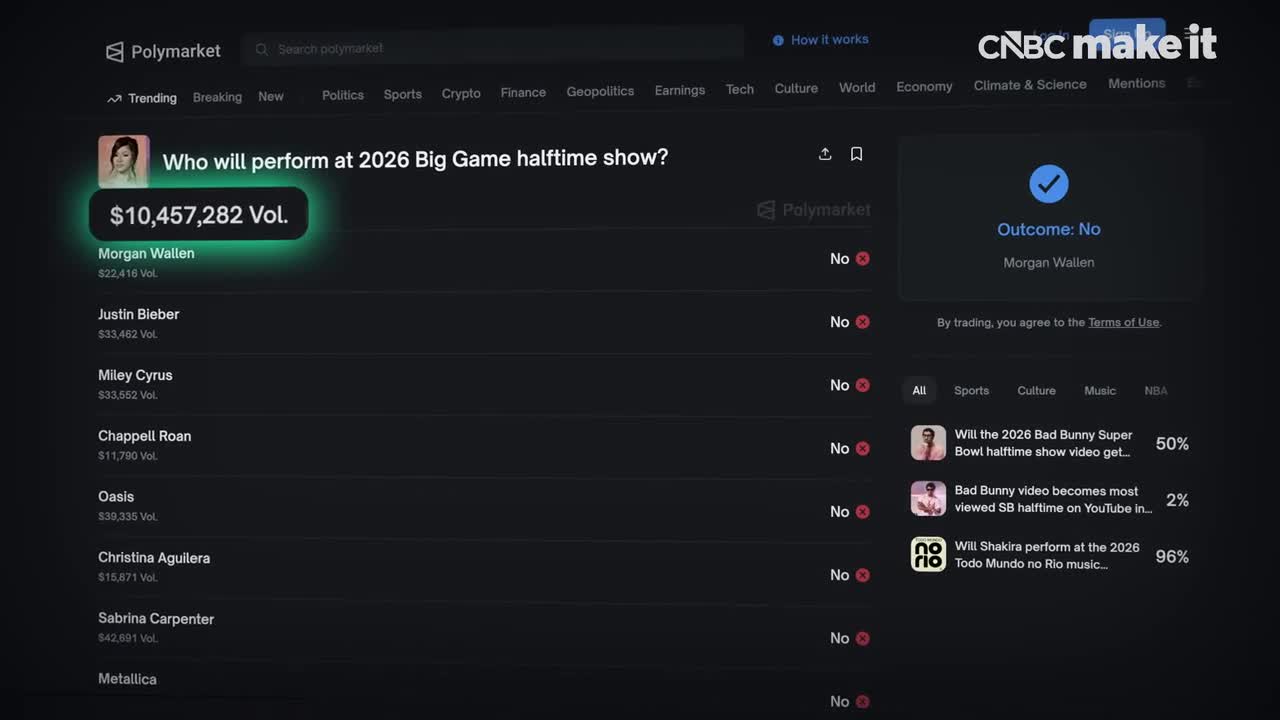
This can include bets on who will be the next Fed chair or who will perform at the Super Bowl halftime show which, by the way, collectively had more than 10 million on the line across polymarket.
The platform gained a lot of attention when bettors touted President Trump as a heavy favorite in the lead up to his victory in the 2024 US election, even as polls showed a close race.
Proponents of prediction markets say that they provide uniquely useful data even if you're not a bettor.
Want to know what the Fed will do with rates in March?
Which country will win the most gold medals in this Winter Olympics?
The idea is that, if people are actually willing to bet money on it, this crowdsource data could provide some insight that polls or individual experts can't.
I understand that.
You know it's a novel concept and people were skeptical when it came around, but hopefully now people will be a lot more embracing of market based information.
Prediction markets have their detractors, too.
Financial advisors warn that putting money behind predictions is like gambling and should only be done with money that you're really willing to lose.
We're talking about something that's probably more of a hobby and more fun, you know really, than anything that's seriously a part of a long term investment strategy.
What's more, concerns abound that insider trading is skewing the markets.
After all, if there's an open bet on whether Lady Gaga will perform at the Super Bowl, who's to stop one of her dancers from betting big that she would?
Ironically, Americans couldn't place bets on their own election through PolyMarket.
That's because the CFTC, our commodities regulator, fined the company 14 million back in 2022, alleging it failed to obtain proper registration and forced PolyMarket to block US users.
But now let's fast forward a bit.
When President Trump won the 2024 election, he picked new agency leaders who are more in favor of emerging technologies, including crypto and prediction markets.
There are markets that have really languished here on shore because during the prior administration frankly, there was failure to act, failure to regulate.
There was action to try to be a merit regulator and predict, you know, ban things before a political election.
But we're not going to do that.
We're going to exert our authority, make sure these markets flourish here in the US.
Can you imagine the ride that these guys have been over the last couple of years?
I mean, start a little piece of tech in their basement.
It starts to get a way bigger uptake than they think.
They then find out that what they're doing is illegal.
And then all of a sudden Trump gets in.
Thank you guys for having me.
My first TV interview and 10 billion plus valuation, the hottest thing in the world.
Everyone wants to interview you and you're going like, man, what is going on here?
So that brings us back here with Polymarket staging brand events in the US, like this grocery store.
Polymarket re-entered the states after acquiring a smaller regulated and licensed options trading platform in 2025 and after the Trump administration ended investigations into whether Polymarket had been accepting bets from Americans during the company's exile.
Prediction markets are becoming increasingly popular and could see annual trading volumes of a trillion dollars by the end of the decade, according to a report by research firm Eilers and Krejcik.
With all the recent hyper on these platforms, plus headline grabbing brand moves like free groceries, more Americans may be dipping their toes into these products.
I just heard about it, just like two days ago, and I was like well, I wanted to come check it out and see what it's all about.
I've never heard a parlor market before this at all.
It looks like it's gambling adjacent, but I'm not a part of any of it.
I feel like this is a good event to give back to the community.
So I'm all for that.
But I feel like I'm going to need to do a little bit more research to find out a little bit more about it.
Competition in the space is also heating up.
Kalshi, which has a commercial relationship with CNBC, has been registered with the CFTC since 2020.
Newcomers in the space also include retail trading platform Robinhood and crypto exchange Coinbase, both now offering prediction markets on their platforms.
This free grocery store comes after Kalshi also gave New Yorkers up to 50 of groceries earlier this month and may be a nod to New York City Mayor Zora Mundani, who has pledged to open permanent city run grocery stores across each borough.
We asked Polymarket about the purpose behind running the grocery store, but didn't receive a response.