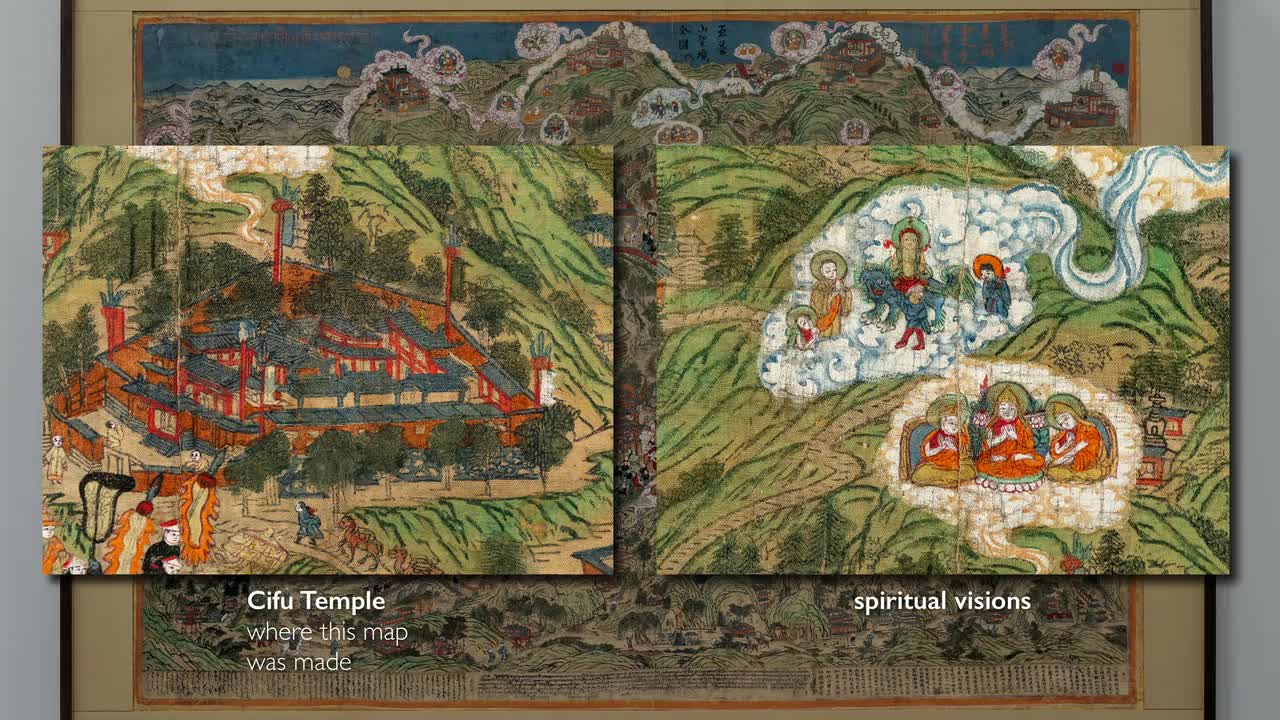
We're looking at a large woodblock print in the collection of the Rubin Museum and we get to imagine, through this pilgrimage map, what it would be like to visit Mount Wutai, this sacred mountain.
I admit that one of the things that fascinates me about this is that it combines real buildings that one could see, but it also has these cloud-like shapes with figures within them.
We're clearly accessing a different level when we look at these parts of the print.
Pilgrimage is really about encountering the divine here on Earth.
Mount Wutai is interesting because it's considered to be the earthly abode of the Bodhisattva of Wisdom Manjushri.
I can imagine that for centuries, people visited this place.
Wutai Shan was considered to be a sacred site to Chinese Buddhists since at least the 5th century, but starting in the 7th century it drew Buddhist pilgrims from as far away as India Kashmir Tibet, Japan and Korea.
Tibetan Buddhism was firmly established on Mount Wutai during the Mongolian Yuan Dynasty in the 13th and 14th centuries, and here we can actually see that, marked by this bright white stupa which was built in 1301 by the brilliant Nepalese artist Aniga, who was Kublai Khan's head of the imperial workshops.
But it's really by the 18th and 19th centuries that Wutai becomes especially important to Tibetans, Mongols and Manchus.
So what you see on the map, with the clouds and the deities emanating out of mountains, is really what the pilgrims come to Wutai Shan to encounter.
So you can say that this map actually visually records these divine manifestations.
They're mapped onto the mountain, and this seems to be one of the map's primary functions.
One of the first things I notice when I think about it topographically is that it's not one mountain but actually five peaks or terraces.
Wutai Shan means five-terrace mountain, or in Tibetan, five-peak mountain.
It's a cluster of five peaks.
Each of them has a temple or monastery and a different form of Manjushri on top.
One can imagine that this map could be used in many different ways.
As an actual literal guide.
The pathways that connect the different temples suggest different routes of possible pilgrimage.
But one can also imagine that this would be used as a surrogate, as an imagined pilgrimage for those who could not make it.
And as we look at the pilgrims who've come here, we see some prostrating themselves, others in prayer, others experiencing visions, encountering deities.
We see a festival going on in the center.
In a way, it's overwhelming to think about this visit.
Let's start with this procession down the center.
This is a depiction of one of the most prominent festivals that takes place at Wutai Shan the Maitreya Festival, which is usually around July.
And this was a huge draw for Mongolian pilgrims and they came both for the festival and also to trade.
And if you look in the lower left corner, you will see travelers with camels, which is something that's specifically associated with Mongolian depictions.
And so here we see a procession leading from the largest monastery, Pusading Monastery, which was a monastery that was converted into an imperial monastery in the mid-17th century, at the beginning of the Qing Dynasty, and you can tell that by the yellow roofs marked as an imperial site.
And then you can see this procession that includes a figure in a sedan chair and that's the Jasak Lama, head of Buddhist Affairs, on the Mountain.
And here you see a procession with an image and another pelican, and then these masked dancers.
And you can see masks of various kinds, including a bull-headed yama, mahakala and deer, which are all reflective of actual dance masks that were performed as part of the ritual.
And I think I recognize one other figure that we've looked at together, and that's mahakala.
We can see Mahakala on one of the hills, and the Mahakala sculpture that was employed to help Kublai Khan in the conquest of China was taken to Wutai Shan after the establishment of the dynasty.
And so this seems to be in recognition of that.
Maybe one of the most confusing areas of the map when I first looked at it was this scene toward the top where we see three nude figures.
There are some comical depictions in the map.
For instance, here we have what appears to be a folk tale, where the Kangxi Emperor sees what appears to be a dissolute monk frolicking with two naked ladies and shoots him, whereupon he reveals himself to be Manjushri in his attendance.
This idea that you could encounter Manjushri anywhere and in anyone on Mount Utai.
And there are many gazetteers and pilgrimage guides which talk about encounters with Manjushri and many different guises.
Another part of the map that fascinates me is this section on the lower left where we see a figure whose legs seem to be dangling from the rock.
And this is a site where there's a small hole, and those who were able to pass through it were believed to be reborn with their sins expunged.
And here you can see a midwife helping shove through a hapless pilgrim.
And this is still a site that's very much active and of interest to pilgrims today.
So let's talk about the Tibetan Buddhist aspect of this map.
This map declares not only a Tibetan Buddhist identity, but more specifically a sectarian identity.
Many Mongolians are followers of the Golugpa tradition, one of the four main schools of Tibetan Buddhism, and their founder Tsongkhapa, was considered to be an emanation of Manjushri, and you can, in fact, see him all over the map.
For instance, at each of the five peaks you can see a small image of a mandala emanating out of each peak a different form of Tsongkhapa, which are, in fact, five different visions that KJJ had of his teacher.
Maps like this are produced now that are for 21st century visitors.
And you still see pilgrimage guides in various languages, from Chinese to Tibetan, being produced to this day.
And it makes sense that the inscription that we have at the bottom is actually in three different languages.
The Chinese inscription talks about this in the most detail.
It says, those who see this map of the mountain will, in this life, be free from all calamities and diseases and enjoy boundless blessings, happiness and longevity.
After this life, they will be reborn in a blessed land.
Should a person make the vow to print this image, they will accumulate immeasurable merit.
So the object is telling you what benefits you have to see it and to print it.