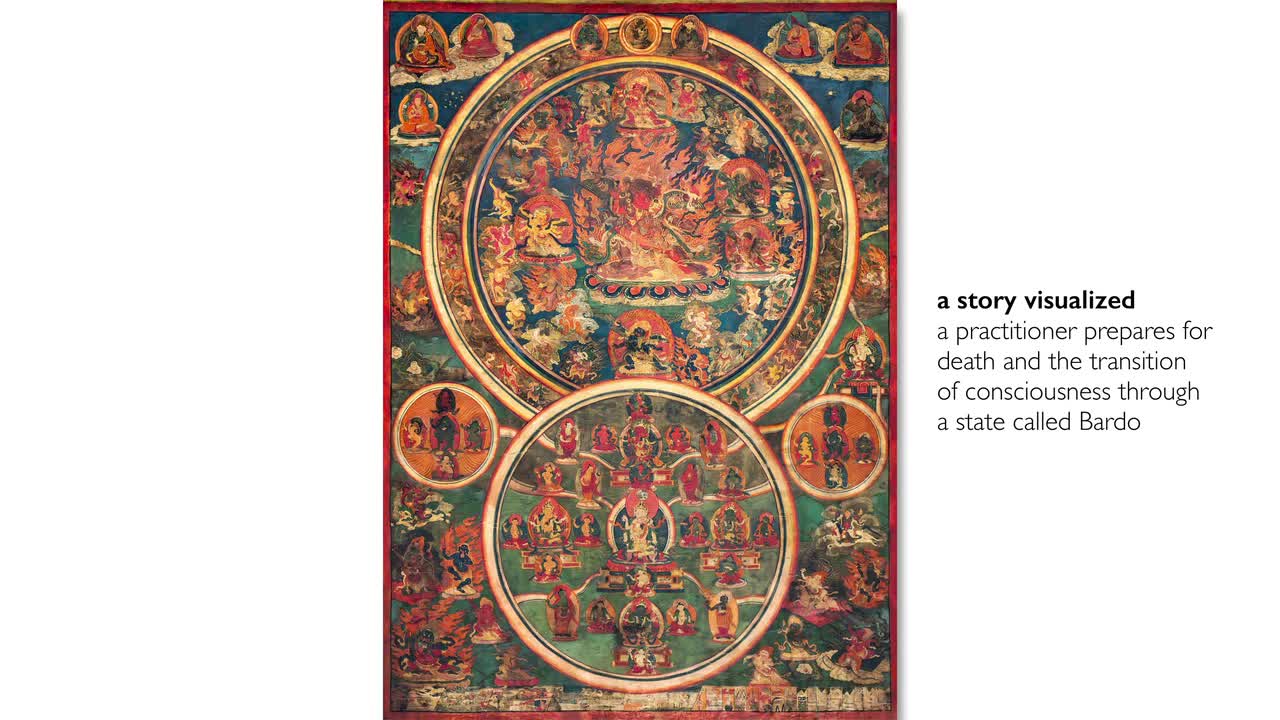
We're looking at a large thangka, a Tibetan painting.
It's an incredibly elaborate painting.
You see these large circles with rainbow colors and multiple figures of deities.
Some are in very dynamic stances and some are in traditional cross-legged or standing posters.
When I look at this painting, I see it as a story.
We have a mental story that is visualized by an artist who may be working with a person who commissioned the painting.
Imagines how a practitioner might prepare oneself for an eventuality of death and the transition of consciousness through this state called the bardo.
It is this intermediary period after death and before rebirth.
The painting depicts peaceful and wrathful deities of the intermediate state, and it is structured as an imagined experience between death and rebirth, as described in the 14th century text, whose titles are in translation The Peaceful and Wrathful Deities, The Profound Teachings of Self-Liberated Wisdom, Mind and the famous Liberation Upon Hearing in the Intermediate State.
Both are treasure teachings or terma revealed by Karmalingpa, who lived in the 14th century.
It is popularly known as the Tibetan Book of the Dead.
So this painting is really meant to help a practitioner to focus their attention to be prepared for this period that's called Bardo.
And there's a lot to look at.
Some might find that it's very hard to read this painting, but if we break it down to a general composition and hierarchy of depictions, then the compositional structures still apply here.
The most central and or largest images within the painting are the most important ones.
So, from the perspective of a practitioner, these deities appearing in the rainbow spheres are the most important.
A practitioner would imagine how, at the time of death, when all the physical senses are being dissolved, the subtle consciousness remains and images made of light are said to appear in their mind.
According to the teachings and the practices described in the text of the Bordeaux, realizing the true nature of the mind is the key to free the consciousness from entering another existence.
What's interesting here is that the meditators are depicted here in the caves, and they would visualize themselves as Vajrasattva, the deity depicted on the throne. we see streams of rainbow light emanating from this deity, and these streams form these spheres, and these streams of light from these spheres seem to flow back to this deity Vajrasattva as well.
So, despite the beauty and the complexity that we've seen in these large spheres, the practitioner is trying to discipline their mind so that these do not become distractions.
And in this particular composition, perhaps the two most important aspects are quite small.
Vajrasattva on the right, and then the depiction of the practitioners within their caves meditating on the left.
And the Vajrasattva is the agent who generates these beautiful rainbow spheres that are made of light, reminders for the practitioners to understand the nature of their own mind as being clear light and not be attached to the peaceful images that we see in the lower circle or be fearful of the complicated and dynamic and scary-looking images depicted in the larger upper sphere.
It still holds true to a traditional way of images of deities or specific subjects depicted in Tibetan thangkas, where we have, in the upper portion, images of teachers and sources of the practices and the tradition and the lineages of the teaching.
And then in the bottom corners, we see images of protectors of this tradition.
But what is most interesting in this painting is this register at the bottom of the painting.
And that's quite unusual representation of six realms of existence.
So this spectrum of the six realms begins on the left, where you can see Mount Meru, which is the center of the universe according to the Buddhist cosmology and above which live the gods, and then a realm of demigods, where you can see them fighting.
The human realm, with the houses and architecture and human beings, and the realm of the animals, and you can see depictions of various animals and typical Tibetan landscape, and then the realm of the hungry ghosts, who are said to have very narrow necks and therefore are suffering because they cannot eat.
And then we have a variety of hells depicted here, from hot hells all the way down to these cold hells.
It's a reminder that if one is not able to break the cycle of samsara, that one will end up in one of these realms.