
[Visualizing the Bardo: A Comprehensive Analysis of Tibetan Thangka Art and the Tibetan Book of the Dead]-[Peaceful and Wrathful Deities of the Bardo]
📋 Summary
Decoding the Thangka: A Map of Consciousness and Rebirth
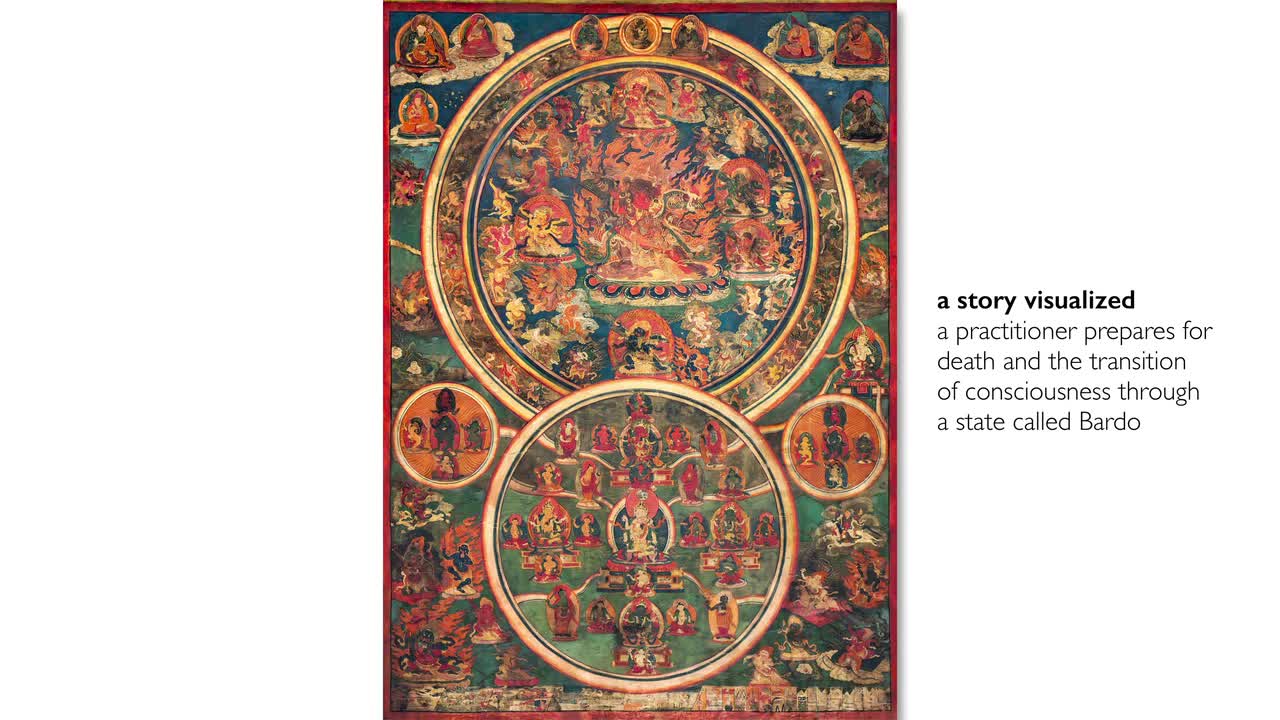
The Thangka as a Narrative of the Bardo
At the heart of Tibetan Buddhist practice lies the thangka, an elaborate painting that serves as far more than mere decoration. As described in the podcast, this specific thangka acts as a visual narrative for the bardo—the "intermediary period after death and before rebirth." The painting is a physical manifestation of the "mental story" that a practitioner must internalize to navigate the transition of consciousness. It is deeply rooted in the 14th-century terma (treasure teachings) revealed by Karmalingpa, collectively known as the Tibetan Book of the Dead, specifically the text titled Liberation Upon Hearing in the Intermediate State.
Compositional Hierarchy: Focus and Distraction
Navigating the complexity of the thangka requires understanding its "compositional structures" and "hierarchy of depictions." The speaker notes that the "most central and or largest images within the painting are the most important ones." These large "rainbow spheres" contain various deities in both "peaceful and wrathful" states.
However, the true purpose of these images is pedagogical. A practitioner uses them to prepare for the moment when "physical senses are being dissolved" and the "subtle consciousness" remains. The goal is to "realize the true nature of the mind" to prevent the consciousness from drifting into "another existence." Interestingly, the most pivotal figures—Vajrasattva and the meditating practitioners—are relatively small. Vajrasattva sits on a throne, acting as the "agent who generates these beautiful rainbow spheres." These spheres serve as both a guide and a test: the practitioner must learn to acknowledge the "clear light" of their own mind without becoming "attached to the peaceful images" or "fearful of the complicated and dynamic and scary-looking images."
The Architecture of the Universe
Beyond the central deities, the thangka adheres to traditional conventions. The "upper portion" is reserved for the "teachers and sources of the practices," while the "bottom corners" house the "protectors of this tradition." These elements anchor the painting within the established lineages of Buddhist practice.
The Six Realms of Samsara
The most striking and distinct feature of this particular work is the "register at the bottom of the painting," which depicts the "six realms of existence." This section serves as a stark warning of the consequences of failing to "break the cycle of samsara." The cosmology presented is comprehensive:
- The Realm of Gods and Demigods: Centered around "Mount Meru," the center of the universe, where demigods are depicted "fighting."
- The Human and Animal Realms: Represented by "houses and architecture" and "typical Tibetan landscape" filled with various animals.
- The Realm of Hungry Ghosts: Portrayed as beings with "very narrow necks" who suffer eternally through their inability to consume food.
- The Hells: Ranging from "hot hells" to "cold hells."
By documenting these realms, the thangka functions as a profound reminder of the urgency of the practitioner’s discipline. It forces the viewer to confront the possibility of rebirth within these states, reinforcing the necessity of using the "profound teachings" to transcend the cycle of suffering and recognize the ultimate clarity of the mind.
Deep Learning with ListenLeap


