I've always wanted to ask you this question.
Do film critics like yourself actually get excited about the Oscars?
I have a love-hate relationship with the Oscars.
I mean, I've watched, I think, probably almost every single Oscar since I was a child.
I often spend the entire time cursing at the screen and speed dialing friends and then cheering wildly when one of my favorite movies wins something you know.
So the Oscars are terrible unless they're right, which means unless they pick my movies, you know.
From The New York Times, I'm Michael Barbaro.
This is The Daily on Sunday.
The 98th Annual Academy Awards are one week from today.
Of the untold hundreds of films that were released in the United States last year, some 50 or so are nominated for Oscars.
And according to critics and industry insiders, those movies are uncommonly good.
Despite all the forces arrayed against Hollywood, it was kind of a magical year.
Great movies were made, and audiences found them.
Mostly.
Mostly.
So, with one week to go before the Oscars, we asked Manola Dargis, the Times' chief movie critic, to come in and talk about 2025's unmissable performances and unskippable movies.
So take notes, even if they're just mental notes, and plan your watching very wisely for the next seven days.
It's Sunday, March 8th.
Manola, welcome to the Sunday Daily.
Thank you, Michael.
It's nice to be here.
This is our first ever conversation, you and I. What took us so long?
Great question.
So if you had to pick a single word to describe this year's Oscar nominees, what would that word be?
One word?
That's the exercise here.
Surprising.
Hmm.
You know, and why it's surprising on some level, is that there are so many good movies that are up for awards.
I mean, two of the movies are the top of my top 10.
You know, centers in one battle after another.
You know, and I think So, you and the Oscars in sync this year.
What happened?
I mean, yes.
So, despite all of the dire warnings and broadcasts and articles that are out there, the movie industry is not dead and moviemaking and movies are certainly not dead.
It's kind of like think of the ending of Carrie when the hand pops out of the grave.
That is American cinema.
You know, it's back, baby.
The industry might be completely a mess, but the movies are there and they're wonderful.
Okay so Manolo, we're here to talk about some of the movies our listeners should definitely plan to watch for the Oscars ceremony next Sunday.
I was thinking that the way we could do that is to talk about some of the frontrunners for Oscars and then some of the actors and the performances you personally loved this year.
So basically, the will win versus should win.
So let's start with the actresses competing for best actress in a leading role.
Who do you think is likely to win there?
Well, I think the consensus is that Jessie Buckley, who plays Agnes, William Shakespeare's wife in Hamnet, that she is going to win.
I think it would be very shocking.
It would be probably the major upset of the evening if she did not win.
What is it about her performance in Hamnet that you think makes her the frontrunner?
Well, it's a kind of classic role.
It's about the woman behind the man.
In this case, the man is William Shakespeare.
What are you writing?
Nothing of note.
It's nothing.
Usually the women are introduced in a movie classically and then they wave at their husband as their husband goes off and has his adventure, you know.
And in this case we are seeing him through her and they fall in love, they have children, they build a home.
Part of the richness of the character is the character goes through all the feelings.
You know, we have the love of the young, sexy man, Will, played by Paul Mescal.
And then we have mother love.
And then we have marital drama.
And then we have tragedy.
So as an actress, Buckley really has to go through every single thing.
And she has to bring us along well.
And she is really the character who is bringing us through all of the different emotional registers.
There's a harrowing birth scene where she's giving birth to her twins.
And the scene takes you through every possible emotion.
You know where you're like oh, someone's going to give birth.
And, oh, what's happening?
She's starting again.
You're having twins, my girl.
And the birth is very, very difficult.
And it seems like it may end in tragedy.
Why is she not crying?
Why is she not crying?
And she takes us through every single moment as her face is contorting.
But there is love and there is also serenity in there.
And that is really beautiful to see.
And then, of course, there is the tragedy you alluded to just a little bit ago, the grief that she embodies.
And it's almost animalistic.
The tragedy which I will address and if people don't want to listen to it, they can, you know, put their fingers in their ears for a moment is that one of their twins, their only son Hamnet, dies while Will is in London working on a play.
And Agnes resents him for being away, even though she was the one who encouraged him to go away.
He was in agony.
And just remember, the Academy loves big performances.
They like really, really big emotions, and they like watching other actors go through it.
Right.
The Academy roots for Shirley MacLaine in terms of endearment, and it always will.
Yes.
You know, if there's snot running down your face, you probably will get an Oscar.
Okay.
So is Jessie Buckley your favorite of the nominated performances, or is there somebody else who is perhaps more deserving?
I'm very fond of Renate Rensselaer, who is a Norwegian actress, and she's in a movie called Sentimental Value.
It's a more subtle and, I think, a more complicated performance than Buckley's, because the character is more complicated.
Well, tell us about the character and the film.
The movie is focused on a family.
The father is a filmmaker played by Stellan Skarsgård.
The camera's here on her.
And this is crucial.
The expression she has here.
And his daughter Nora, played by Renata Renseve, is an up-and-coming theater actress.
I let your children into my home.
He wants to make a new movie and he wants her to star in it and she does not, because they have a very fraught relationship.
So instead, he hires an American actress played by Elle Fanning.
And over the course of the movie, the Elle Fanning character basically tries to turn herself into a version of the daughter.
Maybe I should have a Norwegian accent like Ingrid.
I don't have an accent.
Do I?
And Renata Rensive is just a.
It's a tour de force performance, but it is a quiet tour de force performance.
Talk us through one of these quiet moments that makes this a tour de force performance.
There's a great scene when Elle Fanning's character goes to visit Renata Rensive at the theater where she's doing a play.
Hey.
Hi.
So nice to meet you.
The two women are seated in the auditorium of the theater.
So it's pretty intimate.
But the director does something really interesting.
He puts Elle Fanning in the foreground of the shot.
So she's really close to us, yet she's out of focus, slightly out of focus.
But the other woman, the Renata Rensvig character, she's really crisp.
And she is listening to Elle Fanning talk.
Just keep thinking that he made it.
He made a mistake.
And she's talking about her struggles with the role that the Renata Rensive character should have taken but turned down.
The more that I study her, the more lost I feel trying to be her.
As an actress, Renata Rensive has what I think of as like great emotional transparency.
And we are watching her face ripple with emotions as she listens to the other woman.
So you see her curiosity, her wonder, her difficulty.
And because the filmmaker is not telling us what to think and how to feel, we come to that ourselves.
It's a very beautiful moment, a very emotionally honest moment.
Well, he's a very difficult person.
So in the particulars, these two roles have a lot in common.
Both films have this overlapping focus on the theater.
They both have some real tragedy.
But these are two very different, from what you're saying, performances.
Right.
I mean, if I was going to.
You know, to use an analogy, one is a kind of thundering storm of a performance.
And the other one is a kind of gentle, you know, mist.
And sometimes the rain gets a little heavy, but it's not.
There's no lightning and thunder.
It's a slow reveal of a performance.
Well, Manola, we are going to take a very quick break.
And when we come back, we're going to talk about who is likely to win and who should win when it comes to Best Actor.
We'll be right back.
So, Manola, Best Actor.
Best Lead Performance by a Man in the Last Year.
Who is likely to win that Oscar?
This is such a hard one because it's a really unusually great slate.
I like all of the performances.
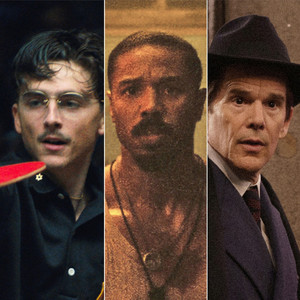
However, if I had to be forced to narrow it down, I would say it could be Timothee Chalamet in Marty Supreme, Michael B Jordan for his dual roles in Sinners, or Ethan Hawke in Blue Moon.
Okay, so what you're telling us is that perhaps our will-win framework might implode a little bit here.
But if that's the case, let's just talk about all three of these actors and their performances, and where do you want to start with them?
Well, let's start with Timothee Chalamet.
And I have tremendous respect for your money and I know it's hard to believe, but I'm telling you this game that fills stadiums overseas.
And it's only a matter of time before it fills stadiums in the United States too, before I'm staring at you from the cover of a Wheaties box.
He's in this movie called Marty Supreme, which is about a table tennis champion.
It's after World War II.
It mainly takes place in New York.
It's very much about someone who is really racing toward his American dream, and he's doing it through table tennis.
He's an amazing, amazing table tennis player, and he hustles on the side for money.
He works in a shoe store.
He's a Completely ruthless.
How could you of all people do this to me?
The way I treat you?
How could I do this to you?
Yes, how could you know what I'm going through?
How could I do this to you?
How about what you're doing to me?
I mean nice boy who impregnates a woman in the basement of the shoe store while he's supposed to be getting an old woman a pair of shoes, short.
Asterisks, man. got to put it with asterisks.
That's what I'm saying.
He's a disreputable character as some of the most interesting characters are.
I mean, it's a very aggressive performance.
And I don't know where we are in this stage of American movie going, but people just seem to have a really hard time with characters who are spiky and barbed.
This is a complicated, interesting movie about what is the American dream for this very specific person.
And in one of my favorite sequences.
Yes, tell us about one.
What does he do?
He goes after the ultimate shiksa.
I mean, you know, Gwyneth Paltrow.
I mean, it's just like I don't even know what her identity is, but she's like She's definitely not Jewish in this movie.
She's playing someone you know, a retired actress who's married an extremely wealthy and disgusting man.
And Timothee Chalamet sees her in a hotel and just zeroes in on her.
Kate.
Hey, it's Marty Mouser.
I'm in the Royal Suite.
I saw you in the lobby yesterday.
Okay.
Yeah, we made eye contact.
I was being interviewed.
And this great scene, he's checked himself into a hotel he cannot afford.
He's trying to get someone else to pay for it.
And he calls her up.
He just cold calls her and starts fast talking.
You know, I'm something of a performer too.
Are you?
Yeah.
You don't believe me?
And we see him and he just looks absurd.
He's standing on his bed in his room, wearing a bathrobe in his boxer shorts and socks.
This is you?
Yeah, the chosen one.
It's a nice picture, right?
And he's just talking a mile a minute, trying to seduce this woman.
And she hangs up on him.
He calls back and he manages to convince her, you know, to meet up.
It's just going to happen.
I'm going to make an apple appear in that bowl.
And if I do, you're going to blow off your little rendezvous.
No, no, no.
I'm not agreeing to anything.
All right, we don't have to agree to anything.
I'm going to do it anyway, okay?
And they do.
Do they ever.
I'll leave a ticket for you at the box office.
It's a very exuberant out there role and exuberant out there performance.
It's a hard thing to play a character this unlikable and not make the movie totally unlikable.
Exactly right.
You really need to bring in some warmth, what they call relatability, and charm.
And I actually think that Chalamet does do all of that.
We're just not used to such abrasive heroes in American movies at this point.
But I think that he's absolutely charming in this film as well.
I have to agree with you.
Let us now turn to Michael B. Jordan and his performance in Sinners.
More time I spend with y'all, the less sure I am you boys are serious about it.
Ain't no boys here.
I just grown men who grown men money and grown men bullets.
In Sinners, Michael B. Jordan plays identical twins through the magic of cinema.
One named Smoke and the other one named Stack.
We've been gone a long time, Stack.
Seven years ain't long enough to forget about us.
It's very seamlessly done and very beautiful.
Love you.
Love you, too.
Be careful.
I will.
And they are basically gangsters and they've returned to their hometown in the Mississippi Delta and they open a juke joint.
There's a lot happening in this movie.
You know, it's a horror movie.
Specifically, there's a you know, there's a vampire, an Irish, an ancient Irish vampire.
And that vampire.
It really embodies kind of a white exploitation of black culture, black cultural history.
You know everything.
And so the movie is incredibly ambitious.
And one of the things I really love about Jordan's performance, beyond the fact that he actually is able to create two very distinct characters and make them work in a very complimentary fashion is that he really inhabits each one and gives each very specific personality.
And Smoke, there's this great scene where Smoke visits his wife.
How you been?
No misery is worth complaining about.
And they haven't seen each other for a while, and they have really very painful, tragic history.
I ain't never saw no roots.
No demons.
No ghosts.
No magic.
Just power.
And it's basically you're watching two people rediscover each other.
How you know I ain't brave?
I work every route my grandmama taught me to keep you and that crazy brother yours safe, every day since you've been gone.
And so what you're watching is a kind of renewed courtship.
You know you're watching two people re-find each other and fall in love again, and then fall into each other's arms.
It still hurts coming back here.
But I love you.
And I'll miss you.
And then it gets, well, smoking hot.
I mean, his name is Smoke, I guess, you know.
Yeah, they have quite a profound amorous encounter.
Yes, it's beautifully done.
And just to say that is one half of the performance, because there's literally two performances in this one actor's performance in this movie.
Absolutely.
Absolutely.
Okay, the last person in our potential likely to win best actor category and he's only playing one role is Ethan Hawke in the film Blue Moon.
Okay, best line in Casablanca.
Nobody ever loved me that much.
Isn't that magnificent?
Six words.
Nobody ever loved me that much.
And really, who's ever been loved enough?
Who's ever been loved half enough?
Would you get me a shot?
So talk about that performance.
Well, this is a movie that largely takes place on one night, a very, very important evening.
It's March 31st 1943 and we are with The lyricist Lorenz Hart who, with the composer Richard Rodgers, wrote a bunch of important musicals like Pal Joey, as well as the title song Blue Moon.
At this point, though, Hart is a wreck.
He's an alcoholic, and Rodgers...
Has a new partner named Oscar Hammerstein II and they have a new musical that Hart has just walked out of, a little thing called Oklahoma.
With an exclamation point, as he repeatedly says throughout the film.
In fact, any title that feels the need for an exclamation point, you want to steer clear of.
There's a lack of vanity here that I love in the performance, because Ethan Hawke has been made to look very sad.
He has a tragic comb over.
He's very short.
They cheat his height all the time.
He looks like he's in a suit that it looks too big for him.
He looks like he at times is literally shrinking before our eyes.
And that actually really almost seems to happen when he has a confrontation.
It's friendly, but it's very needy and needling with Richard Rodgers, played by Andrew Scott.
I remember when I first heard about you, you were just Morty Rodgers' little brother.
What, you were 17?
16.
Yeah, I was 23.
Well done.
Yeah, you were the wise old man in the mountain.
But when I first heard you play your stuff, I knew you were...
We are just basically watching Hart kind of debase himself, groveling, and yet he's so proud.
I'm right here, right now, ready to work.
And you see these warring emotions in Hawke's performance and in his face.
I don't need to go back to doctor's hospital.
And I don't need a psychiatrist either.
Thank you very much, who's we?
You see the face harden, soften, almost collapse in and of itself.
Look, I am sorry.
I don't care if somebody attacks me.
It doesn't mean anything to me.
But nobody can attack my work.
It's really quite remarkable.
Right.
It is...
Such a profoundly sad performance because you're watching someone who believe themselves to be so great and to have such an enduring legacy, recognize that he's been bested.
And it's very, very tragic.
It is.
Yet at the same time there is a lovely kind of restraint, where you're not hit over the head with the tragedy.
You know, Hart is very funny.
He has a lacerating wit.
He is an entertainer.
He wants to entertain and seduce.
So he is leading... with a kind of enthusiasm and a brio.
And at the same time, we can see the neediness and the desperation.
So all of that, that little war is always there.
Hey fellas, just for the record, the corn is as high as an elephant's eye is the stupidest lyric in the history of American songwriting.
Yes, it makes perfect sense.
You know, Hawk is a much greater...
And much more interesting actor than he was when he was cute and didn't have as many lines on his face.
Some of us, you know, we improve with age, you know.
His history is in his face.
The lines, the age, what he's been through as a human being.
Huck is basically tapping into all that and then adding his interpretation of this man who is soon going to depart this earth.
Right.
Right.
Well, because I would like to maintain some version of the will versus should construct here.
Who do you think should win of these three?
I really would like, it's more about what I like, would be Ethan Hawke.
I think it's a magnificent performance.
But I also think that Michael B. Jordan is wonderful.
I don't.
You know, it's one of these times which, just again, because it's such a rich group of performances that you know it's very, very difficult to do our usual binary where we should, you know.
Let's take a break.
And when we come back we will talk about the main event, the last award or the second to last award of what is always an incredibly long evening, which is Best Picture.
Manolo, we are now at the best picture phase of this conversation.
And you had mentioned earlier that this was a year when big studios took over some big risks.
And two of those risky films which you had mentioned, One Battle After Another and Sinners ended up being films that you really like as a critic, which is pretty great on top of the fact that both did quite well at the box office.
So let's talk about these two films as best picture films.
And I think because we already talked about sinners, let's start with one battle after another.
I said I got HMEs.
I got mortars.
I got tear gas.
I got whatever you guys need.
But I'm unclear as to what the plan is.
I need some direction.
Don't be unclear.
We got a plan for us.
This is a Paul Thomas Anderson experience.
It follows a group of would-be revolutionaries, including Leonardo DiCaprio, who's actually wonderful in this movie.
And he plays Bob.
Bob is a total burnout.
You know, he's just basically drinking and getting stoned on his couch while he's raising his daughter, Willa.
How did you get home?
Well, with my car.
You drove home?
So what are you, my babysitter?
What, what, what?
Yeah.
I know how to drink and drive, honey.
I know what I'm doing.
He has a nemesis, played also a wonderful performance, Sean Penn, who basically goes after them.
And we follow Leonardo DiCaprio's character as he basically goes underground and tries to rescue his daughter, who's been taken, and he doesn't know where his daughter is.
Do you have her phone number, man?
No.
Everybody knows she has a phone.
Everybody knows she has a... Why didn't she tell me she has a phone?
Maybe she didn't want you to get mad.
No, she's not allowed to have a goddamn phone.
No, maybe she didn't want you to get mad.
I don't get mad.
I don't get mad about anything anymore.
It's a really shocking movie in some ways, because it is about people who believe that there is a better America and are fighting for it.
But they're actually.
Some people would characterize them as terrorists, other people would just call them as revolutionaries.
And I think that one of the reasons that it really kind of grabbed audiences is it seemed to be speaking about to conflicts that we are all reading about.
I guess there's about 250, 275 people in there.
It's hard to count.
The opening sequence you find begins with a bunch of revolutionaries basically rescuing some people who have been seized by the United States military.
And I just remember when I first saw the movie, everyone got really, really quiet in the audience.
I think everyone was shocked because it felt like you were almost watching a dramatization of something that had just happened yesterday.
Mm-hmm.
But for all that seriousness, it's also a rather goofy movie at times.
Oh!
Gloriously so.
I mean, it is not a solemn eat your vegetables movie.
You know, it is a movie that is kind of suggesting that the other side of tragedy is comedy that, however tragic this can seem, it's also goofy.
There's a great scene where DiCaprio's character is now on the run.
He is trying to connect with his old comrades and he makes a phone call.
Rise and shine.
Ahem.
Pat an eyelash.
Good morning.
There's a series of codes and he forgets what he's supposed to tell the other person.
What time is it?
Ah, fuck.
You know, I don't remember that part.
Let's just not nitpick over the password stuff.
Look, this is Bob.
He can't remember, man.
It's been so long.
I only remember half of this shit and this stupid fucking hotline, which is a fucking miracle.
So stop fucking with me and give me the fucking rendezvous point.
Well, maybe you Man, I just can't remember.
I just need... And it's gloriously funny.
Call us back when you have the time.
Did you just fucking hang up on me, you fucking liberal fucking prick?
Okay, so that's one battle after another.
When it comes to Sinners Manola, since you've already extolled its virtues through the performance of Michael B Jordan, I wonder if you can talk us through a scene or a dimension of the film beyond that performance that helps people understand why it may win Best Picture.
Hold on, hold on, hold on.
Tell me who you are, where you're from.
There is a scene in the middle of the movie that I think is a masterpiece.
And I think it really displays Coogler's cinematic genius.
And part of what makes this movie so moving, because it's not just that it is an entertaining movie.
It's an extremely rich movie in terms of how it is dealing with history.
Mm-hmm.
It's a scene where we're now the joint is open and there's a young bluesman named Sammy and he starts to play a song.
And the camera starts moving around the room as he is singing.
And suddenly you hear a little bit of electric guitar playing.
And then you see somebody who looks like he could be out of a 1970s funk band.
And then the camera just keeps on going as this blues song is playing.
And you see b-boys, you see a DJ at a turntable.
You actually see a modern ballerina time and space kind of collapse and you get a sense of the great arc of history that takes us from Africa to Mississippi and all of the culture and all of the people that have led us to this moment and are pointing us toward the future, where a young filmmaker named Ryan Coogler will pick up a camera and make one of the great American movies.
Part of what's so interesting is that Sinners and One Battle After Another, are two movies that are speaking to the American experience in a way that American cinema doesn't necessarily do, particularly from the big studios.
These movies feel urgent to us, you know?
I mean they feel really urgent to me and they really seem to be speaking about what it is to be an American right at this moment in time.
And I think that's part of why audiences have been so receptive to them as well.
Right.
So in both Sinners and One Battle Left for Another, we've been talking about films that a lot of people saw.
I wonder, to end our Best Picture conversation, if there is a nominee that maybe wasn't as big of a hit, but something that you think our listeners really should see and understand?
Oh, well, it's The Secret Agent, which is a Brazilian film from one of my favorite directors.
And also, I just want to say, former film critic, Cliber Mendoza Filho.
This is a movie that opens in 1977 during the military dictatorship.
And we are following a former professor who has basically gone underground.
One of the absolute delights of this movie is that you, I can guarantee you will never know what is going to happen next, which is just absolutely so welcome.
It goes from moments of outrageous violence almost kind of burlesque comedy.
There is literally a severed leg jumping around and kicking people in this movie.
But it's also about what is it like to live under oppression, political oppression.
And it's about coming together with like-minded souls in order to survive.
It's very moving on that level.
He is a wonderful filmmaker and people should really check this movie out.
So Manolo, when you look at this slate of movies, and particularly these movies like Sinners and One Battle After Another, what do they leave you feeling exactly about the always in jeopardy future of Hollywood?
Well, I think one of the things that I would hope is that movie executives would look at this lineup and look at the success of these movies and say, gee whiz.
Actually, maybe people want movies that are very well made and say something about the world that we live in.
Maybe actually we don't want to watch movies that are completely divorced from reality, the way that so many American you know the big blockbusters often are.
I think it would be really nice if the movie executives got in line with the movie audiences at some point.
I feel like this is going to be the first Oscars in a very long time where you may not actually be screaming at the television.
I can always call you, Michael, and start yelling if you need me to.
I am available for speed dial anger, you know.
Well, I really can't wait for that.
Manola, thank you so very much.
This was a real treat.
Today's episode was produced by Alex Barron, with help from Luke Vander Ploeg and Tina Antolini.
It was edited by Wendy Doerr and engineered by Sophia Landman.
It contains music by Dan Powell, Pat McCusker, and Marion Lozano.
Our production manager is Franny Carr-Toth.
That's it for The Daily on Sunday.
I'm Michael Barbaro.
See you tomorrow.