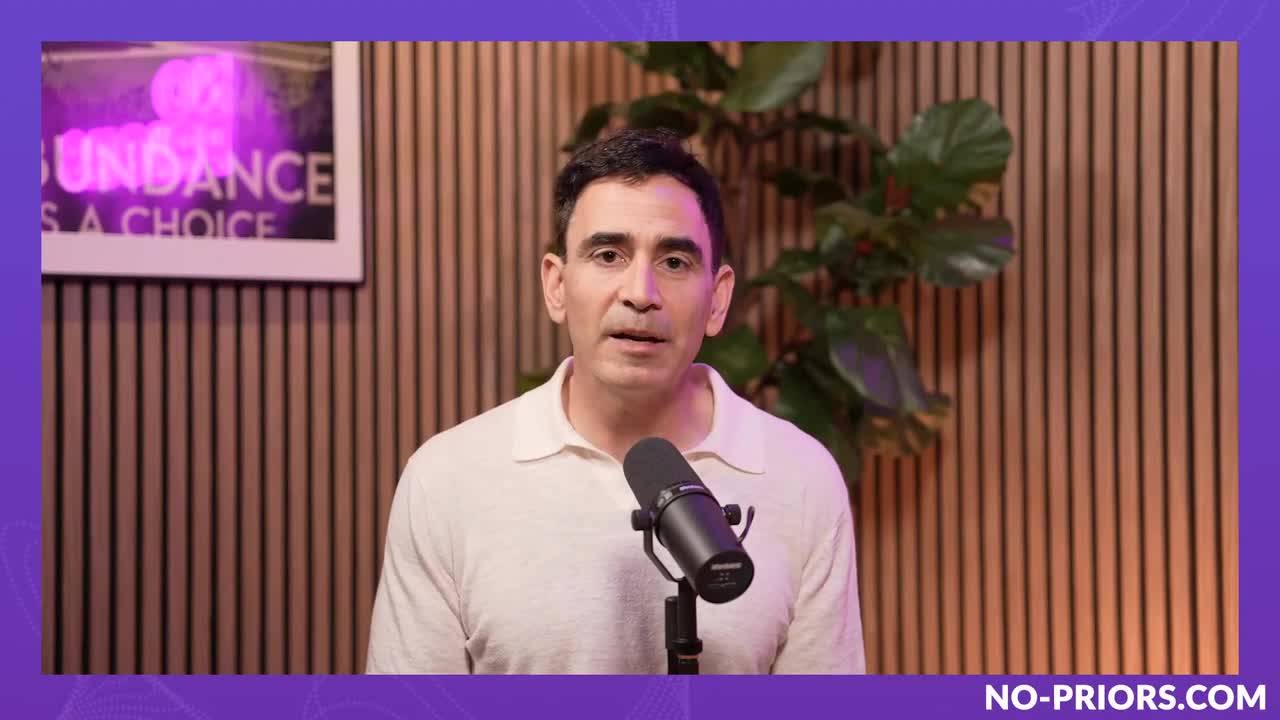
Today on Repriers, I'm joined by Zach Dell, the founder and CEO of Base Power.
Base just announced a $1 billion fundraise from folks like Addition, Thrive, Andreessen Horowitz, Lightspeed, Altimeter, Valor and myself.
Zach previously was at Blackstone working in different private equity and Thrive doing investments in various AI and software companies.
Very excited to talk to him today about not only his company but also, more broadly, about the energy industry and how energy is an input into literally everything that we do and consume.
That's AI data centers.
That's the pencil you're using to write.
That's your computer.
That's mining.
That's basically everything in the world.
Energy is a major input.
So very excited to talk with Zach today.
Zach, thank you so much for joining me today on No Priors.
Thanks for having me.
Energy is an input into everything in the world that's produced, right?
It drives data centers.
It drives electric cars.
But it also drives all of manufacturing.
It drives the internet.
It drives basically every aspect of our lives.
And it's a key cost input into everything.
So if you have very cheap energy, everything else becomes dramatically cheaper.
And that opens up entirely new spheres.
You've been working on base energy, excuse me, base power for a couple of years now.
Can you tell me more about how you landed on what you're doing and what Bayes actually does?
Yeah, our mission is to lower the cost of electricity for all.
And we think that is the most powerful thing we can do to promote human prosperity.
So to create a world of energy abundance where power is less expensive and more reliable.
So I got here by way of finance world.
So I started my career at Blackstone.
I was on the private equity team there.
I spent a couple of years at Thrive Capital investing in technology companies and then left Thrive, ultimately to start the company with my co-founder, Justin.
And I think at those firms I was able to see a lot of the industry, the value chain of energy, of different kinds of technologies like solar and storage, and see this kind of paradigm shift unfolding where, If you look at the last five decades of energy it's really been defined by coal and then natural gas.
And it seems pretty clear now that, based on where the cost curves are going, the next five decades of energy are going to be defined by solar and storage.
And there's really no energy technology platform company built around that thesis.
And so that is really the kind of vision and the idea around which we started the company a couple of years ago.
And you just closed literally a billion dollars in new financing, which I think brings your total over time to 13 billion.
What is that money going to go to?
What products do you provide?
What services?
What are you currently doing?
Yeah, so the capital really is going to accelerate our vertical integration, which allows us to ultimately lower costs for consumers.
So our strategy at the highest level is to develop a compounding cost advantage through vertical integration.
So we design batteries, we make them like, literally manufacture them, we install them, own them, operate them and we sell power directly to a homeowner.
So to answer your second question specifically, When you sign up with base, we become your electricity provider.
So today we're only available in Texas, where now we sell power to deregulated customers who can choose their electricity provider.
And then we do sell our technology to the regulated utilities in Texas.
And then they offer our services to their customers.
So when you sign up with Base, we install our battery on your home.
When the grid's up and running, we use that battery to serve the grid.
When the grid goes down, you get that battery to back up your home.
And we're able to save our customers on the order of 10 to 20 a month on their electricity.
So as we invest further, as we build new generations of the technology, our costs will go down, our returns will go up.
We'll be able to share those returns, so to speak, with the customer in the form of lower and lower prices, driving the price of of the electron down, driving the availability or the reliability of the electron up, which is really our mission.
And so you basically have these batteries you install in people's homes.
It's a sort of smart battery, so it can interact with other batteries across the network.
And it basically responds to different power, availability and fluctuations and allows you to then make money off of that.
Exactly.
Yeah.
Another way to think about is we're building the world's largest distributed power plant, right?
So we install these energy assets all over the grid and we use software to connect them effectively and bid them into the market intelligently.
And we use all the income that we generate from that to drive down costs for our customers.
How did you decide to work on this problem in particular?
Like you, had a great vantage point working at Blackstone and Private Equity, which is a generalist team at Thrive who've done investments in companies like OpenAI and Stripe and others.
And so you've seen like a wide swath of the world between those experiences.
What honed you in on energy in this particular Yeah, it's a great question.
I mean I first got really fascinated with energy in college and actually worked on a project in energy space there and actually worked on a number of projects.
One in particular was to develop a solar farm and put panels in the ground and sell the power back to the local utility and do it in this very kind of financially engineering oriented way.
And so I'd been studying the energy value chain, so to speak from a finance perspective, for a long time.
And then I think at Thrive, I was exposed to this pattern match of companies that were going after big incumbent dominated industries where the leader in the space was not technology focused, engineering led or RD driven.
And it happened in autos with Tesla, it happened in aerospace with SpaceX, it happened in defense with Anduril and it wasn't being done in energy.
And turns out energy is the biggest industry of all of those, and it's the most important.
And so I was really inspired to go build that modern power company of the electric era, engineering led, technology focused, RD driven and what I think is the largest and most interesting category in the economy.
And as part of that, you had to build a very multidisciplinary team.
You have people working on hardware, you have people working on mechanical engineering, on software, on a variety of things.
What was the founding team like and how big are you now?
What sorts of people?
Yeah, this business is a complex coordination problem.
We have to be good at a lot of things at the same time.
And so the way to buy down execution risk, so to speak, is to build a world-class team of people across a bunch of different domains.
If you look at myself and my co-founder, we have very different skill sets, right?
Justin is very operational and technical.
He led manufacturing at SpaceX.
He led manufacturing at Anduril.
Our first hire, Jared Green, our head of software, led the laser topology team at Starlink.
So the team that built the mesh that connects all the satellites in space.
Not only is he a world-class software engineer, but he understands firmware and mechanical engineering and power electronics.
And our next couple of hires.
You know Cole Jones, our head of growth, who ran go-to-market at Starlink.
Dana Paz, our head of deployments, who led manufacturing engineering at Anduril.
And some other early team members.
Suzanne Dang, who ran procurement at SpaceX for 10 years, our head of supply chain.
Andy Ross, our head of manufacturing, who led Model 3 battery manufacturing at Tesla.
Dino Sassaridis, our head of hardware, who led Powerwall Engineering at Tesla and worked on the design of the Powerwall 3.
So we've been able to pull together an incredible group of people with domain expertise across all of these different functions.
And I think one of the really special things is that, if you think about those five, six leaders of the company, like all of them were part of our first 10 hires, right.
And so, as we went from 10 to now 250 people, To answer your other question, the culture of the company is really defined by those core leaders and those people who are now leading teams.
They were once the IC.
They were doing all the IC work.
And now the leaders are still doing IC work.
I still do IC work every day.
So does Justin, as you know.
And so it's a big part of our culture to kind of lead from the front.
And we were able to pull together a really incredible team.
That sounds like an amazing.
Are there specific areas that you're hiring for right now or looking for key talent in?
Yeah.
So as part of our announcement, kind of the big theme here is join the charge, right?
It's a call to action to the most talented engineers, operators and creatives in the world to come join us on what we think is the most interesting, exciting and important mission out there in technology right now.
And so we're really hiring across all teams software hardware finance, go-to-market business development, regulatory policy, deployments engineering, manufacturing engineering.
Specifically, some areas where we're really focused right now are firmware, power electronics, mechanical engineering, design engineering, all kinds of software engineering basically everything from very low-level firmware to front-end, to back-end and cloud engineering and everything in between.
So right now, as you noted, we've raised 1.3 billion in the last 18 or so months.
We've got more demand than we can serve.
We're standing up our first factory in Austin to produce our product at really large scale.
And really the constraint is great talent.
And so we want to put the word out there that We're open for business and we want to bring more great people down to Austin to join our team.
How did you inspire such heavyweights to join you to act as ICs early on?
Because often I think founders struggle with both what's the seniority of people to hire as well as how to convince somebody who's actually led a major part of SpaceX or Anduril or one of these core companies that are still growing like crazy themselves.
How do you convince people like that to join you so early?
I think it's pretty obvious that the best people want to work on the hardest problems and the biggest, most important mysteries.
Right like very capable people want an opportunity to put a dent in the universe, and what we are going after impacts the whole planet.
It impacts industry.
It impacts homeowners.
It's very visceral.
People think about you know well, my power bill has been going up every year the last ten years and my power outages are becoming more frequent than they've ever been.
Like, this is a problem that actually needs solving.
And then look, I think the best people, really largely, or most people, are looking for three things.
One is they want to have fun at work.
They want to do interesting work.
They want to work with smart people that are nice to be around.
They want to be pushed.
They want to be challenged.
Number two is just a massive kind of never-ending list of hard problems.
I think you see at companies you know hire a bunch of really great people, come up with a bunch of really awesome things.
And then over time they kind of struggle to retain the top talent as the problems become less and less interesting.
If you peek under the hood at a base which you have, you know, with the best of them, you'll see that the list of hard problems to solve is really mind blowing.
And we kind of unlock the ability to solve new problems as we enter new markets and release new products.
And the energy space is big and it's complicated and it's hairy.
So it's a massive bucket of hard problems to solve.
And then, look, I think the third is economic upside, right?
You know we're going after what we think can be one of the largest, you know opportunities in the economy, one of the biggest companies in the world.
And, you know, if we're successful, you know, it's going to it's going to be very big.
And so there's a really exciting upside case there for top talent.
So, as we were discussing earlier, energy is one of the most important markets for humanity, or most important industry is because it drives everything else.
And it drives the cost of everything, from AI to the car you're driving, to the pencil that you use to write, et cetera, because it's an input into everything.
Projections that we were discussing earlier said that the demand for energy may be going from a 2 compounded annual growth rate a year to closer to 10.
And so the question is, how do we actually fill the supply side of that?
Where does all this new production come from to make sure that those needs are met?
A, do you think those projections are correct?
And B, how do you think about how we solve for that?
I do think directionally the demand projections are correct.
And I think that, or actually potentially understated.
I think there's a massive amount of electricity demand coming.
Now, how do we serve it is the question.
You'll hear people talk all the time about, oh, we're running out of energy.
We have no energy.
That's not really true.
We're not using the energy that we have in the most effective way possible.
And another way to think about it is, you know, the US grid kind of max peak is somewhere in the order of 700 gigawatts.
But average demand across the country is closer to like 300 gigawatts, right?
So we've got another 300, 400 gigawatts, you know, up to 700 gigawatts if you believe that.
You know that peak is going to grow to a terawatt of latent capacity.
And you know the way to access that capacity is by time, shifting electricity right using batteries and software.
And so you know we think that our technology layer is going to unlock a bunch of latent capacity on the grid.
Help us meet that demand.
But we will also have to build more generation.
Right.
And there's tons of smart people and interesting companies that are working on.
What do you think are the most promising aspects of generation?
So, I mean, I think we've seen a lot of this progress happen in solar, right?
The solar cost curves have been, you know aggressive, to say the least, and they've played out right.
And now the cost has largely been driven by Chinese subsidies, because I know the Chinese government subsidize a lot of very early solar production.
It's been.
It's been driven by CapEx.
Yeah, it's been driven by CapEx.
A lot of the CapEx has been subsidized by the Chinese government and through Chinese companies.
A lot of CapEx has come from U.S. companies and companies in Europe.
And so it's been driven by CapEx.
I think, you know, solar will continue to get cheaper to deploy.
Batteries will continue to get cheaper to deploy.
And I think Texas is now the biggest deployer of solar.
Is that correct?
Solar and wind.
And wind.
And it's interesting because I was looking at these cost curves or projections and it looks like solar is now a couple of years ahead of where people thought it was from a deployment perspective.
Do you know what percentage of the U.S. market is now solar in terms of actual energy production?
It varies a lot by state.
Texas is about 20% right now in the fuel mix.
And it's on the higher end.
I think California is higher, closer to 30.
And you have states like New Mexico, Nevada, Utah, Arizona that are up in that range.
I think you pointed out to the... Sorry, go ahead.
Well, if you look at the map of the US and you map solar penetration as a percentage of a fuel mix, it pretty closely maps like where the sun is right.
A ton of solar in the Sun Belt and you don't have a ton of solar in parts of the country where sun is less prevalent now.
As the cost of land, solar and storage on the grid goes down, I think we'll kind of turn on, so to speak, other geographies where solar used to not make sense and now it does make sense.
But there's tons of investment going into other forms of generation.
Nuclear obviously has been a topic of conversation across the country and I think there's a lot of great work happening there, but right now it's too expensive.
Do you think it will credibly take off?
Because I looked into the cost structure for nuclear before and there was two or three drivers.
One is honestly just environmental delays and the cost of debt as you get delayed.
And so you have these big project financing things that you raise money for.
And then, if you're delayed a couple of years, the costs go up so dramatically that it makes it an uneconomical project.
And because people are so used to these delays, they always build giant projects because they're like, if we're going to take the hit, we'll take the hit big.
People are now moving towards these smaller, more modular reactor systems.
Do you think that will actually credibly take off?
Because solar was never an issue of safety.
I mean, nuclear was never an issue of safety.
It was never an issue of some aspects of cost.
I mean again it was.
It was almost like these imposed delays through environmental lobby or nimbyism or other things that often seem manufactured.
But do you think it's kind of dead in the water going forward?
I don't think it's in the water.
I hope it takes off.
I think it has to get a lot cheaper and has to get a lot faster.
My opinion is that the rate of solar deployment will go up so fast as the costs continue to go down that it might just not matter that it'll be so easy and low cost to deploy solar and storage that the economics of building nuclear reactors just won't make sense.
And is storage really the core component of it?
Yeah, because i mean you have to.
You know, the sun is only shining so many hours in the day right, so you need uh, you need so storage to to, and that's because you can't really transmit like long distances on the grid right, and so i think well, you can, but there's transmission costs yeah right, and so what the the?
What matters is the landed cost of the electron, And so solar and storage is the way that you get that landed cost down.
And I hope that we're able to come up with breakthroughs in nuclear to drive down the landed cost of a nuclear-generated electron.
But right now, we're not in a world where it's really competitive with solar.
But at base, we are fans of all kinds of energy generation.
We're really more competitive, so to speak, with poles and wires than we are with solar wind nuclear geothermal hydroelectric, et cetera.
Batteries move energy through time, right?
Poles and wires move energy through space.
If you're generating all your electrons via a nuclear reactor, you still need to move that power right, because unless you have reactors everywhere in everyone's backyard which you know i don't think is all that likely you have to have a lot of these reactors everywhere.
You need to move the power.
You have to match up the generation of the power with the you know the supply with the demand right, and so we think having storage demand side really helps you.
So you're basically really moving from a centralized grid to a distributed grid.
Correct.
And that's the core insight of what you all are doing.
And to your point, solar is the best way to create that core insight for energy generation in general.
That's right.
Yeah.
And you'll see us, over time, come out with new products that are distributed in manner technology defined, that help us lower the cost and increase the reliability of energy.
If you look at a lot of the things that people talk about as things that open up, with um, lower energy or open up entirely new markets i mean one is just ai and data centers.
With these massive buildouts, we're gonna need energy for them.
There's things like desalination like you should be able to produce water anywhere where there's like um, an ocean or anything else.
Yeah, green hydrogen electrolysis uh, i mean the cost per megawatt, per kilowatt, is a is an input to all these processes.
And as we drive that cost down, you know, take decolonization, for example.
Right now it's kind of an emergency use case every once in a while thing.
If it was five times cheaper, like this would be something that we did all the time in lots of places.
Now, again, geographically, geographically defined, where do you have saltwater?
Where do you have it?
But you know, we'll see a massive boom in large scale infrastructure technology projects as we drive down the cost of electricity.
And you know boring stuff too, like heavy industry and uh building.
You know refineries and uh things like that that really matter, that keep the economy going.
We'll just see more of it as we drive down the cost of electricity, and do you think those will all centralize next to cheap energy or g power?
It's nuanced.
I think at the limit.
Yes, more of the highly capital, intense energy dependent use cases will go towards the low cost energy parts of the world.
And I do think you'll have energy hubs where there's a ton of highly available, low cost power and a bunch of heavy industry goes there.
But, as you know, there's nuance in all of these things and there's technology, There's geographic implications here, where it's like well, you need X, Y or Z in X, Y or Z place because of this other reason that it does not have to do with the cost of electricity.
So I think largely it will concentrate to low-cost electricity places.
What do you view as the low-cost electricity places of the globe today?
Right now, unfortunately, it's China.
And we got to make the United States.
Is that because of solar?
Is that because of nuclear?
It's supply and demand.
It's because they built out a massive amount of supply.
And it's all of the above, right?
They built nuclear reactors.
They built solar farms.
They built wind farms.
They built a ton of battery storage.
They have tons of high voltage transmission.
And so our hope and really what we're working on is kind of stimulating this build out of the US.
I think Texas will be a low cost place to build energy technology, but build all technology due to the cost of energy.
And I think other parts of the country will pop up as energy hubs as different states and policymakers and regulators really embrace that.
Okay.
And then one thing that I've heard some people talking about increasingly is if you look at the cost of energy and then you look at the overlay regulation, especially relative to AI, it suggests that a lot of the big at least training center build-outs, where you take a bunch of data and you train a new model on it, are going to basically happen in the US and the Gulf.
They're not going to happen in Europe because of rising energy costs, as well as because of some of the extra regulations.
It's not going to happen in parts of Asia because of security or other concerns.
Do you think that's a correct view of the future in terms of most AI training is just going to be in two parts of the world and they're going to be effectively a US domain?
I think the highly energy-intense workloads will converge around the low-cost electricity places.
You'll see a lot of that go to the Gulf.
You'll see a lot of that go to Texas.
And you're seeing that now right with Stargate and Abilene and all the big projects that have been announced in the Gulf.
So I do think that that is likely to continue playing out in that way.
And then, what do you think are the biggest drivers of future energy adoption from a technology perspective?
And then I'd love to get your perspective from a regulatory perspective.
You mean what will drive more build out of energy technology?
Like what's lacking today, or what technology is most promising, or what do you think are the most interesting shifts happening from?
Yeah, I mean, besides what you're talking my book a little bit.
I think batteries are the key.
Batteries are the unlock to the energy transition and will continue to drive out cost uh, both the hard costs and the soft costs.
Right, i mean you have the cells and the modules and the power electronics and uh, the bus bars and the current collectors and all the things that go into a battery.
But then you have the epc, you know, getting the battery in the ground, the logistics, the transportation, all the software that goes on top of it, monetizing these assets, and there's costs to attack in all parts of the stack.
And so I think that battery storage will define the next chapter of the energy transition.
And I'm super hopeful that new kinds of generation will break through as super economic.
And I hope that breakthroughs happen in nuclear.
There's some interesting companies working on geothermal and hydroelectric and I think that has a lot of promise.
But as we discussed, energy is a geographically defined problem in parts of the Pacific Northwest.
And in Canada, where there's tons of hydro, it makes a ton of sense to use that as a generation type.
In Texas, you don't have a lot of that, but you do have a bunch of wind and a bunch of solar.
And so I think it'll look a little different in different parts of the world.
But really, another way to think about this is like, look at the cost of an electron, right?
Basically anywhere across the country, the cost is really made up of two components.
One is the cost to make the electron.
The second is the cost to move the electron.
The cost to make the electron has gone down really significantly over the last 20 years, largely driven by the build out of solar
But the cost to move the electron has gone up very significantly because our infrastructure is aging and utilities have this kind of perverse incentive structure to build instead of innovate.
And so costs are going up.
You know the generation technologies solar wind nuclear hydro, geothermal.
They're really attacking the cost to make it.
We're really tackling the cost to move it.
This one's going down already.
This one is going up.
So I think most of the opportunity is to innovate and to drive out costs, which really all that matters in the commodity industry, which energy is, is opportunities around transmission, distribution of power and driving those costs down.
Could you talk more about the incentives that exist for utilities and why uh, the costs of transmission are actually going up versus down?
Yeah um, utilities are, are regulated monopolies uh, and the way that the regulated entities work is that they earn a, a rate of return, a predefined rate of return on the capex that they invest and that's set through some regulation by the public utility commission, typically uh, in in the given state, and so, and this is kind of all governed by uh, first the federal energy regulatory commission outside of texas, which is not governed by first.
So it's just some complexity.
What is the reasoning behind regulating the rate of return that a utility can have, like why don't they want it to be higher?
Well, they do want it to be higher and they often argue that it should be higher.
I mean, there's a big history lesson here which is kind of how the grid was built on the early 1900s.
And then world war ii and the fed basically asked all the the grids the eastern interconnect and the western interconnect in texas to to connect and, and texas basically said no, we're going to have our own grid.
And then, you know, urquhart was born in the 70s and the late 90s or early 2000s bush and rick perry and and uh um some, some other cowboys in texas basically said hey, we're going to have a competitive industry, we have a competitive market, we're going to deregulate this thing, we're going to invite competition, we're going to open it up to price signals.
That's why you saw so much investment in the early 2000s.
That happened in texas specifically.
Why didn't that happen in the rest of the country?
Well, it started in California actually, and then in Iran happened, and that that put it into that pretty quickly.
But Texas carried the torch.
And so you had a massive build out of solar and wind in Texas in the early 2000s.
And I think that was really constructive for the industry.
And, you know, will that happen in other parts of the country?
I don't know.
I think there is reason for regulation in some parts of this.
And you know, if you have neighborhoods like it doesn't make sense to have seven different power lines running through the neighborhood, right.
It's like you should have shared infrastructure to some extent, but it's an old, highly regulated.
I mean, it's really the only part of the economy that is still regulated in this way, right?
If you look at trucking or airlines or telecom, you know all of these industries deregulated over the last 50 years, except electricity.
What do you think prevented it?
I think there's some, just like market fundamentals that we talked about around.
Like you know, don't have more than one wire going to your home, kind of thing.
Partially just the difficulty of building out this infrastructure.
I mean, the grid is the most complicated engineering machine ever built.
It is a wild, wild system.
And maintaining it and expanding it is really hard.
And so I can see why it makes sense to do that in a kind of concentrated, or at least regulated, centralized way.
But there are other parts of the country that have some amount of retail competition in the Northeast and you are seeing some, you know more, more innovation happen in those areas.
What do you think are the regulations that are most prohibitive in terms of our energy future?
So, if you were able to remove two or three regulations, what would they?
Yeah, i think uh, we got to make it way easier to permit building energy technology like we need.
You know, we talked about demand going up.
We need more supply, right?
Well, what's holding back supply?
A lot of it is permanent, just like interconnection.
Queues need to go be shorter, permits need to go faster.
That, I think, is one of the biggest things.
And then the bottom point I'd make is exposure to price signals, right?
Like more competition.
You know, markets are reasonably efficient and giving market participants access to price signals such that they can, you know, monetize flexibility.
And really what I mean by that is, if you're able to move when you consume power, around when power is available, you should be compensated for that.
Right.
And that's not really the way the industry works today.
And I think it hopefully will move in that direction.
What are you most optimistic for or thinking about from a positive perspective for the energy future that's coming?
I'm a pretty optimistic guy by nature, and I really am inspired by and believe in human ingenuity.
Over the last 50 years, the electricity industry has not been the place that the most talented engineers and operators have gone after school or breaking into their career.
It's not like, I'm going to go work in electricity, I'm going to go work in utility.
So I have a ton of optimism that comes from this idea that the nation and our kind of really talented young people wake up to the idea that this is an incredibly important problem and we need to send our best and brightest to go work on it.
And I hope a lot of them come work at base.
But I hope other companies get started in this space to attract the best and the brightest to come solve these really hard engineering problems in the category in in the energy space to help drive cost down and reliability up.
So i visited your office a few times now and um, one of the things that really stood out to me is the energy that you feel is no pun intended.
As you sort of walk around, everybody seems very motivated, very driven, very on it and it's kind of like a buzzy space and culture.
How did you guys?
Was that purposeful?
Did that just happen through the people that you hire?
Like, how did you approach that?
A bit of both.
I think culture largely is the people that you hire and those people define kind of the early culture.
And then you can, it's a bit of nature and nurture, right?
You can kind of tend to the culture and make sure it gets better and moves in the direction you want it.
And so I'd say you know the things that we really value as part of our culture.
You know, the first thing that comes to mind is working with urgency and focus right.
And I think it's really easy to have urgency without focus.
And companies often get themselves into trouble by, just like you know, the whole 996 thing and they're like yeah, we do 996, we probably do more than 996, but we don't really talk about it in that way and it's like just kind of natural to how we operate but we have an extreme focus and we ruthlessly prioritize the most important things.
Everyone at the company knows what the north stars of business are.
They know how the thing they're working on ladders up to the north stars.
We talk about our business very openly.
So you know, as you've seen, team has lunch and dinner together.
Lunch dinner table conversations are really about like our long-term vision.
Where are we going?
What kind of new things should we be thinking about?
And you know, you walk around the office and the place looks like a Best Buy because there's just TVs everywhere, as you've seen right.
Metrics everywhere.
All the stuff that matters to the company is visible for everyone to see.
And so that gives you a level of focus where it's like, if it's on a TV, it must matter.
And if it's not on TV, it probably doesn't matter, right?
And that really helps people prioritize.
And then I think you know we try to be an organization that people yeah, I say the word organization that kind of makes my skin crawl, right.
Like, we try to be small and lean and nimble, but as a group we seek and give feedback right to each other.
And we're really open with each other.
And it's a very flat structure.
You know, I sit next to and work with interns all the time.
And you know there's not like a oh managers manager, manager kind of concept where people are very open with each other.
And we really invest in young talent and try to train them directly with like very quick kind of open, direct feedback.
And that has helped a lot of us, including myself, level up in a very short amount of time.
A lot of us are young and largely inexperienced, and so we learn from each other kind of in real time.
And I think, you know, we think about our business as a as a competitive endeavor, right?
Like we are competitors and we are here to win.
And we frame a lot of the stuff we're doing in terms of competition.
And we're not afraid to say that.
And we're very proud of that.
And I think that's a very unique part of our culture.
And the last thing I'll say is we like to have fun.
And, you know, we like to laugh and smile and high five and make jokes.
And, you know, we take our work very seriously, but we don't take ourselves too seriously.
And I think people love being a part of that.
They want to have fun at work, right?
If you're going to be there, you know, five, six, seven days a week, like you better be having fun.
And so over the last 18 months you've raised 13 billion.
I think 1 billion just now that you're announcing.
And it was from a real who's who list.
It's Thrive, Valor, Addition, Lightspeed, Altimeter, A16Z.
I'm lucky enough to or me and my firm are lucky enough to be involved.
And I think the fact that you have this private equity and investment background means that you view the lens of capitalization, how you raise money for a company, very differently.
And that's not only the traditional venture money, which you sell shares in the company in exchange for cash, but also using debt or other more complex structures relative to what you're doing.
So i'd love to hear more about how you think about that.
Yeah, so we are in a highly capital-intense industry and our ability to access low-cost capital is a real competitive advantage.
Said differently.
If you and I are building a thing to go sell to someone else and you have to pay 10 interest on the capital to build the thing and I only have to pay 5 interest on the capital to build that thing, I'm gonna have more money left over, I can charge less for the product and I can out-compete you, right?
So in this endeavor we have to figure out a way to access really low cost capital over time.
But there are different kinds of capital, right?
So when we make investments we invest in operating expenses opex, which is the cost to run the business day to day, pay the engineers, pay the rent, buy the snacks, that kind of thing.
And then we have uh, capital expenditures capex, which is really the large investments we make in batteries and inverters and manufacturing lines and all the inputs to go into those things.
On an operating basis.
On the OpEx side, we have a pretty clear path to operating profitability and actually near-term timeline, because the business generates a lot of cash and revenue and our operating base is low and we're quite efficient.
And so we can that part of business can be profitable quite quickly.
And then on the capex side, our ability to raise and deploy low cost capital here is just a massive, massive competitive advantage right,
So you know, one thing I've said to the team is like this billion dollars is necessary, but not sufficient to achieve our mission.
You know, in the game that we're playing, which is to build a global energy technology market leader, a billion dollars is the ante to sit at the poker table right.
We're competing against the biggest and most well-capitalized companies on the planet, and so we have to run down that cost of capital curve very quickly and raise billions of dollars in a short timeline to be able to compete with them.
So over time, as we prove out the predictability of, and strength and kind of value of, our cash flows, we will be able to access those lower cost pools of capital which are typically the largest kind of pools of capital in the world.
The largest pools have the lowest cost, right?
And so, as we access those, we'll continue to invest in CapEx while getting to operating profitability on the OpEx side and be in a position to really control our destiny in the capital markets.
Yeah, it's amazing.
I think there's a lot of businesses that people talk about as having scale effects.
And the bigger the scale, the more the economics of the business get better.
And so you mentioned one example.
Steelmaking has some aspects of this, depending on the model that you're doing.
Payments, actually, has this model.
The more payments that you have, the lower your interchange fees go on the back end.
So if you're Stripe or someone else, you get a real advantage from having real scale.
So it's interesting to see how you folks are really using that to your advantage.
Totally.
I think you see this mostly in commodity industries, where cost is a source of competitive advantage, right?
And what we sell is a commodity.
Electricity, there's no sexy electrons, right?
Electricity is a commodity.
I think so.
Right?
It depends on who you ask.
Right.
So...
Our whole strategy is built around driving the cost down for the customer.
And as we get to more scale, our cost structure goes down, right?
Scale economies.
As our cost structure goes down, our returns go up.
As our returns go up, we pass those returns on to the customer in the form of lower prices.
When you have lower prices and you're selling a commodity product, get more demand, you get more scale.
You get more scale, your costs go down right and that's the flywheel that you create.
And so you know why raise 13 billion in 18 months, like well, because we need to get that flywheel going really fast, because we got, you know, to compete with these really large, well-capitalized companies.
Now we're doing a ton of stuff with technology, obviously to come down the cost curve in a way that they, they can't, and that's really how we win.
That's the real advantage then, exactly this is the technology, development and innovation versus just the the money basis.
Exactly like 90 of the cost down comes from technology and innovation and 10 come from cost of capital.
But you really you want that 10 too, and if you can't, you know, like i said about the anti, it's like if you can't get the billion dollars and you can't really go compete on a global scale, you're just not going to be relevant.
Zach, thanks so much for joining me in the priors.
Thank you for having me really enjoyed it.
Find us on Twitter at NoPriorsPod.
Subscribe to our YouTube channel if you want to see our faces.
Follow the show on Apple Podcasts, Spotify, or wherever you listen.
That way you get a new episode every week.
And sign up for emails or find transcripts for every episode at no-priors.com.