Hello hello, hello and welcome to English Learning for Curious Minds by Leonardo English, the show where you can listen to fascinating stories and learn weird and wonderful things about the world at the same time as improving your English.
I'm Alistair Budge, and today it is the start of another three-part miniseries, this time on the making of modern Saudi Arabia.
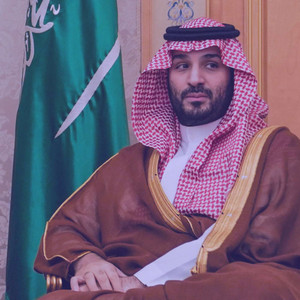
In part one today's episode, we'll be talking about the rise of the man behind it, Mohammed bin Salman, or MBS as he is often known.
In part two, we'll turn to one of the most ambitious, almost science fiction-like projects of the 21st century a planned desert city of the future, 500 meters high and 170 kilometers long, called Neom.
And in part three we are going to look at a somewhat darker chapter the blood-curdling murder of the dissident journalist Jamal Khashoggi.
Like all of our mini-series, parts two and three will be member-only episodes.
So now is my chance to remind you that if you like the sound of those and you'd like to more than double the number of episodes you can listen to and unlock all of the interactive transcripts, study packs and more, then now might just be the time to think about becoming a member.
You can do that at leonardoenglish.com.
Okay then, let's not waste a minute and get right into it.
If you went up to a random person on the streets of Britain and asked them to name as many British princes and princesses as possible, My guess is that they might be able to name a good chunk of them.
If you stumbled across someone who is a serious royal watcher, perhaps they could name all 17.
In Saudi Arabia.
However, I'm pretty confident that nobody, not even the king, would be able to name every Saudi prince or princess.
And even if they could, it would take them several hours to list them.
There is no public list, but it's estimated that there are anywhere between 5000 and 15000 princes and princesses in Saudi Arabia thousands of people, with some claim back to the country's founder, Abdulaziz bin Abdul Rahman, Al Saud, or Ibn Saud as he's commonly called in the West.
He had almost 100 children, with a mixture of official wives and concubines, and most of them went on to have large families of their own, with each descendant having the right to call themselves a prince or princess.
Now the history of Saudi Arabia.
Even the relatively short history of the modern kingdom of Saudi Arabia is as fascinating as it is complicated, and we don't have the time to go into it in detail today.
But for the purposes of our story, the thing to underline is firstly, the size of the Saudi royal family and secondly, how succession works, how the title of king passes from one person to the next.
In a typical monarchy like Britain, Spain or the Netherlands, the crown passes downwards from ruling male to the eldest next eligible male, from father to eldest son, and if that son has died, then to the grandson.
It follows a straight vertical line down the male line of the family, with some more forward-thinking monarchies now allowing daughters to be considered as well.
But Saudi Arabia was very different.
When Ibn Saud died in 1953, he didn't have one eligible son.
He had almost 45 acknowledged sons, with the oldest in his 50s and the youngest still a boy.
This created both a problem and an opportunity.
The problem was that many of these sons were grown adult men with military experience, political authority and powerful backers.
Choosing just one of those sons or one of their children would have meant favoring one branch of this enormous family over all the others.
And with hundreds of princes and thousands of descendants, that could have led to an immediate and possibly violent power struggle.
But the flip side of this was that there was an almost 50-year age gap between the oldest and the youngest son.
Saudi Arabia could adopt a different system that kept things in the same generation.
Instead of moving vertically father son, grandson the throne could move horizontally from brother to brother, staying within the founder's generation for as long as possible.
So when Ibn Saud died in 1953, the crown passed not to one of his son's children, but to one of his adult sons, King Saud.
When King Saud was removed from power, the crown passed to yet another brother, and then another, and then another.
For decades, power moved horizontally across a single generation, between the dozens of sons of Ibn Saud.
This was a deliberate decision.
It kept the peace between branches of the family.
It rewarded seniority, experience, and age.
And above all, it preserved consensus among a very large pool of powerful princes.
But this was also something of a ticking time bomb.
As time went on and the founding generation began to age, the number of potential successors grew dramatically.
Each of those sons had children.
Those sons had children, and all of them had opinions, ambitions, and networks of influence.
The House of Saud was no longer a family tree.
It was more like a dense, thick forest.
And by the early 2000s, Saudi Arabia had reached a moment of quiet tension.
Everyone knew the horizontal model of succession couldn't last forever.
Eventually, the crown would have to pass down to the next generation.
And the next generation was huge, dozens upon dozens of princes who had grown up with extraordinary wealth, political connections and varying degrees of competence.
Some were talented, some were not.
Some wanted reform, others wanted stability.
And many had spent their entire lives preparing for the possibility, just the slightest of possibilities, that they might one day rule.
For the first time since the kingdom's foundation, the question hanging in the air was not just who would be king next, but how that choice would even be made.
And it was into this world, a world of vast wealth, complicated family politics and an increasingly urgent need for a younger, more dynamic leadership, that we find Mohammed bin Salman MBS.
He wasn't in the obvious line of succession.
He wasn't the eldest son of the eldest son.
In fact, for much of his early life, he barely registered on the list of potential future kings.
He was born in 1985, the sixth child of Salman bin Abdulaziz, a then 50-year-old senior prince who had served for decades as the governor of Riyadh, the capital city.
His father was respected, serious, disciplined, a man with reputation for hard work and order.
But his father was only one of the almost 50 sons of Ibn Saud and not at the very top of the succession list.
It's not clear exactly what number son he was, but it's believed he was around number 25.
So MBS, as the sixth son of a prince not expected to get anywhere near the throne, didn't grow up expecting to be king.
He wasn't educated abroad like many of his royal cousins.
He didn't spend his teenage years floating between luxury compounds in Europe or the United States.
Instead, he stayed in Saudi Arabia, went to local schools, and lived a comparatively grounded life.
Well, grounded by the standards of a Saudi prince.
According to a recent biography, as a teenager he showed little ambition or interest in climbing the royal ladder.
He preferred video games and McDonald's to business and politics.
Whether something changed or he was silently plotting from a very young age, we do not know.
But sometime in his late teens, slowly but surely, he started to make his move.
He cultivated connections with businessmen, security officials and younger members of the royal family.
He developed a reputation for being the prince who got things done, who followed up, who didn't disappear into luxury or lose himself in excess something of a rare trait for a young Saudi prince.
He developed a reputation for being serious, determined, and surprisingly focused.
He studied law at King Saud University, graduating near the top of his class, and then began working informally as an advisor first to his father then to other senior royals.
These weren't glamorous roles.
They were administrative, bureaucratic, and sometimes tedious.
But they were important.
They gave him insight into into how decisions were made, who held power, who merely appeared to hold power, and where the weaknesses in the old system lay.
And here's an important detail.
Saudi Arabia is an absolute monarchy.
It doesn't run on political parties and elections.
It runs on networks, tribal networks, business networks, security networks.
And all this underpinned by the sprawling network of the royal family itself.
Knowing the right people and being trusted by them is one of the most powerful currencies in the country.
MBS understood this instinctively.
He also believed that his country needed to change.
Around half the country is under the age of 30.
Yet it was stuck in the past, ruled by men in their 70s and 80s and beholden to conservative religious authorities that were given de facto power in the 1980s.
Criminals were still publicly beheaded.
Women needed male guardian permission for many aspects of life, and they weren't allowed to drive.
Muhammad knew that something had to change for the country to modernise, but he must have thought that he would never have got the chance to have any say in it.
This all changed in 2012, when his father, Salman was appointed Crown Prince in other words, next in line to the throne and the then king Abdullah was rapidly approaching his 90th birthday, so this really was an imminent succession plan.
Suddenly, MBS was one of the sons of the next king and he began to position himself right at the heart of the royal court.
Sure enough, in January 2015, King Abdullah died and the crown passed to Salman, MBS's father.
Now, Salman had other sons, but he made it pretty clear that MBS was his favourite.
He immediately accelerated his son's career, handing him two truly monumental positions that put him in control of both the money and the military.
First, MBS was named Minister of Defence.
At just 29 years old, he became the youngest defence minister in the world and within months he launched a controversial military intervention in Yemen.
Second, and perhaps more importantly, he was appointed chief of the royal court.
This made him the king's official gatekeeper, controlling all access to the monarch.
If anyone in the sprawling royal family or the government wanted to speak to King Salman, they had to go through MBS.
With this authority, he began his campaign to centralise power.
He started pushing the ambitious Economic and Social Reform Plan known as Vision 2030, a plan to remake Saudi society and end the kingdom's dependence on oil.
By promoting this radical vision, he positioned himself as the moderniser and the champion of Saudi youth, earning huge popular support.
But, and it is a big but, he still wasn't crown prince.
He wasn't technically in line to the throne.
This title went to an older cousin, Mohammed bin Nayef, or MBN for short.
Now, MBN was a serious figure.
He was the interior minister, a known counter-terrorism expert and a favoured long-time partner of Western intelligence agencies, including the CIA.
He was the established choice to be the next king under the old system, a safe pair of hands.
But in June 2017, King Salman made a shocking announcement.
MBN was going to be removed from all duties, and MBS would replace him as crown prince.
Power was officially moving vertically from father to son, shattering the seven-decade-old tradition of horizontal brother-to-brother succession.
The transition was not exactly peaceful.
Sources later revealed, NBN was summoned to a royal palace late one night, held against his will and pressured for hours to sign documents resigning his position.
To show a facade of continuity, Saudi state television broadcast a clip of the newly appointed MBS kneeling to kiss the hand of the deposed heir, MBN.
But the message was clear.
The consensus era was over.
MBS had engineered a quiet behind the scenes coup, consolidating power in a manner unseen since the kingdom's founding.
And this was only the beginning.
The next step in securing his absolute dominance was even more shocking.
A royal purge that turned one of the capital's most luxurious hotels into a gilded prison.
On the night of November 4th, 2017, something extraordinary happened in Riyadh.
Without warning, dozens of the most powerful people in Saudi Arabia princes ministers, billionaires received sudden orders to report to the Ritz-Carlton Hotel.
Some thought they were being invited to an urgent meeting.
Others believed they were being summoned for an audience with the king.
Instead, they walked into what was effectively the world's most luxurious detention centre.
The Ritz-Carlton was shut to the public.
Its phone lines were cut.
Security forces surrounded the grounds and inside.
Some of the richest and most influential men in the entire Middle East were told they were under investigation for corruption.
Among those detained was Prince Alwaleed bin Talal, the so-called Warren Buffett of Arabia, one of the most recognisable Saudi billionaires, a man with major shareholdings in big American technology companies.
There were former ministers, media tycoons, heads of major companies and even senior members of the military.
In total, around 380 people were rounded up over the course of the purge.
They were held not in cells, but in the ballroom and bedrooms of the Ritz, sleeping under gold chandeliers and ordering room service under armed guards.
Officially, this was an anti-corruption campaign.
Billions of dollars had been siphoned off through decades of patronage, contracts and opaque deals.
And the government, or rather MBS, said it was time to clean up the system.
But almost nobody believed the official explanation.
This wasn't simply about corruption.
It was about power.
By arresting some of the kingdom's wealthiest and most connected figures, MBS was doing something unprecedented.
He was removing every rival who could challenge him.
And it worked.
Within a few months, detainees agreed to hand over assets, property or cash in exchange for their freedom.
The Saudi state claimed to have recovered over $100 billion worth of assets.
But more importantly, Mohammed bin Salman emerged as the undisputed centre of authority.
The message was unmistakable.
If he could detain princes and billionaires at will, there was nobody he couldn't touch.
And while the purge at the Ritz-Carlton made headlines around the world, inside Saudi Arabia it did something else.
It made MBS wildly popular among young Saudis.
To many ordinary people, the old elite had lived above the law for decades.
Suddenly, a young prince was taking them on, publicly, decisively, dramatically.
It felt like a revolution, but a revolution led from the top.
But popularity at home was only half the battle.
MBS knew that to truly transform Saudi Arabia, he needed to change how the rest of the world saw his country.
And that meant tackling the kingdom's greatest vulnerability, oil.
For decades, Saudi Arabia had been defined by a single resource.
Oil paid for everything.
The palaces, the welfare state, the military, the sprawling bureaucracy.
But oil prices were volatile and MBS could see that the world was slowly turning toward renewable energy.
He wanted to wean the country off its reliance on oil before it was too late.
He wanted to reshape the country's entire economy, its international relationships and, perhaps most ambitiously, its global image.
He wanted Silicon Valley, Wall Street and the world to see Saudi Arabia not as an oil state stuck in the past, but as the next great frontier for innovation.
He created a huge sovereign wealth fund committing tens of billions of dollars to be invested in technology startups, pouring money into companies like Uber Slack, WeWork and DoorDash.
In just a matter of a few years, Saudi Arabia wasn't just buying football teams or luxury hotels.
It was sitting right at the table of global tech's biggest bets.
And it didn't stop there.
MBS struck personal relationships with world leaders, including Donald Trump, who visited Riyadh in 2017 on his first foreign trip as president.
Trump and his administration warmly embraced the young crown prince, announcing major arms deals, praising his reforms and offering the kind of diplomatic support MBS needed as he consolidated power at home.
For the first time ever, it seemed as though Saudi Arabia was on the cusp of reinventing itself entirely, modernizing socially, diversifying economically and becoming a hub for futuristic projects.
And perhaps the boldest of all these projects was one we'll be talking about in part two of this miniseries.
A new city in the desert, 170km long, built in a straight line, powered entirely by clean energy and designed as a kind of techno-utopia for the 21st century.
A place called Neom.
But alongside this glossy vision of the future, there was a much darker side to MBS's rule.
Because, while foreign investors were flying in and global leaders were shaking hands, opponents of the government activists critics, journalists they were increasingly being targeted.
Inside Saudi Arabia and abroad, women's rights campaigners were arrested.
Rival princes who had not been caught up in the Ritz-Carlton purge suddenly found themselves silenced.
Even tweets at times became grounds for imprisonment.
And in 2018, the world witnessed something so shocking, so brutal, that it permanently changed the international perception of Mohammed bin Salman.
The gruesome murder of the journalist Jamal Khashoggi inside the Saudi consulate in Istanbul.
Now, We'll be going into this in much more detail in part three.
But in short, this well-known Saudi journalist went into the consulate, was murdered and then chopped to pieces with a bone saw.
Although this was first denied by Saudi authorities, the official policy line is that it was carried out by rogue state actors without the knowledge of MBS.
And for a brief period after this shocking discovery, it looked like it would be hard for MBS to come back.
Businessmen who had once been happy to be photographed beside him declined meetings.
Investors pulled out of the country and newspaper columns were filled with damning reports.
But time and money were on his side.
And sure enough, investors, politicians and celebrities didn't take too long to change their tune.
Saudi Arabia's enormous wealth, its strategic importance and its ambitious plans for the future proved too attractive for many to ignore.
Global CEOs quietly flew back to Riyadh.
Tech investors resumed their courtship.
Hollywood stars returned for glitzy events.
And governments, publicly or privately, re-engaged with the kingdoms.
Within 18 months, MBS was hosting the G20 summit in Riyadh, where world leaders, including those who publicly condemned him, stood side by side with the crown prince for official photos.
And that brings us to today.
As of the time of recording this episode, his father, the 90-year-old King Salman, is still nominally on the throne.
Today, Mohammed bin Salman is not just the crown prince.
He is the de facto ruler of Saudi Arabia.
When he becomes king and perhaps he already will be by the time you listen to this.
It will merely be a formality.
He already oversees everything from oil strategy to social reforms, from foreign policy to football clubs.
He has relaxed some long-standing restrictions.
Women can now drive.
Cinemas have reopened.
Concerts are allowed.
And the infamous secret police have been stripped of much of their power.
For young Saudis who grew up unable to go to a cinema or lived in fear of being stopped on the street by the religious police, these changes felt revolutionary.
Yet, the darker sides of his rule remain impossible to ignore.
The silencing of critics, the imprisonment of activists, the ongoing humanitarian crisis in Yemen and the unresolved questions around the murder of Jamal Khashoggi.
To some, MBS is a visionary moderniser. to others, a ruthless authoritarian.
To many, he's both.
He's only 40 years old and, in all likelihood, will look forward to the best part of 50 years on the throne of Saudi Arabia.
What is certain is that he is someone you cannot ignore.
Okay then, that is it for today's episode on Mohammed bin Salman.
As always, I would love to know what you thought of this episode.
We have lots of listeners from Saudi Arabia.
So let me know what you think.
How has MBS changed the country?
And what hopes do you have for the future?
Let me know in the comments below if you're listening to this somewhere where you can comment.
And for the members among you, you can head right into our community forum, which is at communityleonardoenglishcom, and get chatting away to other curious minds.
And as a final reminder, this is part one of a three-part mini-series.
Next up, in part two, we'll be looking at the astronomically ambitious and expensive project of NEO.
And in part three, it'll be the gruesome murder of Jamal Khashoggi.
Those will both be member-only episodes, so let me remind you one final time that if you'd like to listen to those as well as more than double the number of episodes you can get, plus learn with our interactive transcripts, subtitles and key vocabulary then the place to go for that is leonardoenglishcom.
You've been listening to English Learning for Curious Minds by Leonardo English.
I'm Alistair Budge.
You stay safe. and I'll catch you in the next episode.