We're in a very crowded hallway in the British Museum standing in front of a massive piece of ceramic, a massive vessel that comes from the Minoan palace of Knossos on the island of Crete.
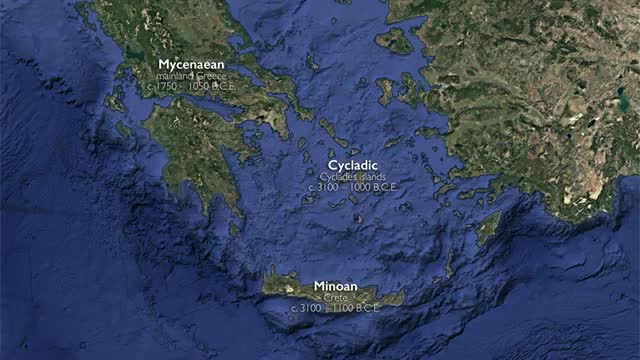
This is a culture that we associate as part of the three main Aegean cultures.
That is, the Minoans, the Cycladic culture and the Mycenaeans, who were all roughly in the second millennium BCE.
But when we study these cultures, we often study elite objects, that is, the objects that the king would have seen.
What's fascinating about this pot is that it's a window into the everyday life of the workers at this moment.
This is a pot that makes us think about who made it, how it was made because it's so big and, of course, what was inside of it.
It's about four feet tall, and it must weigh a ton.
And it's so interesting because it's a utilitarian object.
It's made to store things, but it's beautifully decorated.
The decorations of this pot, in some ways, all look the same.
But then when you look more closely, you realize there's some sort of more complicated pattern happening.
At the very top, you have a ring of horizontal and slashed-looking lines.
And when you look more closely you realize that they're decorated with actual fingerprints large fingerprints on a top ridge and then beneath them, at angles, smaller fingers have impressed lines of wet clay.
It's almost as if we see the impressions of the workers themselves.
There's a big cord, almost a rope-like form, and then from that, at an angle, these smaller cords that seem to come down, almost as if they're suspended from above.
And that large rope and those smaller diagonal ropes.
You're right, they're all indented with somebody's finger.
And the large rope has fairly large indentations, but the smaller ropes have very small indentations.
It is amazing.
You really have the feeling that it was two different hands.
Maybe the hands of an adult with big thumbs and the smaller indents look like children's fingers.
We have evidence contemporary with the use of this pot, that children are working in the textile industry.
Maybe they're also potting.
So we're looking at the indentations of, perhaps children who helped to decorate this plot 3500 years ago.
These were pots that were found in storage rooms of the palace, in the western storage area of the palace of Knossos, often called the magazines.
They're long skinny rooms and they were found on the floor of the magazines and many different types.
Several dozen are discovered at the palace that date to this period, which makes us think that there's a lot of staple produce that's being stored within them.
Something like olive oil or wine or figs or grain, barley or wheat.
These are all staple commodities that again are mentioned in these linear B tablets, which are contemporary with this pot.
And it's a reminder that the palace is a gathering point for goods from across the Mycenaean world.
The Mycenaean Linear B documents tell us about lots of commodities that the Mycenaeans produced and collected and traded.
And this pot gives us evidence of the way in which they were stored and indeed maybe, the kinds of containers that were used for the trade.
As you can see on the pot itself, there are two sections, the top and the bottom, where there are big loop handles.
They could be used either to hold it with one's hand and you'd have to have a couple sets of hands because it's extremely heavy or you could use ropes to secure a pot like this to a boat or some sort of wheeled vehicle.
These loops could be used to tie a cover to the pot to make sure that its contents would stay inside.
It really describes how it was moved around and used.
So I love the fact that the decoration is a reminder of the use of the object.
Without rope to tie it, without rope to move it around, it would be largely useless.
So it's so interesting that that sense of a rope is so strongly invoked in the depuration of it.
What's really interesting is that we know a lot again from the Linear B tablets about the textile industry at this time.
And we know that the creation of rope, the creation of linen, was important in this era, not only for clothing, but as tools, the likes of which we see on this pot.
Well, and rope is clearly important here, because not only is it referenced across the entire surface of the pot, but somebody has taken the time to incise it to reveal the weave of the rope.
Yes, it's very specific, isn't it?
In fact, the rope represented across the very widest belly of this pot is of one variety.
And that is different from the kind of rope represented on the registers above and beneath it, which is so interesting.
They're very specific.
And then at the very bottom, which includes one of these fabulous loop handles, we again see a different kind of rope represented.
Is this a dictionary of rope?
Probably not.
But this was important enough for the manufacturer of this pot to take the time to differentiate it.
It must have meant something.
Now, it would have been made using a coil method.
That is, snakes of clay would have been stacked up and then pressed together and smoothed.
And this coil method was used to create these big pots, these pithoi, for quite a while, in the tradition of Aegean pottery.
But here in the 15th century, in the late Minoan III era, we find the coil method used for the construction of the whole pot, which is an interesting methodological advancement.
It's hard to believe that a pot this big could be constructed just with coils.
It's more obvious on the inside.
On the outside you can see the impression of what was probably a paddle used to smooth the surfaces.
And the paddle marks, which are like very light lines that go around the belly of the vessel, give us evidence that probably something like a lazy Susan was used to manufacture it.
Some sort of a mechanism is used to be able to literally turn the pot slowly, to facilitate the use of this paddle to smooth out those coils and then afterwards the rope decoration will be added.
The only two parts of the pot that lack decoration are the foot, which makes sense because it's likely rolled, and the lip at the top.
It's very, very thick.
And one wonders if there isn't a function to that.
And it probably does have a function.
It could accommodate a very thick cloth or leather covering and a very thick, strong rope to seal it around that rim pithoi of this size we find with rims that are not as thick.
Looking at this, you think it must have some sort of a function, because so much weight, so much clay has been used to create that thick rim.
It's such a tease.
We want to know what was inside.
We want to know how much that cost.
We want to know if this was for the palace's own consumption or if it was being traded or distributed in some way.
But in any case, these objects talk about a society where trade was central and enormously sophisticated, and where they took even the most utilitarian objects and made them beautiful.
The sense of movement that's created with these undulating rope lines and the monumentality of the size for a storage vessel for what today would be probably a plastic bin.
It's just an incredible object that demands our respect and attention.