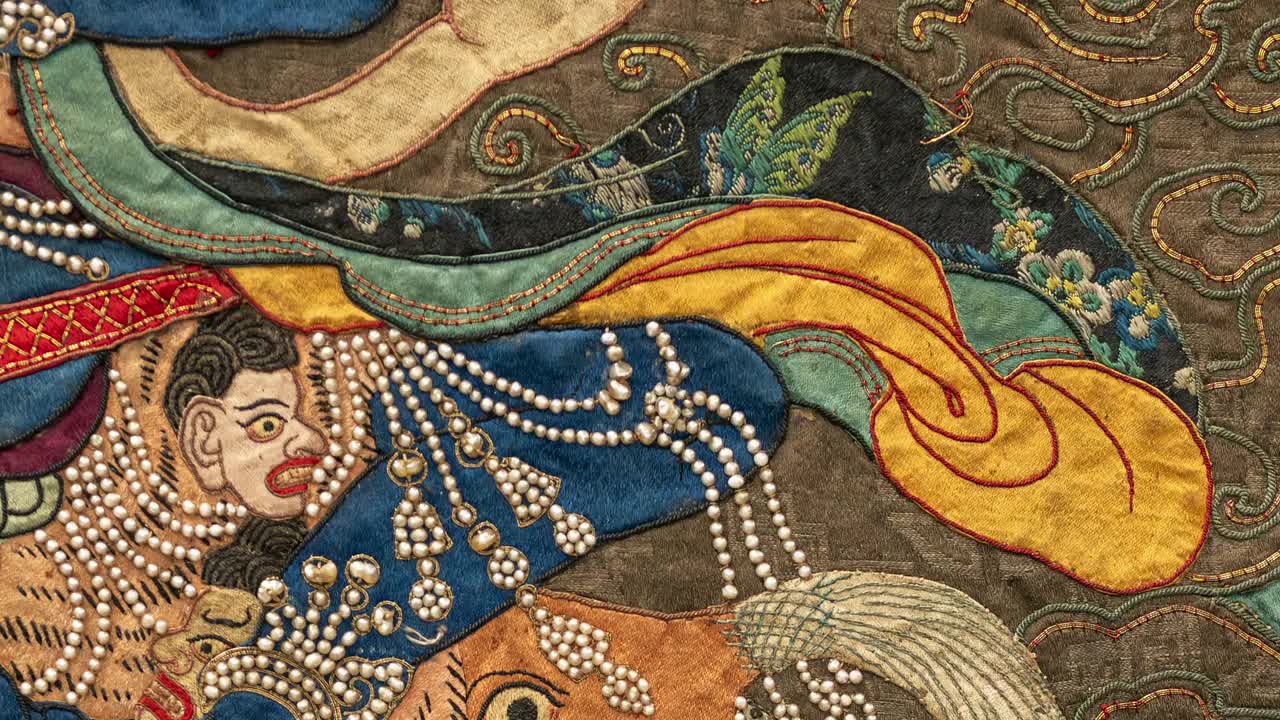
We're looking at an astoundingly beautiful appliqué that's part of the collection of the Rubin Museum.
Appliqués are made of scraps of silk and, in general, sacred textiles.
Such as this would be designed by monks or master artists, and the collage of silk would then be stitched together by laywomen.
We see one fabric laid upon another and then stitches laid on top of that and then pearls.
And so it comes alive in a way that sometimes a painting doesn't.
In the 18th and 19th centuries, when this work was probably made, appliqué came to compete with painting.
This is a wonderful example of the kinds of masterful textiles produced in Mongolian workshops in that period.
They would take scraps of Chinese silks and they would use a variety of embroidery, stitches and gold couching, where they would wrap horsehair in gold and then stitch it onto the textile to delineate the detail.
So for instance, in her hair or the flames, And all of this gleams in the light.
And as we continue to look, we see in the clouds the decorative patterning of the fabric itself.
There's a kind of richness here that is really special.
And, as you touched on, especially distinctive for Mongolian applique are tiny seed pearls, small coral beads and other semi-precious stones that are stitched onto the surface.
And this is a wonderful example of that.
What we're looking at is one of the forms of Palden Lhamo, one of the principal female protector deities of Tibet.
And this is a translation from the Sanskrit Shri Devi, meaning glorious goddess, a term which denotes a whole class of female protector deities.
And she is also simply called Lhamo, the goddess.
So she takes many different forms, and here we have Mokzar Gelmo, queen who repels armies.
And this is the most popular form in Mongolia, and they simply refer to her as the goddess.
Some of what she's wearing and what she holds, and the animal that she rides and the other figures around her are standard iconography for protector goddesses.
So Lamo is typically depicted as an extremely fierce dark blue figure with flame-like hair standing on end, which we see here.
She has a crown of five skulls and bone ornaments which are here made of pearls, and a garland of severed heads.
She rides on a mule across a sea of blood, and the mule has an eye on its rear flank, watching out for enemies of the Dharma, and her saddle blanket is made from the flayed skin of her son.
And within the sea of blood, it's actually a sea of blood and fat.
We see a skull, a rib cage, a femur bone, and then this odd shape in the bottom center.
Yes, at bottom center the raffle offerings for the five senses, where the actual sense organs are represented.
Eyes for sight, tongue for taste, ears for sound, nose for smell, and heart for touch.
Now Lamo takes many different forms, which are considered wrathful forms, of different deities with their own stories.
Moksar Gelmo, who we see here, is considered a wrathful emanation of Saraswati, goddess of arts and learning.
In her form as Moksar Gelmo.
She has two arms, which we see here, and she brandishes a sandalwood club with a Vajra finial over her head and holds a skull cup filled with blood at her heart and a peacock feather canopy above her head.
Among her magical implements, we see a scored divination stick stuck in her belt and a divination dice, and these objects relate to her important divination practices.
In her arsenal of weapons which she can unleash on enemies of the doctrine include a red book of curses bound by a snake and a bag of diseases.
And her name Mokzor.
Gelmo Mok means army, and Zor is a kind of magical weapon that a deity can hurl at its enemies, and Gelmo means queen.
Thus, her name might more properly translated as Queen of the Army Defeating Weapon.
And so, as her name implies, she is a powerful protector of Buddhism and considered to be especially efficacious in magically intervening in military conflicts.
According to a short history of the worship of Lamo by the second Dalai Lama, her cult was introduced to Tibet during the 11th century and she becomes a special protector of the Dalai Lamas.
It's under the fifth Dalai Lama that her worship enters state ritual and a key responsibility of the goddess becomes to safeguard his government, which came to power largely through Mongol military force in the mid 17th century.
So we're looking at a Mongol applique, but we know that this is a figure who comes to Mongolia through Tibet.
Mongolians have been deeply active in the political, religious and artistic life of Tibetan Buddhism since the 13th century and then later.
Tibetan Buddhism becomes essential to Mongolian identity.
And she adopts a particularly militaristic role for the Mongols.
So, as Buddhism crossed borders, deities took on new meanings in Mongolian contexts, as they were integrated into local cosmologies.
So when we change regions and cultures, we also need to consider local understandings of deities, as well as the differences between doctrinal understanding and popular lay beliefs and customs.
So in her local Mongolian appropriation there's a greater emphasis placed on her function as a war goddess, and she's also known in Mongolia as Fierce Tara.
In Mongolian regions.
Lama was believed to have special healing powers and it's said that she can cure any illness by swallowing them and then breathing them into her bag of diseases, which you see on the applique.
And while this might seem like contradictory roles, it's not unusual in inter-Asian contexts to have protector gods who have functions of healing and prolonging life, as their fierce power of defending is not only against enemies but also diseases.