
[The Art of Devotion: Appliqué Masterpieces and the Fierce Protector Lhamo]-[Makzor Gyelmo]
📋 Summary
The Sacred Art of Mongolian Appliqué
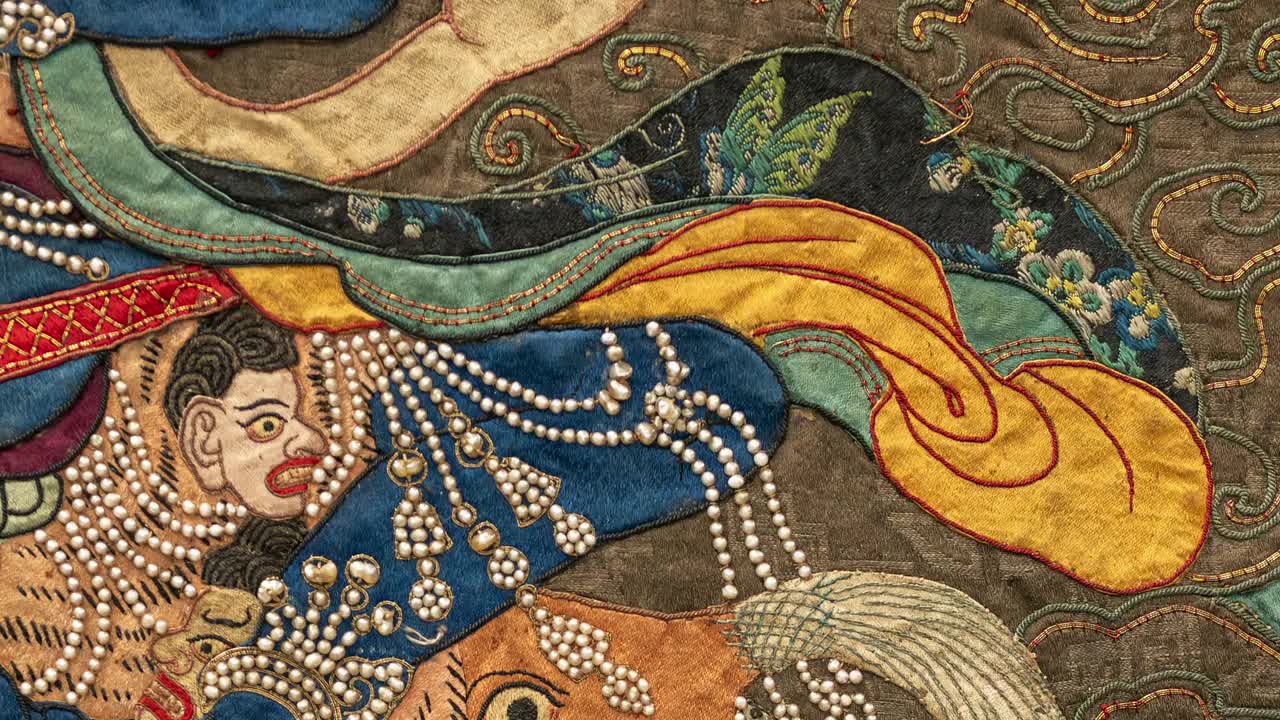
In the collection of the Rubin Museum lies an "astoundingly beautiful appliqué," a testament to the masterful textile traditions of 18th and 19th-century Mongolian workshops. These sacred textiles were conceptualized by monks or master artists, but the physical creation—a meticulous "collage of silk"—was executed by laywomen. The technique involves layering fabrics, employing intricate embroidery, and utilizing "gold couching," where horsehair is wrapped in gold thread to delineate fine details like flames or hair. This creates a tactile, three-dimensional "richness" that allows the artwork to "come alive in a way that sometimes a painting doesn't," especially when adorned with "tiny seed pearls, small coral beads and other semi-precious stones."
Iconography of the Fierce Goddess: Palden Lhamo
The subject of this appliqué is Palden Lhamo, a principal female protector deity of Tibet. Known as "Shri Devi" (glorious goddess) in Sanskrit, she appears here in her most popular Mongolian form: "Mokzar Gelmo," or the "queen who repels armies." The iconography is intentionally harrowing, reflecting her wrathful nature. She is depicted as a "fierce dark blue figure" with "flame-like hair standing on end," riding a mule across a "sea of blood and fat." Her appearance is replete with symbolic terror: a "crown of five skulls," "bone ornaments" made of pearls, and a "garland of severed heads."
At the base of the composition, the "raffle offerings for the five senses" are represented through anatomical motifs: eyes, tongue, ears, nose, and heart. These elements underscore the ritualistic depth of the depiction, where every detail serves a specific symbolic function in protecting the Dharma.
The Warrior Queen: Power, Divination, and Healing
As the "Queen of the Army Defeating Weapon," Mokzar Gelmo holds a "sandalwood club with a Vajra finial" and a "skull cup filled with blood." Her arsenal includes magical implements such as a "scored divination stick" and "divination dice," which link her to critical divination practices. Furthermore, she carries a "red book of curses bound by a snake" and a "bag of diseases," weapons she can unleash upon the "enemies of the doctrine."
Her history is deeply entwined with the political evolution of Tibetan Buddhism. Introduced to Tibet in the 11th century, she became a special protector of the Dalai Lamas. Her worship was elevated to a "state ritual" under the fifth Dalai Lama, whose government relied on "Mongol military force." This highlights the fluid nature of religious iconography; as Buddhism crossed borders, deities were integrated into local cosmologies.
Cross-Cultural Synthesis: War and Wellness
In the Mongolian context, Lhamo’s role shifted toward a more pronounced militaristic function, where she is also known as "Fierce Tara." Despite her terrifying appearance, she is paradoxically viewed as a healer. It is believed she can "cure any illness by swallowing them and then breathing them into her bag of diseases." This duality is common in inter-Asian contexts, where the "fierce power of defending" is applied not only against military enemies but also against the existential threats of illness, illustrating the complex intersection of doctrinal tradition and popular local belief.

Deep Learning with ListenLeap


