Hello, I'm Cecile McLaurin-Salvant.
I'm a jazz singer and a visual artist.
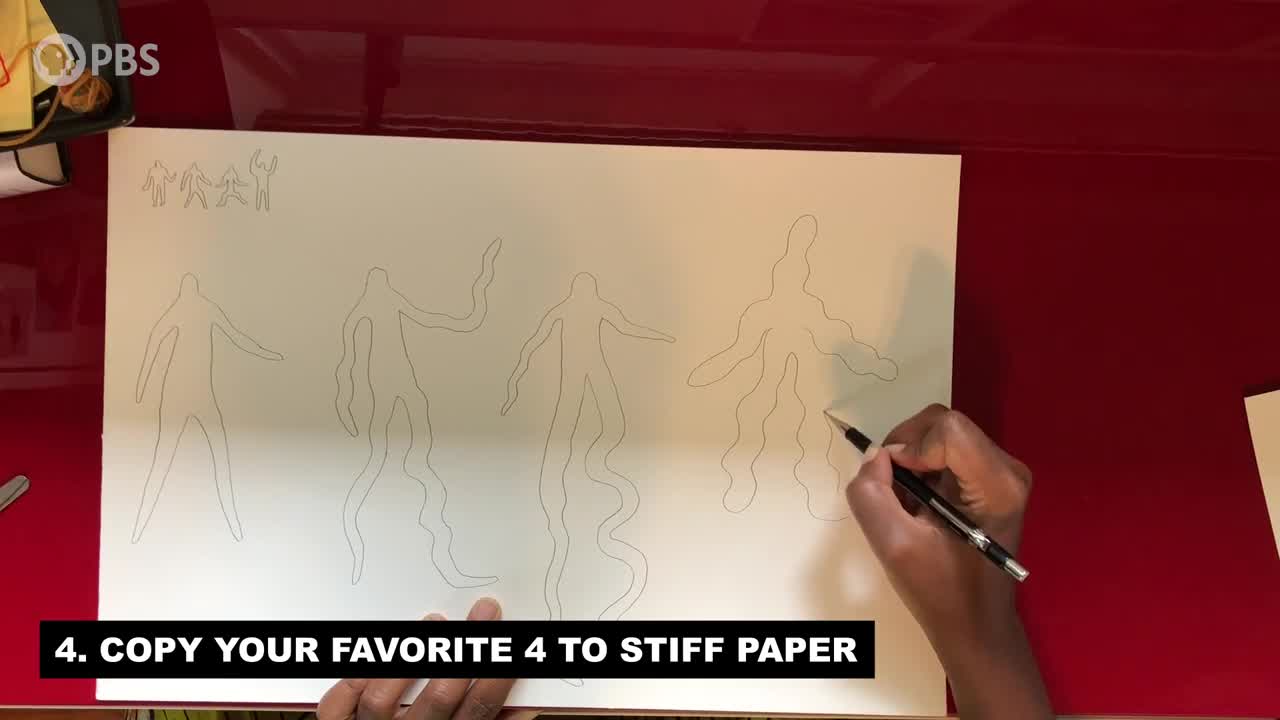
Your assignment is to draw a simple outline of a human body.
Keep doing that until you find one that you really like.
Then draw variations of that outline, playing with the limbs and the proportions.
Pick four of your favorite outlines and copy those onto some stiff paper.
It can be watercolor paper or that cereal box cardboard.
Cut those outlines out and tape a piece of string on the back of it so that you can hang it wherever you'd like.
When I reached out to you, was there like, did you have an idea right away of an assignment?
I immediately thought of embroidery. but I know that it's a little bit involved.
I think it's less about embroidery and more about like silhouettes.
Cause I've been playing with this type of silhouette and I think it's really fun to do.
Can you see it?
This type of guy.
With the one with the wobbly arms?
Yeah.
Or like this kind of guy.
The process is usually I'll draw a lot on paper and then, if something catches my eye, that's worth spending three months, four months on, then I start to embroider.
How do you think about your art making?
How do you frame it for others?
I think I've just been a little shy with really coming forward with like my visual art.
Even though, like the instagram is this sort of safe haven for me and like the internet is a place where i can just post things and not worry about them.
I've started to, little by little, accept that i do like to make visual art, like i.
I'm very uncomfortable calling myself a visual artist, but i That's what I do.
That's what I do most of the day.
Yeah, that was actually one of the questions I was going to ask.
You are sort of like the kinds of characters you find yourself returning to again and again.
There are these characters a lot of times they're silhouettes or big shaped characters.
Usually they're women, usually they're like bald, fat women and i don't know why it just it just is.
It's just something that keeps, that keeps coming, and lately i've been playing with messing with the shapes a little bit more.
It's kind of like a stick figure.
How a stick figure is, just so uh, like it's so clear what it is with not a lot of, not a lot of lines, not a lot of shading.
Like there's nothing.
And I really like I guess that's that's me being really attracted to just like really graphic things where with just one movement you've created not only a character but also also a mood, like their mood and their feelings.
Maybe you could tell us about Ogress.
It's basically like a musical fairy tale or like a musical fable, and I sing all the characters and I play all the characters and I'm also, I guess, the narrator.
The process with that.
This is the first time that I've really married both my drawings and my music together.
I had done album covers, but it was always kind of just like oh, we need an album cover, now let's just do it.
This is really like what does the character look like?
What do the plants look like, what do the animals look like?
I had done like a series of a series of drawings that i turned into a little zine called the invisible woman, and this, this sort of shape character, kept coming up and i think that became the ogress um.
So I think it is a situation where the music was written in direct influence of drawings and ideas of shapes of people that I kept having over and over again.
I sing jazz, which is a music of theme and variations, which is a music of like you have a song and you improvise variations on that song and on that interpretation and on that performance, and you can vary it a little bit or you can make it this completely abstract, unrecognizable mess.
And looking at the cutouts here, what would that mean?
If the song is the person and my variation on it is the flower or the butterfly or whatever abstract, weird shape?
That ends my variations.
How can I really push it musically? to the point of it being unrecognizable.
I mean, I don't usually do that.
There's still always something there.
I mean, I still remain close to the theme, but how does it affect your perception to really work on like exaggerating or making something really small?
Like what changes when that happens?
Are there any like practical tips?
I think bigger is better because it's just easier to cut and it's also more dramatic that way.
I think focus on the general lines.
This is something that you're cutting out.
This is almost like halfway between a drawing and a sculpture.
So just remember that.
So when you look at your finished work, what do you think about?
To be honest, right now I think about social distancing.
And the fact that they're always like at a certain distance from each other.
Like I'm very interested now in social distancing and I've been playing around with with that idea, I guess in my drawings and in my music too, just like this weird dance that you now have with people.
If you move forward, they have to move back.
If they move forward, you move back.
And so I think that's what this makes me think of.
For other art assignments, check out the book You Are an Artist, which features a wide range of voices and prompts for making art.
You should also check out Pride Land, a new PBS Digital Studios show premiering on their documentary channel Voices.
Pride Land explores LGBTQ plus life in the American South and is hosted by Dillon Burnside from the FX show Pose.
He recounts his own coming out experience and travels throughout the South to meet people, breaking down barriers.
Follow the links in our description and subscribe.
Thanks to all of our patrons for supporting the art assignment, especially our grandmasters of the arts David, Golden and Divide by Zero Collection.
Thank you.