Hi, guys.
I'm Alex.
Thanks for clicking, and welcome to this lesson on gerunds.
Now in this lesson we're going to look at all the various functions that a gerund can have in a sentence.
So before we begin that, we should understand what a gerund is and how a gerund is formed.
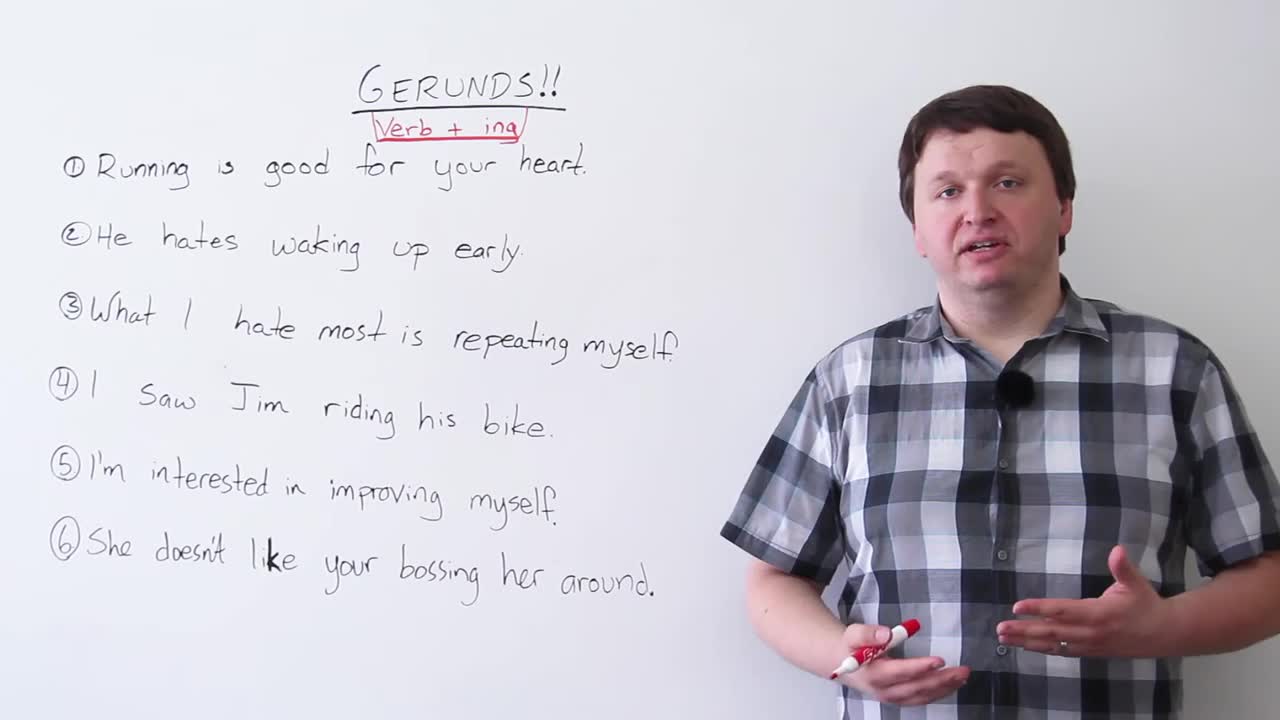
If you look at the title, you can see that a gerund is basically a verb plus ing.
So what is it?
Is it a verb?
Is it a noun?
Well, it's actually a verbal noun, which means that while it looks like a verb like for example in the first sentence we have running it can perform the same functions as a noun.
So think of it as a verbal noun leaning more towards the noun part.
Okay?
So let's look at the six ways that we can use a gerund.
The top one says, running is good for your heart.
Now, as we've identified, running is the gerund.
And in this situation, running is clearly the subject of the sentence.
Right?
So a gerund can be the subject of a sentence. just like a noun, right?
So, running.
Running is what you're talking about, the activity of running.
You follow it with a verb, is good for your heart.
Okay?
So, in the second one, we say, he hates waking up early.
Now, what is the gerund?
The gerund is waking.
It's actually a complete thought here, waking up.
And which position of the sentence is the gerund in this sentence?
So we have he, which is the subject.
We have hates, which is the verb.
And then he has to hate something, right?
So in this situation, what he hates is the object, just like a noun.
It can be pizza or anything else here.
Think of it as a noun.
Okay.
Number three, what I hate most is repeating myself.
So what is the subject of this sentence?
Is it what I?
Is it what I hate?
What I hate most?
What I hate most is?
Well, the complete subject is what I hate most and is and we have the gerund here repeating myself, so saying the same thing again and again.
Now, in this situation, the gerund is not actually an object, because the subject is not doing anything to the gerund.
You're just giving more information about the subject.
So what I hate most, and then you're actually telling me what you hate most.
You're giving more information about it.
So what you're doing is providing a subject compliment.
Okay?
Okay.
Now the next one.
I saw Jim riding his bike, so you're probably getting the idea of a pattern developing here.
First, let's identify the gerund.
The gerund is riding.
Okay, now let's look at the sentence.
We have, I, which is the subject, saw the verb, Jim.
I saw Jim.
Okay, Jim is the object.
Okay, now you're giving more information about Jim's actions here, though.
I saw Jim.
What was he doing?
He was riding his bike.
So in this situation, the gerund is giving more information about the object's action.
So in this situation, it's an object complement.
Okay?
Sorry for my writing there.
And No.
5 very, very common way to use gerunds and a very important rule, especially for intermediate and advanced speakers.
I'm interested in improving myself and getting better, so we have improving as the gerund.
Now, why are we using the gerund?
Why cannot we say, I am interested in improve or I am interested in to improve?
Well, any time you have a preposition and normally we have lots and lots of adjective and preposition combinations
After the preposition, always use a gerund.
So a gerund can be the object of a preposition.
Now, more examples of this are, I am excited about doing something.
I am used to doing something.
Okay?
So it can be the object of a preposition.
And finally, this is a rule which is often forgotten, and you can actually check out a deeper explanation of it on wwwengvidcom.
She doesn't like your bossing her around.
So we have bossing.
This means telling a person what to do.
Okay?
So she doesn't like your bossing her around.
Here, we're using your.
We're using a possessive.
So in this situation, a gerund is actually the object of a possessive pronoun.
Okay?
So it can be the object of a possessive.
There we go.
So, as you can see, there are numerous ways that we can use a gerund.
It's not just a simple type of word with only one function.
It has a variety of functions and a variety of ways that we can use it in different parts of a sentence.
Now, do not confuse, never confuse a gerund with a continuous verb.
So, if I say, she is running.
Okay, I am describing her action in the moment.
Running is not a gerund.
Running is a continuous verb in this situation.
Okay?
So that is really the most common confusion.
Don't confuse a gerund for a continuous verb.
Remember, it's a verbal noun.
It can perform the same functions as any noun, like pizza, table, car, etc.
So once more, a gerund can be the subject of a sentence.
For example, smoking is bad for you.
Smoking is the subject.
It can be the object of a sentence, like we have here.
He hates... What does he hate?
Waking up early.
It can be a subject compliment.
What I hate most is repeating myself.
Another example of this might be, my favorite activity is hiking, for example.
I saw Jim riding his bike.
Object complement.
I'm interested in improving myself.
So it can be the object of a preposition, right?
So anytime you have a preposition like in, at, on, by, against, with, okay?
Ing, ing, ing.
And finally, it can be the object of a possessive.
So, she doesn't like your bossing her around.
Or this can even be something simple like, I don't like her cooking.
Okay?
So you're not describing her activity, you're describing the thing, her cooking.
Or I can say, your speaking or your listening, your writing needs to improve.
Okay, guys.
To test your understanding of this knowledge.
As always, you can check out the quiz on wwwengvidcom.
Take care and good luck, and don't forget to subscribe to my YouTube channel.
See you.