
[Mastering Gerunds: A Comprehensive Guide to Verbal Nouns]-[Learn English Grammar: 6 Ways to Use Gerunds]
📋 Summary
Understanding Gerunds: The Versatile Verbal Noun
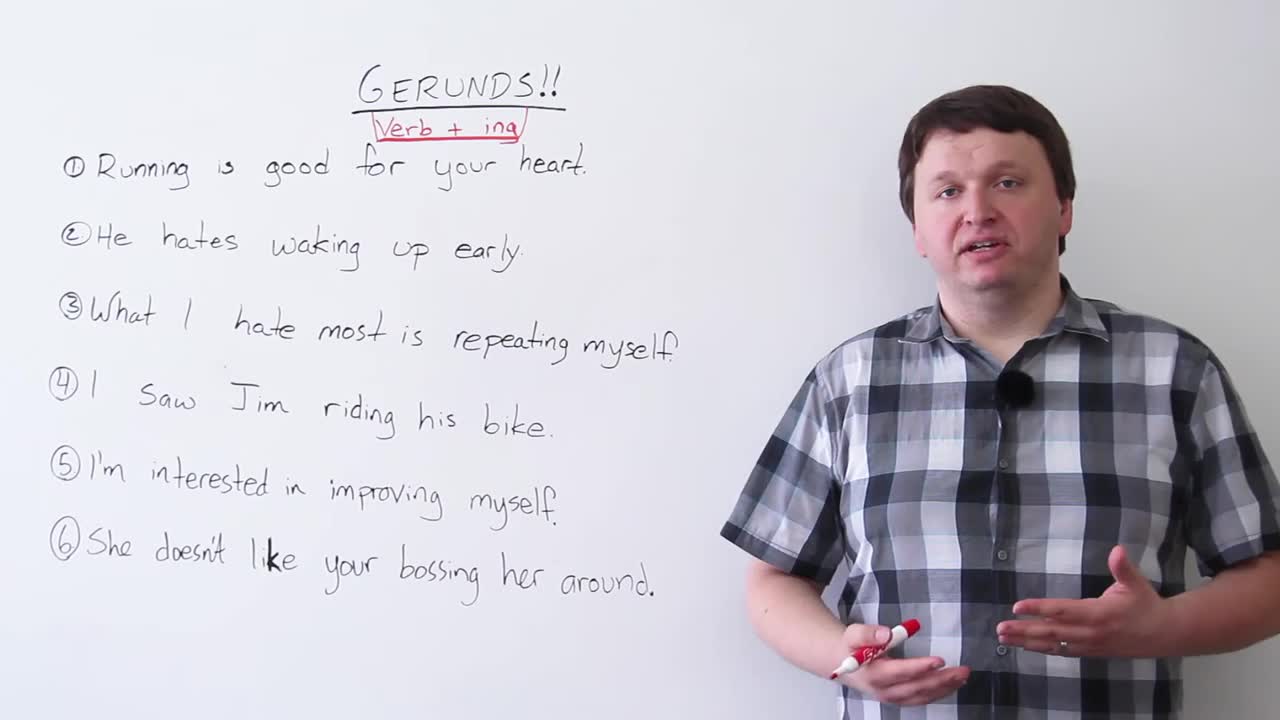
In the English language, gerunds often cause confusion due to their dual nature. As Alex explains, a gerund is essentially a "verbal noun"—a word formed by taking a verb and adding "-ing." While it visually resembles a verb, it functions grammatically like a noun. This article breaks down the six primary functions of gerunds to help learners move beyond basic usage.
1. The Subject of a Sentence
Just as you might use a noun like "pizza" or "car," a gerund can serve as the subject. In the example, "Running is good for your heart," the word "running" is the activity being discussed. It occupies the subject position, performing the same role that a standard noun would in the sentence structure.
2. The Direct Object
Gerunds frequently function as the object of a verb. In the sentence, "He hates waking up early," the phrase "waking up" serves as the object of the verb "hates." The subject (he) is directing his feeling toward the activity (waking up), confirming that the gerund is acting as a noun.
3. The Subject Complement
When a gerund provides more information about the subject rather than receiving an action, it acts as a subject complement. Consider the sentence: "What I hate most is repeating myself." Here, "repeating myself" defines the subject ("what I hate most"). It provides descriptive information about the subject, functioning in a way similar to a predicate nominative.
4. The Object Complement
Gerunds can also provide additional information about the object of a sentence. In the example, "I saw Jim riding his bike," the gerund "riding" describes the specific action Jim was performing at the moment he was seen. It complements the object "Jim" by clarifying his ongoing activity.
5. The Object of a Preposition
This is a critical rule for intermediate and advanced learners. Whenever a sentence contains a preposition (such as "in," "at," "on," "by," or "with"), the following word must be a gerund. Alex highlights this with, "I'm interested in improving myself." Using an infinitive (e.g., "interested in to improve") is grammatically incorrect; the preposition requires the gerund form.
6. The Object of a Possessive Pronoun
Often overlooked, gerunds can follow possessive pronouns. In the sentence, "She doesn't like your bossing her around," the gerund "bossing" follows the possessive "your." This structure is common when describing an action associated with a specific person, such as "I don't like her cooking."
Important Distinction: Gerunds vs. Continuous Verbs
Alex emphasizes a vital warning: do not confuse a gerund with a continuous verb. In the sentence, "She is running," the word "running" is part of a continuous verb tense describing an action occurring in the moment. This is distinct from a gerund, which acts as a noun. If the word functions as a noun (like the activity "smoking" in "Smoking is bad for you"), it is a gerund; if it describes an ongoing action, it is a verb.
Conclusion
Mastering gerunds requires recognizing their versatility. By understanding that they act as verbal nouns, students can correctly identify their roles as subjects, various types of objects, and complements. Consistent practice and identifying these six distinct functions will significantly enhance your grammatical accuracy.

Deep Learning with ListenLeap


