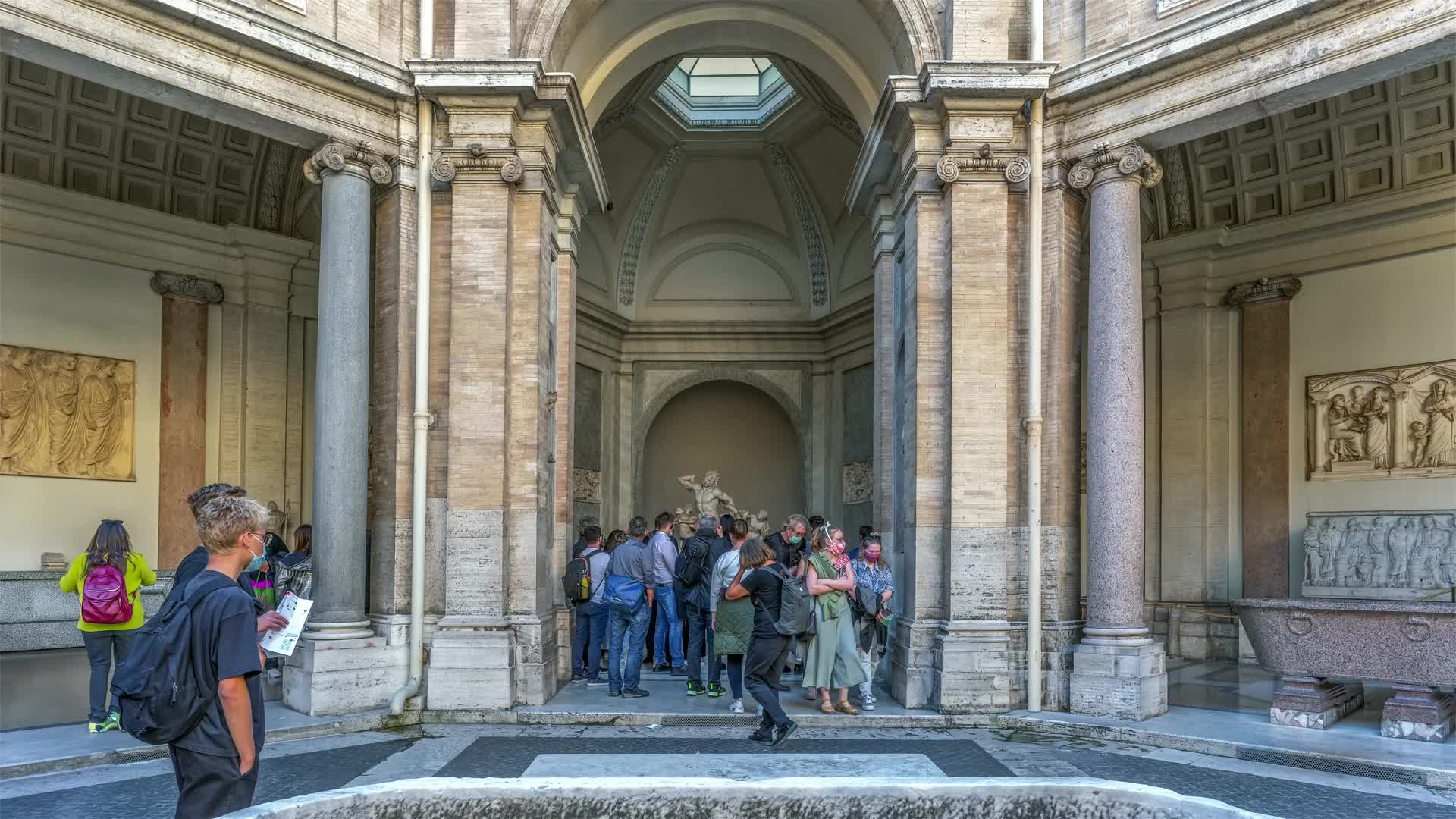
We're standing in the lovely Belvedere Courtyard at the Vatican.
This courtyard was commissioned by Pope Julius II, built by the great architect Bramante and housed even then some of Pope Julius II's growing collection of ancient sculptures.
And today, still in the Belvedere Courtyard, we see some of the masterpieces of ancient sculpture that were collected by the popes.
Now we're standing and looking in a niche that contains the famous sculpture of Laocoon and his sons.
I think often, when we think of classical sculpture, marble sculpture you might think of, for instance, one of the sculptures that occupies a nearby niche the Apollo Belvedere.
That is, this upright nude figure with his arm raised.
An expression of the beauty of the human body, but not this sculpture.
This is all about agony.
This is all about pathos, in opposition to the nobility expressed.
In the Apollo Belvedere, we have a figure writhing in pain.
The image that we're looking at is a story that comes to us from ancient literature.
I think many people are familiar with the great epic poems by Homer of the Odyssey and the Iliad.
And in fact, the story that we're looking at comes from that tradition.
The Greeks and the Trojans are at war.
The Greeks build a wooden horse and they hide soldiers within that horse in the hope that the Trojans open the gates of their city and bring in this beautiful wooden horse, at which time the Greek soldiers will come out of the horse and take the city.
There were Trojans who spoke against bringing the horse inside the city gates, most specifically the priest Lacoine.
When Laocoon did this, it angered the gods Poseidon and Athena, who were on the side of the Greeks.
And so they punish Laocoon, who was in the middle of making a sacrifice, and also punish his sons.
And that's basically what we see here.
We see the older man, who is actually seated on the altar, surrounded on either side by two sons, all intertwined by sea serpents, by these snakes that have been sent by Athena and Poseidon to kill them.
Now there are many ancient sculptures that are described in literature, specifically by Pliny, the ancient Roman historian.
But those are essentially all lost.
But there's one that he did describe of Laocoon.
And so when this sculpture was discovered in 1506, it was immediately recognized as the one described by Pliny.
Pliny says that he saw this sculpture at the palace of the Emperor Titus.
Now he does say that it was carved from a single block of marble, when in fact this is carved from six.
Nevertheless, scholars feel very confident that this is the sculpture that Pliny was talking about.
And it's incredibly exciting when we can tie ancient literature and ancient sculpture together.
And what a sculpture it is.
Well, they knew it was an amazing sculpture as soon as they started to unearth it, because they immediately called Michelangelo.
And within a year of its discovery, the Pope Julius II had added it to his collection and brought it here to the Vatican.
The twisting, writhing figure of Laocoon, the articulation of each of his muscles.
We can see how Michelangelo would have become so excited when he saw this sculpture and the impact that this had on his art.
It looks like it could be one of the ignudi on the ceiling of the Sistine Chapel.
This incredibly complex pose, but here with a kind of emotional intensity that is generally associated with a late stage of ancient Greek art that we know as the Hellenistic.
So we might think about other late Hellenistic sculptures like the Nike of Samothrace or the figures on the great altar of Zeus at Pergamon.
These figures that are full of energy and movement and move out into the space of the viewer and engage us.
This was a time in ancient Greek art when all of the lessons of the classical had been learned, but its restraint was thrown off, so that these figures moved with a newfound freedom and expressiveness.
Now we're talking about this as a late stage in Greek art, but at this moment, Greek and Roman art are basically one and the same.
Rome has conquered Greece.
Greek art is the most fashionable thing one can own if one is a Roman aristocrat.
So, while this is a Greek subject and while the style is derived from this late stage of ancient Greek art that we know as the Hellenistic, this is sculpture that most likely was in fact Roman and was probably produced by three artists from Rhodes who had traveled to what we now call Italy.
Although we look at this sculpture and it seems remarkably intact, it was discovered in pieces and was reconstructed, and there has been debate over the years as to exactly how to put it back together.
But there's another important thing to remember, and that is that we're seeing the sculpture as white marble, but when it was created it would have been painted and we think it would have been quite bright, which is almost impossible for us to imagine today as we stand in the Belvedere Courtyard surrounded by white marble sculpture.
But the Greeks and the Romans painted their sculpture in bright colors.
And the traces of paint do allow for greater insight into the sculpture.
For example, some art historians have looked at traces of paint in the eyes and have deduced that perhaps Lagoin has been blinded by the bites from the serpents.
And so here we are in a Renaissance courtyard in the Vatican looking at a story that comes down to us from ancient Greece, but that may have been commissioned for an ancient Roman imperial palace.
This is a sculpture that was made for the highest level of power in the ancient world.
This connection between ancient Greece and the early emperors of Rome all come together here in the fabulous Belvedere courtyard.