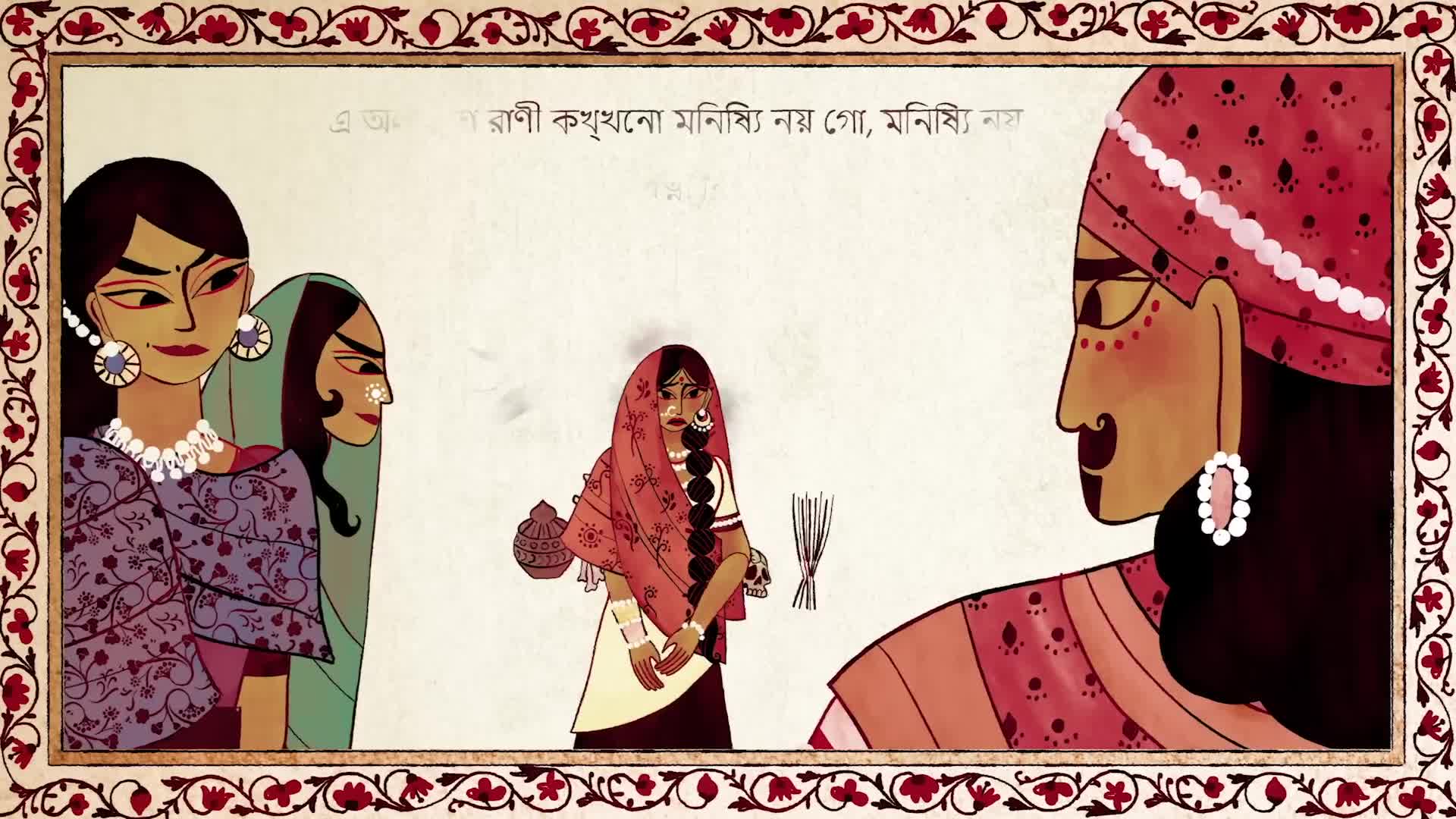
Long ago in a land far away, the queen was panicked, her grasp on reality seemingly slipping.
She had given birth to two boys and one girl but, to her horror, before even meeting their father, each child vanished, something else taking their place.
She faced accusations of witchcraft and demon sorcery, and though the king loved her, he was easily swayed.
He soon grew doubtful and banished his wife, who left the kingdom in anguish.
Little did they know the queen's jealous sisters were the ones to replace the newborns with unhuman items.
They stashed the babies in earthen pots and tossed them into the river, and the currents carried each to the home of a holy Brahman who cherished the children as mysterious blessings and named them Orun, Borun and Kirunmala.
They proved more and more extraordinary as they grew.
Kirunmala especially wise and skilled beyond her years.
Once the Brahman passed, the siblings devoted themselves to the home he left them.
One day, a visitor, desperate with thirst after losing his way on a hunt, sought their help.
It was the king.
The years hadn't been kind to him, but under the siblings' care he felt life brighten inexplicably and was sorry to say goodbye.
Inspired by the king's visit, the siblings began building a palace, traveling far and wide to collect rare jewels, seeds and marble slabs.
Their home became so exquisite that even the divine architects envied it.
When a holy man stopped by, he told them of a magic mountain east of north and north of east, where they'd find their most meaningful treasures.
But, he said, only a true hero could complete the journey.
First, Orun departed, leaving behind a sword.
When it rusted, Kironmala knew an awful fate had befallen him.
Next, Borun attempted the quest, But when his bow splintered, Kironmala understood she'd lost him too.
Determined to rescue her brothers and finish the journey.
She tended to her plants and animals, donned the disguise of a prince for safety, sharpened her sword and set off.
She hadn't trained in hunting or fighting like her brothers, and yet Kironmala ran with the speed of wind and boldness of fire.
She scaled Magic Mountain into the sky, dodging lightning bolts all the way.
At the peak, she found herself on a bejeweled path leading towards a glittering tree, but blasted statues were strewn around her.
These, she realized, were the remains of all the men who'd fallen on the quest, including her brothers.
Suddenly, she was besieged by wild animals and malicious monsters, their voices rising in a cacophonous chorus.
They menaced, snapped, lobbed vicious threats, and warned her to leave before it was too late.
But Kironmala stilled her mind and kept her gaze fixed ahead.
She wouldn't turn back and she wouldn't respond.
She landed one step after another until she finally reached the tree where a golden bird greeted her as a worthy hero and told her to beat the gong at the tree's base.
With one strike, she quieted the deafening din.
And at the bird's instruction, Kironmala sprinkled the fountain's pearly waters across the land.
As she did, the once-doomed princes sprang back to life and bowed before her.
She embraced her brothers, then cut one branch from the tree, collected water from the spring and settled the bird on her shoulder for the journey home.
News of Kironmala's heroic deeds and heavenly home spread until reaching the ears of the lost, regretful king.
He paid a visit for dinner and once again felt a glow in the siblings' presence.
But when he noticed the table was set with inedible jewels and went to complain, the golden bird retorted that if humans couldn't eat gold, rubies and pearls, how could they give birth to kittens, puppies and dolls?
With this, the king finally understood that his queen was the victim of an ugly trick, one he'd been foolish enough to fall for.
These, he realized, were his children, more incredible than he thought possible.
As the golden bird unraveled the story of their separation, Kiranmala determined to clear her mother's name and fully reunite their family.
The stories that we pass down help us better understand the past, and sometimes even the present.
Subscribe to this channel and never miss a myth.