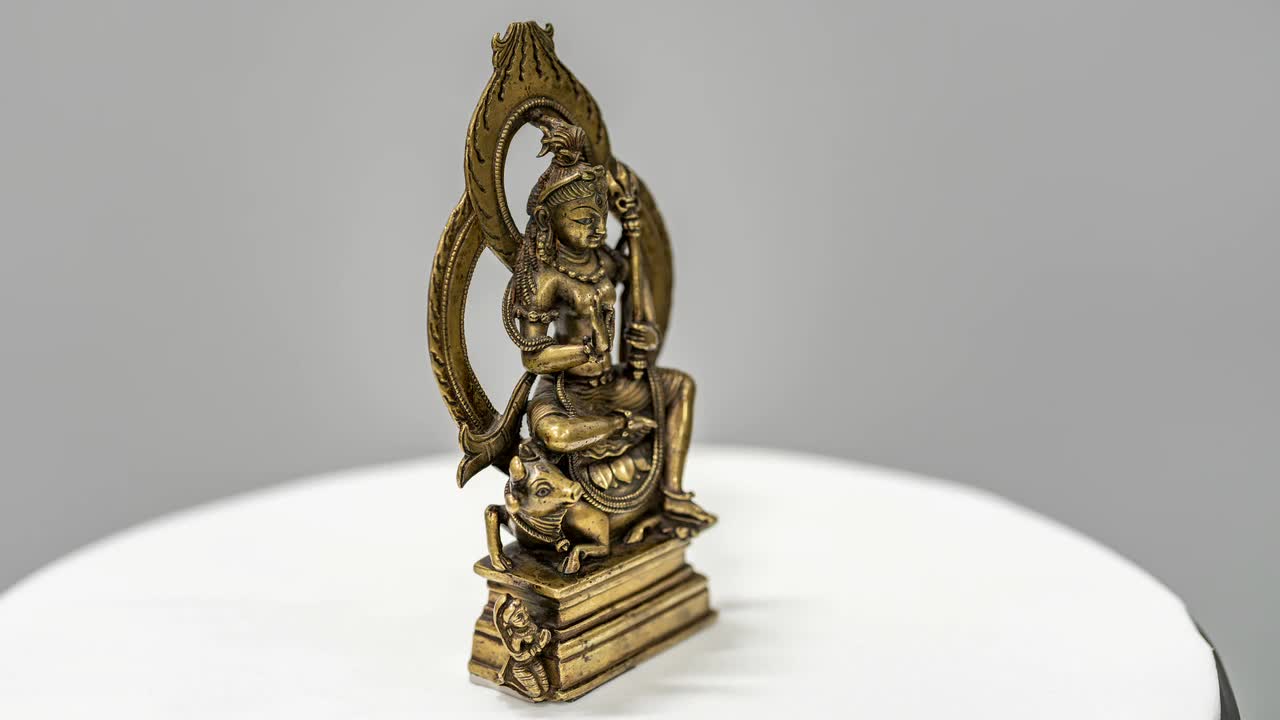
We're looking at a beautiful and very old sculpture in the collection of the Rubin Museum of Himalayan Art.
It's clearly representing a goddess, and it was made in the Kashmir Valley.
Her attributes suggest that she is assuming the qualities of Shiva.
Now Shiva is one of the most important gods in the Hindu pantheon.
And among his characteristics are a third eye, a crescent moon, and then she holds a symbol of Shiva called Trisula.
She also holds a string of prayer beads made of special seeds called Rudraksha, which are associated with Shiva.
And another feature that ties her to Shiva is her lower garment, and has parallel striations that are indicative of a tiger's pelt.
There's also this wonderful garland, this string of flowers that wraps around her shoulders, over her arms, through her legs and just under the petals of the lotus blossom that she sits upon.
And it is another iconographic feature of Shiva.
Now those lotus petals are supported on the back of Nandi, a bull that is the vehicle of Shiva.
So all of this iconography is pointing to this important Hindu god, except here we're seeing a goddess.
The sculpture represents not Shiva but Shiva's consort, who usually is Parvati.
In fact, our records indicate that the sculpture was identified as Parvati when it came to the Ruben.
Parvati means she who dwells in the mountains, and Kashmir is a high valley surrounded by high mountains.
Scholars have noted that she may be associated with Kashmir as a whole.
And one important text about the origin of the valley of Kashmir.
It mentions that goddess Uma is the same as Kashmiri.
So we're really dealing with three identities here.
There is the goddess Parvati, but this is also Uma, who is the consort of the god Shiva.
Uma is also the same as Kashmiri.
So these various identities are nonetheless all flowing into each other in this specific representation, because this is Parvati, she has iconographic features of Shiva and she is also Kashmiri through this connection to the consort of Shiva Uma.
Her worship is especially important to women.
If you look just below Nandi's head, there we see a female figure and you can see that she's kneeling and you can see that her hands are together in prayer.
This is the image of a patron, a woman who probably commissioned this sculpture.
I love the way that Nandi is looking up at us.
The eyes seem so present and look at the way that they've been incised so that they're actually not so different from the ways that the eyes of the goddess are handled.
The neck has these wonderful striations just like you might see on a bull.
And I really like that.
His pose indicates that he's very attentive, probably attentive in service of the goddess.
This brings us to discussing some of the stylistic features of the sculpture, which help us to place it as being created in the Valley of Kashmir.
You can look specifically at the rounded forms, the full breasts, very narrow waist.
The particular feature of the belly that has this very interesting diamond-shaped feature of the navel is a typical characteristic of Kashmiri sculpture.
Her eyes are also almond-shaped, not bow-shaped, as can be found in Eastern Indian images of the time.
And the overall proportions are also typical of the sculptures created in about that time period.
Another prominent feature is the incised eyebrows that are quite high and, of course, the inlaid silver in the eyes, visible in the face of the goddess as well as in the face of Nandi the bull.
And we get a sense of the goddess's importance because she's set before and really framed by this halo.
These incised wavy lines indicate the flames of radiance and you can almost see that the sculpture.
When it was just created, it was much more bright.
The sculpture is hollow cast, at least the base is, and the bottom of the base separated and revealed a consecration scroll with Tibetan mantra on it.
It is also clear that the text was not written by pen and ink, but printed from a woodblock print.
This indicates that the object had a second life within the Buddhist context.
We have not taken the scroll out, and if we would, we may learn more about what particular mantra it is and even potentially, the approximate dates of the paper, which will allow us to understand more about the renewed existence of the sculpture after the 10th century, when it was created.