
[The Iconography and Evolution of a Kashmiri Goddess Sculpture]-[Kashmira]
📋 Summary
Analysis of the Kashmiri Goddess Sculpture
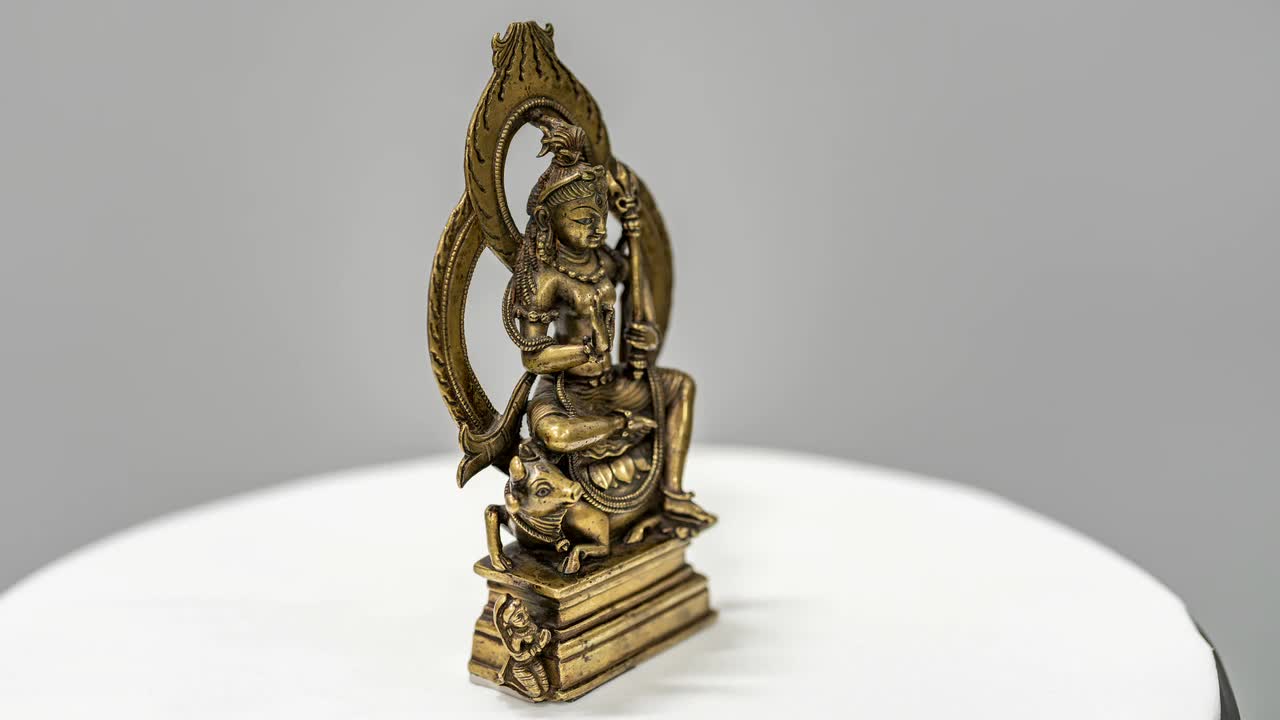
This article examines a significant, ancient sculpture from the Rubin Museum of Himalayan Art, originating from the Kashmir Valley. The piece serves as a complex study of religious iconography, regional identity, and the historical reuse of sacred objects.
The Synthesis of Divine Attributes
At first glance, the sculpture depicts a goddess, yet she is adorned with the distinct attributes of Shiva, one of the most prominent deities in the Hindu pantheon. The figure features a third eye, a crescent moon, and holds a Trisula (a trident associated with Shiva). Further reinforcing this connection, she clutches a string of Rudraksha prayer beads and wears a lower garment with parallel striations that mimic a tiger's pelt.
Perhaps most telling is the garland of flowers that drapes around her arms and legs, an iconographic feature of Shiva, and her position atop a lotus blossom supported by Nandi, the bull that serves as Shiva's vehicle. Despite these masculine-coded attributes, the figure represents the goddess Parvati, Shiva’s consort.
A Triad of Identities: Parvati, Uma, and Kashmiri
The sculpture embodies a fluid convergence of identities. While identified as Parvati—the one "who dwells in the mountains"—the figure is also linked to Uma, another consort of Shiva. Scholarly texts regarding the origin of the Kashmir Valley suggest that the goddess Uma is synonymous with the region itself, effectively making the sculpture an embodiment of the land of Kashmir. This layering of identities allows the figure to exist simultaneously as a mythological consort and a regional personification.
Patronage and Stylistic Markers
The sculpture includes a small, kneeling female figure at the base, hands pressed together in prayer, identifying her as the patron who commissioned the work. Stylistically, the piece is a hallmark of Kashmiri sculpture. Key identifiers include:
- Anatomical proportions: Rounded forms, full breasts, and a narrow waist.
- Specific details: A diamond-shaped navel, almond-shaped eyes (distinct from the bow-shaped eyes seen in Eastern Indian art), and high, incised eyebrows.
- Craftsmanship: The use of inlaid silver in the eyes of both the goddess and Nandi, and the presence of a halo featuring incised wavy lines representing "flames of radiance."
The Second Life: From Hindu Icon to Buddhist Relic
The sculpture possesses a hidden history. The base is hollow-cast and contained a consecration scroll inscribed with a Tibetan mantra. Notably, this text was created via a woodblock print rather than handwriting. This discovery reveals that the sculpture experienced a "second life" within a Buddhist context long after its creation in the 10th century. While the scroll remains inside, it serves as a vital clue to understanding the object's transition and renewed existence throughout history.

Deep Learning with ListenLeap


