Hi, my name is Alex.
Welcome to this punctuation lesson on commas.
This will be very helpful to those of you who are just learning to write in the English language, or especially those of you who are preparing to get into university.
Okay, so we have a couple of different rules.
There are actually more than right now.
We'll put the rest up later.
So let's look at the first rule of using a comma.
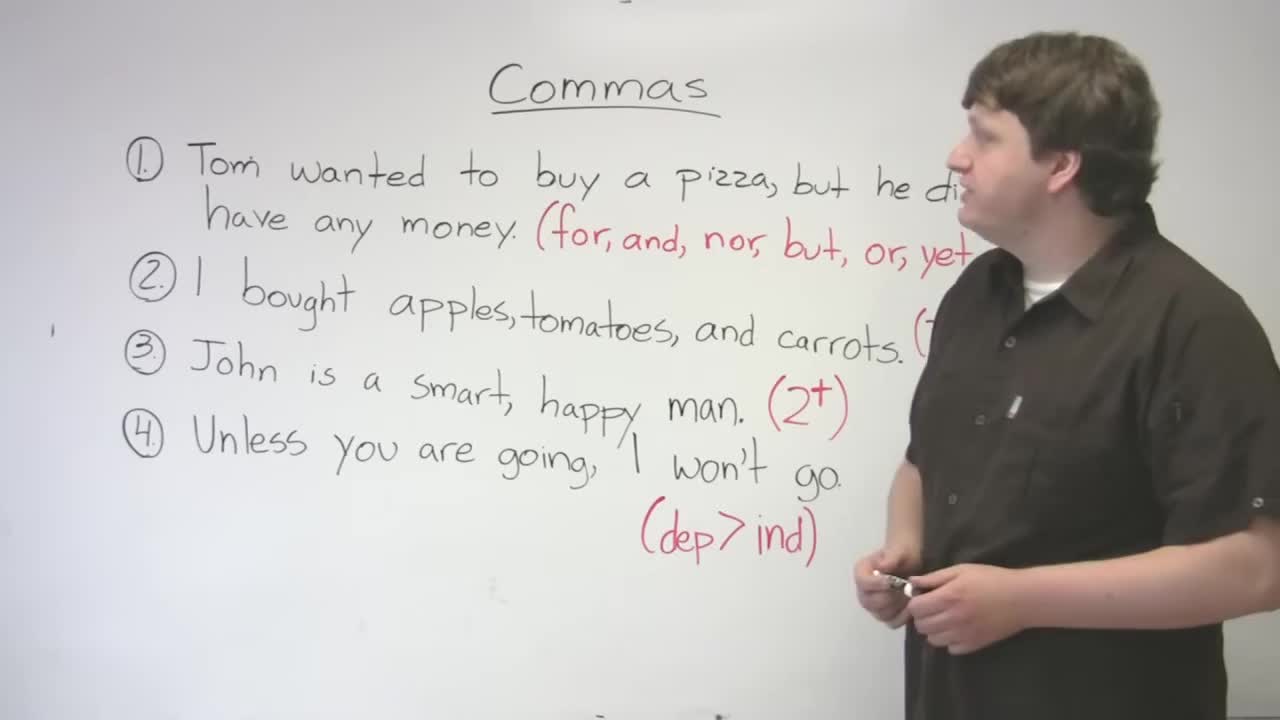
So here I have a sentence saying, Tom wanted to buy a pizza, but he didn't have any money.
So this is an example where you have two independent clauses linked by a linking word.
In this case, the word is but.
And when you have two independent clauses, first of all, what is an independent clause?
An independent clause is a sentence that expresses a complete thought.
So, it's a full sentence.
So, for example, Tom wanted to buy a pizza is one independent clause.
The other independent clause is he didn't have any money.
He didn't have any money.
We link those two independent clauses with one of these small words.
In this case, we used, but.
Tom wanted to buy a pizza, but he didn't have any money.
Now, anytime you have.
If you have a shorter sentence, for example though, you do not need to put the comma, but it is.
Not exactly advisable, but it's an option for you as well.
So, for example, if you had a sentence like I was running but I fell, or I was running and I fell down, you wouldn't really need to put the comma after I was running comma and I fell because it's a shorter sentence.
But for longer sentences where you have two independent clauses, you should put the comma.
Especially when it's linked by one of these words of for, and, nor, but, for, yet, or, so.
Okay, second example where you would use a comma is when you have a list of three or more items.
So let's say you're going to the grocery store.
I bought apples, comma.
Tomatoes, and carrots.
Just remember, you put the second comma in there as well when you have three or more items.
Third rule, similar to the second rule, except now we're talking about adjectives.
So when you're describing someone and using two or more words to describe them, Or not necessarily someone it can be something.
You can be describing a car or a table, a house, anything.
Anything where you can use an adjective.
John is a smart, happy man.
One adjective, smart, two adjectives, man.
John is a smart, happy man.
Okay, let's look at the fourth rule.
Unless you are going, I won't go.
Now, this is an example of a dependent clause coming before an independent clause.
So a dependent clause is one that is not a complete sentence.
It's not a complete thought.
It needs something else to help it become a full sentence.
So, unless you are going, does that sound like a full sentence to you?
No, it's not a full sentence.
Okay?
It begins with, again, unless you are going is not a complete sentence.
It needs something else, right?
I won't go.
So if the sentence begins with the dependent clause, unless you are going, you would have to put comma there.
I won't go, okay.
Another example would be because it was raining, I didn't go to school again because it was raining.
You need something else there right, if you want to avoid using the comma.
In that case, you could actually flip the sentence around and say I
I didn't go to school because it was raining.
But if the dependent clause comes first, you have to put the comma there.
Okay, we'll look at the other rules in a second.
Okay, did you get all that?
So let's continue with our rules.
So rule five that we're looking at here.
So when you want to give extra information on someone in the middle of a sentence, this is what we call an adjective clause.
In this case, kind of like an unnecessary adjective clause.
We would say, Lucy.
We want to say more about Lucy.
Lucy, who is a tall woman, climbed the tree.
So we're giving extra information on Lucy in the middle of the sentence.
Lucy, who is a tall woman, climbed the tree.
Let's look at rule six.
Now this one is very simple.
When you are writing and you are quoting someone, a direct quote, you have to put a comma.
So Mark said, comma.
I want some candy.
You're directly quoting Mark.
Now, you must keep in mind, this must be a direct quote.
For example, you cannot put a comma.
You don't have to put a comma when you said, Mark said he wanted some candy.
You're not really quoting him.
You're just saying, Mark said he wanted some candy.
But unless, if you are saying, Mark said, I want some candy.
You must put that comma right there.
Okay.
Number seven.
Now, I put attention with an exclamation mark.
When you want to get someone's attention in your writing, if you're writing a story, for example.
The example I have here is Racing.
John is a very popular sport.
You want to get John's attention.
Another example would be, you, sir, are not fit to drive.
For example, if you're a police officer pulling someone over.
So when you want to get someone's attention, you have to put a comma before their name.
And finally, when you are using a transition word.
Transition words are something else you'll have to look up.
So words such as therefore or consequently, you have to put a comma before that.
So the example I have is Susie didn't study, therefore comma, she didn't pass transition word.
Okay, Susie didn't study because she didn't study, or therefore she didn't pass comma after the transition word.
Okay, so to ensure that you have these rules down, you can check out the quiz for this lesson at engVidcom, as well as other videos.
Thanks again for watching.
My name is Alex.
Take care, Thank you.