
[A Comprehensive Guide to English Comma Usage]-[How to Use Commas in English Writing]
📋 Summary
Mastering the Comma: Essential Rules for English Writing
Proper punctuation is a cornerstone of effective English writing, particularly for students preparing for university. In this guide, we break down the eight essential rules for comma usage as outlined by Alex, providing clarity on when and where to place this critical punctuation mark.
1. Linking Independent Clauses
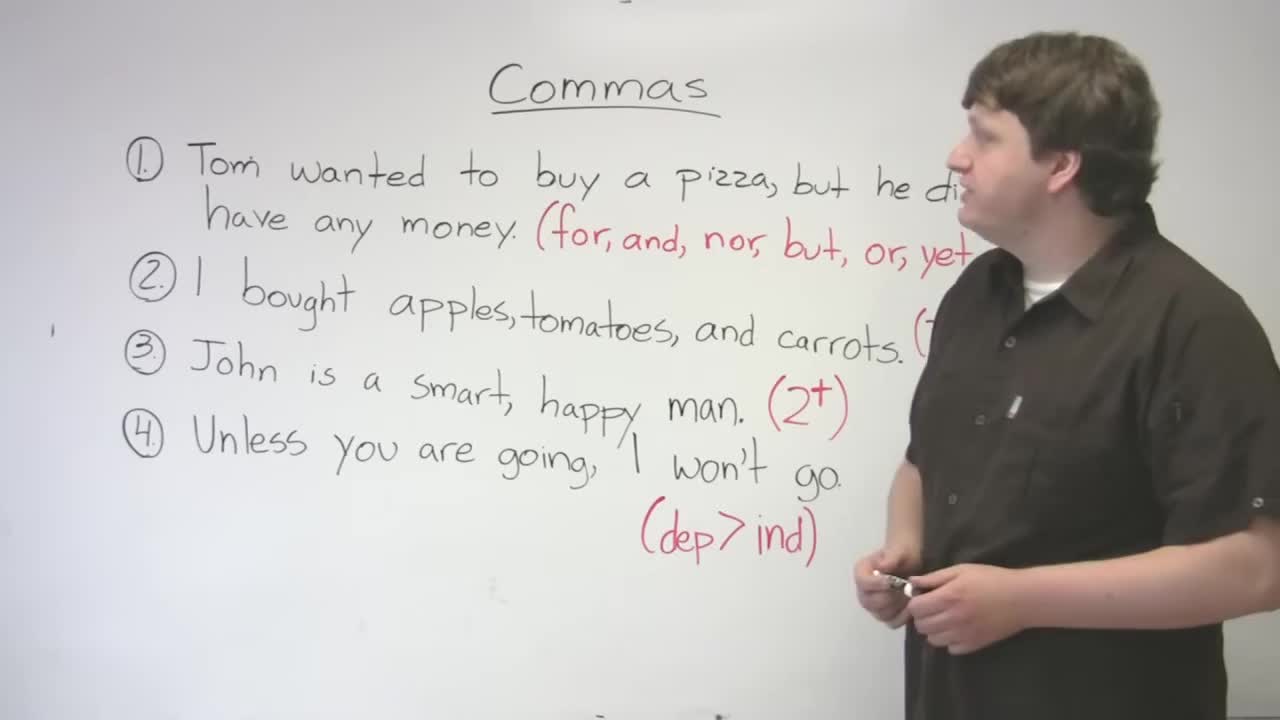
When you have two "independent clauses"—sentences that express a complete thought—linked by a coordinating conjunction (such as for, and, nor, but, or, yet, so), a comma is necessary. For instance, in the sentence, "Tom wanted to buy a pizza, but he didn't have any money," the comma precedes the word "but." While shorter sentences may occasionally omit the comma, it is highly advisable to use one for longer, complex sentences to ensure clarity.
2. Enumerating Items in a List
When listing three or more items, use commas to separate them. For example, "I bought apples, tomatoes, and carrots." Always remember to include the comma before the final conjunction to maintain proper structure.
3. Separating Coordinate Adjectives
Similar to lists, commas are required when using two or more adjectives to describe a single noun. In the example, "John is a smart, happy man," the comma separates the descriptors "smart" and "happy," effectively modifying the noun "man."
4. Introducing Dependent Clauses
If a sentence begins with a "dependent clause"—a phrase that is not a complete thought—you must place a comma before the independent clause follows. For example, "Unless you are going, I won't go" or "Because it was raining, I didn't go to school." If you rearrange the sentence so the independent clause comes first, the comma is typically unnecessary.
5. Inserting Non-Essential Information
When you include extra, non-essential information in the middle of a sentence, such as an adjective clause, use commas to set it off. In the sentence, "Lucy, who is a tall woman, climbed the tree," the phrase "who is a tall woman" provides additional detail about Lucy and is framed by commas.
6. Using Commas with Direct Quotes
Direct quotations require a comma to introduce the spoken words. For example, "Mark said, 'I want some candy.'" However, if you are paraphrasing indirectly—such as "Mark said he wanted some candy"—a comma is not required, as you are not quoting the speaker directly.
7. Addressing Someone Directly
When you want to capture someone's attention or address them directly within your writing, place a comma before their name or title. Examples include, "Racing, John, is a very popular sport," or "You, sir, are not fit to drive." This rule is vital for clarity in narrative writing or formal communication.
8. Utilizing Transition Words
Transition words, such as "therefore" or "consequently," act as bridges between ideas and should be followed by a comma. For example, "Susie didn't study; therefore, she didn't pass." The comma after the transition word helps pace the sentence and signals the logical conclusion to the reader.
By mastering these eight rules, writers can significantly improve the flow, accuracy, and professional quality of their English compositions.

Deep Learning with ListenLeap


