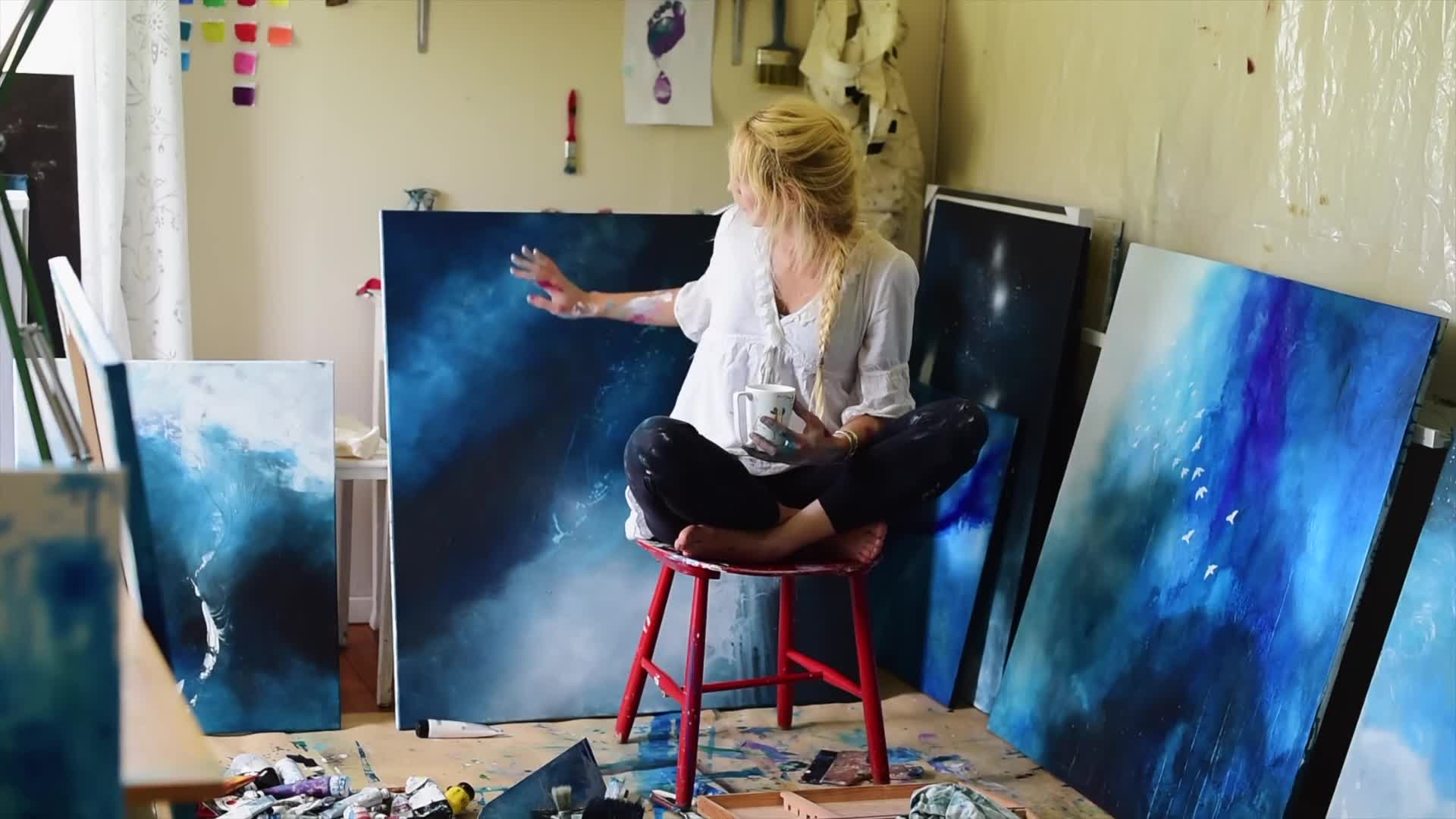
It's about eight years ago now, as I first got interested in art and painting and bought my very first brushes and colors.
I watched some simple tutorials on YouTube and started to learn myself and explore to find my own way of painting.
It took me some years to really find my own style, but no matter what technique or colors I've been using during these years, my one and only inspiration has always been nature.
I live in this beautiful place surrounded by endless forests and lakes in the north of Sweden.
And it's impossible not to feel inspired by the beauty around me.
No matter if I create music or videos or photography or paintings, nature is always the heart in everything I do.
And the constant changing seasons is reflected in my paintings.
Last year, as I was picking blueberries in the forest, I got an idea to try to make my own paint out of the blueberries.
And as I tried it out, I really liked it, and I quickly got curious and began to explore more of the natural pigments around me and learned to make paint out of them.
I found a lot of beautiful pigments from the fire stoves that keeps our house warm in the winter.
I used charcoal to get black pigment.
And from the ashes I could get many beautiful tones of grey and brown.
And stones was also a great source to all different kinds of pigments.
And mud and dirt and sand also turned into beautiful colors.
It felt like a whole new door opened up in front of me.
And I fell in love with making my own paint.
It didn't matter that it suddenly took me way more time to finish a painting.
The whole process of picking the materials and then preparing the pigments made it all feel more meaningful.
And it gave my paintings a whole new dimension.
I love to feel the texture of the natural materials.
And when I look at a finished painting, I know exactly the story of every single pigment.
Where I picked them and how they ended up on the canvas.
So now I'm not only inspired by nature when I paint, but nature has become part of my paintings.
And I really love that.
Ever since I started making my own paint out of natural materials and shared it on my vlogs and videos on YouTube, I've got tons of questions from people asking how I make paint out of these natural pigments.
So, I thought I would share step by step the whole process of how I make my own paint.
And remember, when it comes to creativity, I think that the best way to create art is not to be limited to one way of doing something.
I think that the key is to be playful and curious and try new things and not get stuck in how we are supposed to do something or how other people do it.
Be free and have fun and play around and see what happens and what works for you.
Every time I paint, I see it as an experiment because I never know how the result is going to be.
Absorb what inspires you and then let yourself bloom in your own unique way.
So, as an example for how I make my paint, I will use this yellow rusty sand from my garden.
I will step by step show you how I turn it from this raw material to this paint on the canvas.
First of all, when you work with materials like sand or stones, it's really important to wear a mask so you don't inhale all the dust and smoke.
I begin by using a strainer to get out all the stones or bigger pieces.
I usually do this a couple of times until I use the strainer with the finest dimensions to really get the sand as soft and clean as possible.
And then it's time to use a mortar.
Don't add too much sand at once, it will only make it harder.
I always spend a lot of time at this step, since the quality of the pigment will be much better the smaller pieces you get, and it will also be much easier to paint with.
Try to make it as much as a powder as possible.
I then put the pigment into a jar, and that's how I keep all my pigments that are ready to be used for paint.
Then it's time for the step to make this sand into paint and it's very simple.
I put some pigment into a cup and then I add some water.
Then I need to add some kind of a binder to give it a thicker consistency and to make it get stuck to the canvas so it doesn't fall off as the pigment dries.
And there are many ways you can do that.
It all depends on what painting technique you use.
I have always painted with acrylic colors and I love to paint in different layers, so I just add an acrylic medium.
For example pouring medium or glazing medium.
The very first time I tried to make my own paint, I just took what I had at home and it's been working great so far, so I have just continued with that.
And then it's ready to paint with.
And this is the basic process that I use for all the pigments.
And I also often mix different pigments with each other to create new colors and tones.
It's always interesting to see how they react with each other.
And I sometimes mix these natural pigments together with acrylic colors to create, for example blue, since I have not yet been able to find a blue pigment where I live.
In the beginning I used blueberries, but after some experience I found out that the pigments from, for example, plants or berries fades out after a while and turn into brown.
And to make white pigment.
I often mix white quartz stones with limestones and then some white acrylic to make it more strong and visible.
Every time I paint, I learn something new, and I really look forward to keep exploring ways of using natural pigments for my paintings.
I think it's something very fascinating about using pigments that I can find here at my home.
And it feels beautiful to be part of the whole process when making my paint.
And I really hope that this could give you some inspiration to try it out yourself.
And remember, creativity is meant to be free.
Just let it flow.