We're standing in the galleries at the William Harvey Museum of Art on the campus of Talladega College.
We're fortunate to be standing among Hale Woodruff's masterpieces.
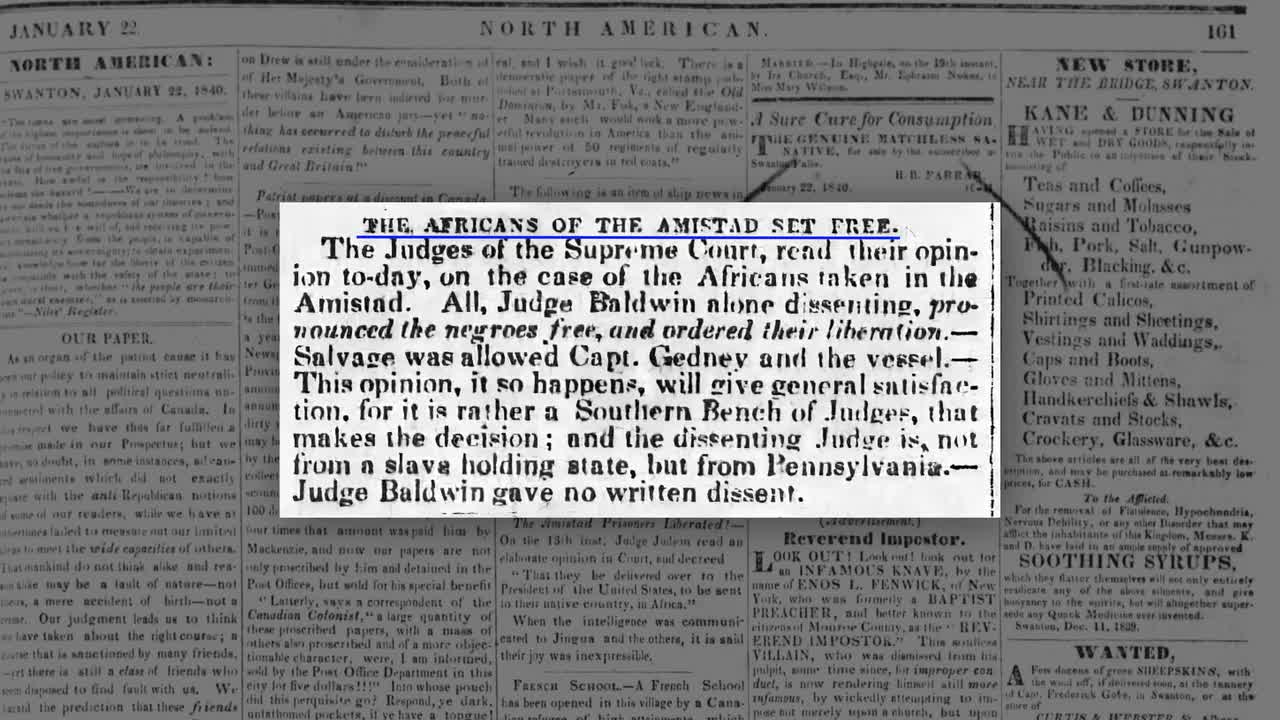
And this is the third canvas in a three-part series that he was commissioned to paint for the library here at Talladega on the story of the Amistad, the slave ship that carried 49 men, four children, to enslavement on a plantation in Cuba.
The mutiny and the historic trial that followed was so important for the foundation of Talladega College itself and so many other colleges across the region.
This painting of the repatriation we see many of those who survived the transatlantic crossing and the terrible events that followed.
But those that did survive and who chose to go back to Africa after they were set free, essentially by the United States Supreme Court, here they are, returning home, this place that they must have longed for in their hearts for so long.
We have Sinque at the center as the leader, as the teacher, in company with the other two missionaries who are there as his comrades, with a mission towards the establishment of societies that would further empower the Mende people, understanding that they could not do that work alone.
They learned from their time in the U.S., but they also taught.
They stay in Africa with the intention to build better society together.
And one of the things that strikes me is that we have white figures and black figures who seem as though they're working for common purpose.
We see the dignity of the returning Africans to their homeland.
The gentleman with the red vest kneeling, freed from this mental and emotional torment that he had endured, and then now at home in the center, in the heart of the canvas, is the sky and clouds and birds.
And the two central figures are on either side of that.
Below that, the excitement of the figures who are returning home.
But I'm so aware of the ocean that separates Africa from the Americas, that separates these two cultures that are so far away and yet so joined together in this cycle of violence, that many of the men here have begun to undo.
Woodruff is painting a story of hope and optimism that now there's a serene scene birds, the ocean, the soil, even at the far end, the bird of paradise.
And it reminds us too, that there's tremendous violence and warfare on both sides of the Atlantic that need healing.
That is the piece that Woodruff is trying to convey, that you can't do this work alone.
They understood that there was more work to be done once they got home and now returning with a new sense of purpose and they are bringing books to build libraries, to build places of learning and knowledge, but also understanding that their legacy continues in the United States.
And this is really where Woodruff begins to think about the creation of the 1942 works.
He has realized that there's more to this story.
So this seems as though this is the end of the three Amistad paintings, but it marks the beginning of the establishment of the institutions that I call the AMA schools.
Fisk University, Berea College in Kentucky, Hampton University in Hampton Virginia.
Lemoine Owen College in Tennessee, in Memphis Strait University.
Tougaloo and Strait have one president that goes between both of those institutions.
These murals tell the story of that 1839 incident, but it also tells the story of the establishment of the college.
So that these colleges are not seen as these one-offs.
They have their own individual histories, But I want to emphasize that they are connecting all of these human rights activists.
Adam Beidel, who is this fierce human rights activist in conversation with Dr. King.
He's here at Talladega.
And then later in 1960, he becomes president of Tougaloo.
And these murals tell the story.
It is Buell Gallagher and George Crawford's vision that Talladega becomes the memorial to all of them.
It is the only institution, of all of the institutions that were established by the AMA, that visually depicts the history of the founding of these institutions.