We're standing in the beautiful galleries at the William Harvey Museum of Art in Talladega, Alabama.
We've been looking at the murals by the early 20th century artist Hale Woodruff.
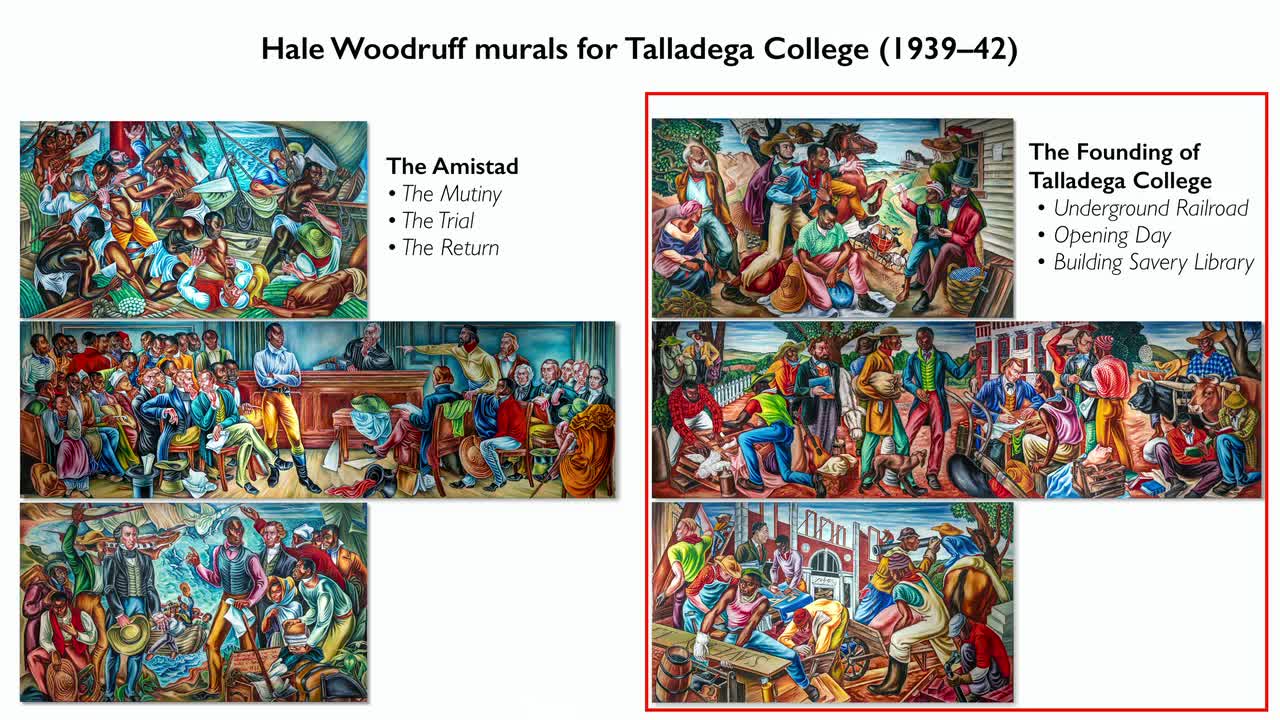
The two cycles that Woodruff painted here the first three about the Amistad rebellion of the enslaved people and then, in this final series, about the Underground Railroad, the building of Savory Library.
This one is opening day 1867, and good to remember that literacy was illegal among the enslaved.
It was illegal.
They were either killed, tortured, or even trying to learn to read.
So you can imagine that they were eager to educate themselves.
You can see the eagerness in the students.
They're students that are already reading. shoes with no shoelaces.
They are slipping on whatever they have to get to this momentous day to become free in their bodies and in their minds.
And so this shows you the activity, the bustling, the animals, the sound.
You can almost hear the sounds.
You can almost feel the excitement.
And Savory, of course, is standing in the center as the leader of this, as a former enslaved person, himself understanding the importance of that.
Savory had actually built one of the buildings that today is part of Talladega campus, Swain Hall.
Then the Emancipation Proclamation freedom, and he comes back and says you know that building that I built.
Let's make that a new home for a school, although the school began as a one-room schoolhouse.
African-American leaders did not view their adoption of the classical liberal curriculum as mere imitation of white schooling.
Rather, they saw this curriculum as providing access to the best intellectual traditions of their era and the means to understanding their own historical development and sociological uniqueness.
So here's Hale Woodruff in the early 1940s, at a time of decades of extreme violence against Black people in the South.
Here he is invited to Talladega to make these murals talk about african-american history and the struggle for freedom.
He's just such a master at storytelling.
The two figures who are reading, the next two pointing to a book, the figure who's enrolling, whose name is being written down.
And our eye slows down and looks at each face and follows the story.
And we meet at the center with William Savory.
Woodruff is thinking about African sculpture.
He was a big fan of African objects and a collector himself.
But he's also gone to Paris, and he's immersed himself in that European tradition of painting.
And Woodruff is learning from the Mexican muralists of art for the public good that reflects the history of the people of the United States, like Rivera's painting The People of Mexico.
It is a beautifully choreographed dance of motion, of excitement.
The carriage pulls up on the left, the figure kneels over the chicken coop.
Everyone is engaged, everyone is looking, everyone is very active.
I think that makes us active as viewers too.
It's as though we want to become part of the conversation that they're having, and good to remember that these were in the entrance room of the library where students at Talladega would see this every day and become part of this history.
You really are in the moment.
You're there and it puts a smile on your face because, although there's chaos, there is also a sense of calm, a sense of reverence.
What you just said made me wonder if the pig and the chickens were a metaphor for what's happening in the painting itself, this yearning for freedom, this yearning for escape.
Indeed.
I believe that it is a metaphor.
It's trying to contain the excitement that you have, but also these looming thoughts around going backwards with, of course, all of the different challenges that lie outside of that picket fence.
And as I stand here with you, I'm thinking about how grateful I am to William Savory, who starts the college along with the AMA and other abolitionists and other formerly enslaved people, which brings us through this history.
And I'm really grateful for that. in such a profound and beautiful way he does.
He centers us, brings us to a place where we can continue to look and reflect.
It is a profound gesture in that moment.