
[Visualizing Liberation: Hale Woodruff’s Murals at Talladega College]-[Hale Woodruff, Opening Day at Talladega College]
📋 Summary
Visualizing Liberation: The Murals of Hale Woodruff
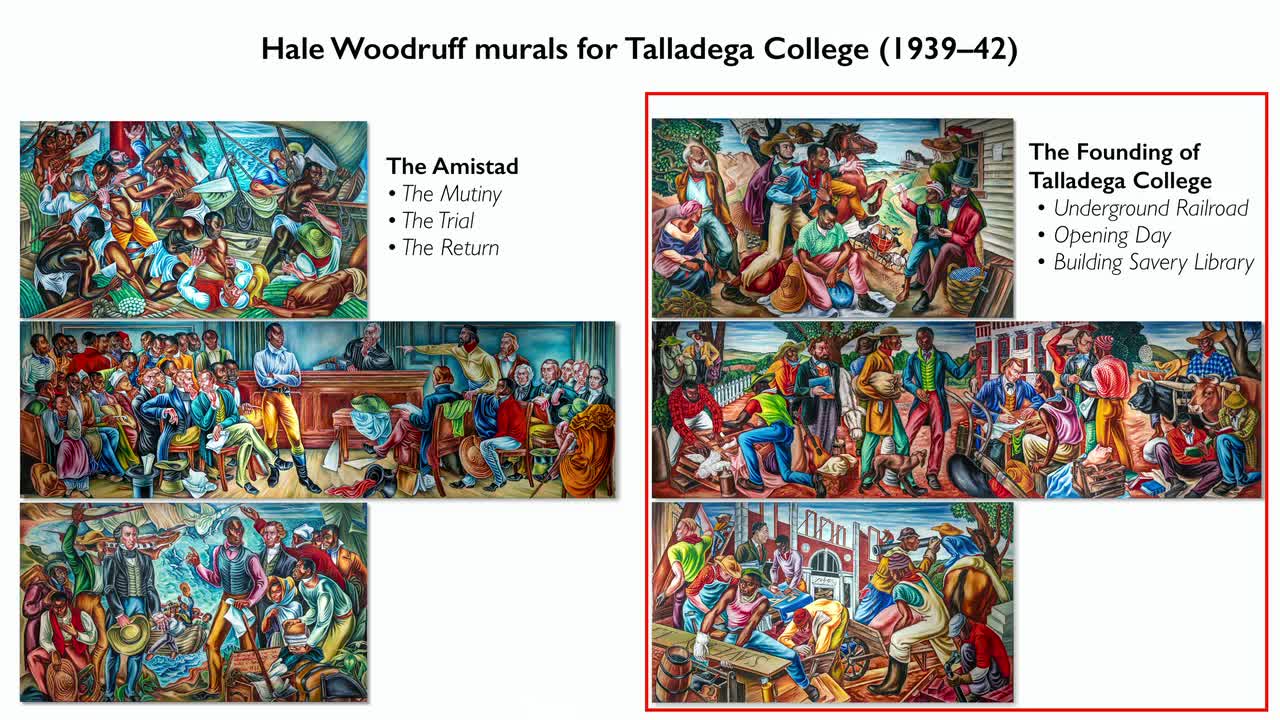
Located within the William Harvey Museum of Art at Talladega College, Alabama, the murals of Hale Woodruff serve as a profound historical record and a testament to the pursuit of freedom. These artworks, particularly the cycle depicting the Underground Railroad and the founding of the Swayne Hall school, capture the raw human struggle and the intellectual triumph of formerly enslaved people in the post-Civil War era.
The Eagerness for Literacy
At the heart of the mural depicting the opening day of the school in 1867 is the theme of literacy. The podcast highlights the historical reality that "literacy was illegal among the enslaved," and those caught attempting to learn were often "killed, tortured, or even trying to learn to read." Woodruff’s portrayal of the students is masterful; he depicts them with an "eagerness" that transcends their material poverty. The visual details—such as students wearing "shoes with no shoelaces"—emphasize their desperate, bustling movement toward "becoming free in their bodies and in their minds."
William Savory: The Architect of Freedom
Central to this narrative is William Savory, a formerly enslaved person who recognized the transformative power of education. Savory’s story is one of reclamation; he had previously helped build the structure that would become Swayne Hall. Following the Emancipation Proclamation, he returned to transform that very space into a home for a school. By centering Savory in the mural, Woodruff acknowledges his role as a leader who understood that the adoption of a "classical liberal curriculum" was not mere imitation, but a strategic move to access "the best intellectual traditions of their era" to understand their own "sociological uniqueness."
Artistic Synthesis and Storytelling
Woodruff’s technique is a blend of disparate influences. He was a "master at storytelling," using his background as a collector of African objects alongside his training in the European tradition and his study of Mexican muralists like Diego Rivera. This synthesis creates a "beautifully choreographed dance of motion." The composition is designed to be immersive, forcing the viewer to "slow down" and examine each face, effectively making the viewer a participant in the historical conversation rather than a passive observer.
Metaphor and the Looming Reality
Beyond the literal depiction of a schoolhouse, the murals contain deeper symbolic layers. The presence of animals, such as the pig and chickens, serves as a "metaphor for what’s happening in the painting itself—this yearning for freedom." The scene is balanced between the joy of the opening day and the "looming thoughts" of the dangers outside the picket fence. Woodruff’s work captures both the "chaos" of the era and a "sense of reverence," ensuring that the history of the struggle remains a living, breathing part of the college environment.
Ultimately, Woodruff’s murals function as a "profound gesture" of memory. By placing these images in the entrance room of the library, the artist ensured that students would interact with their history daily, reflecting on the profound sacrifices made by those who sought to turn a "one-room schoolhouse" into a monument of liberation.
Deep Learning with ListenLeap


