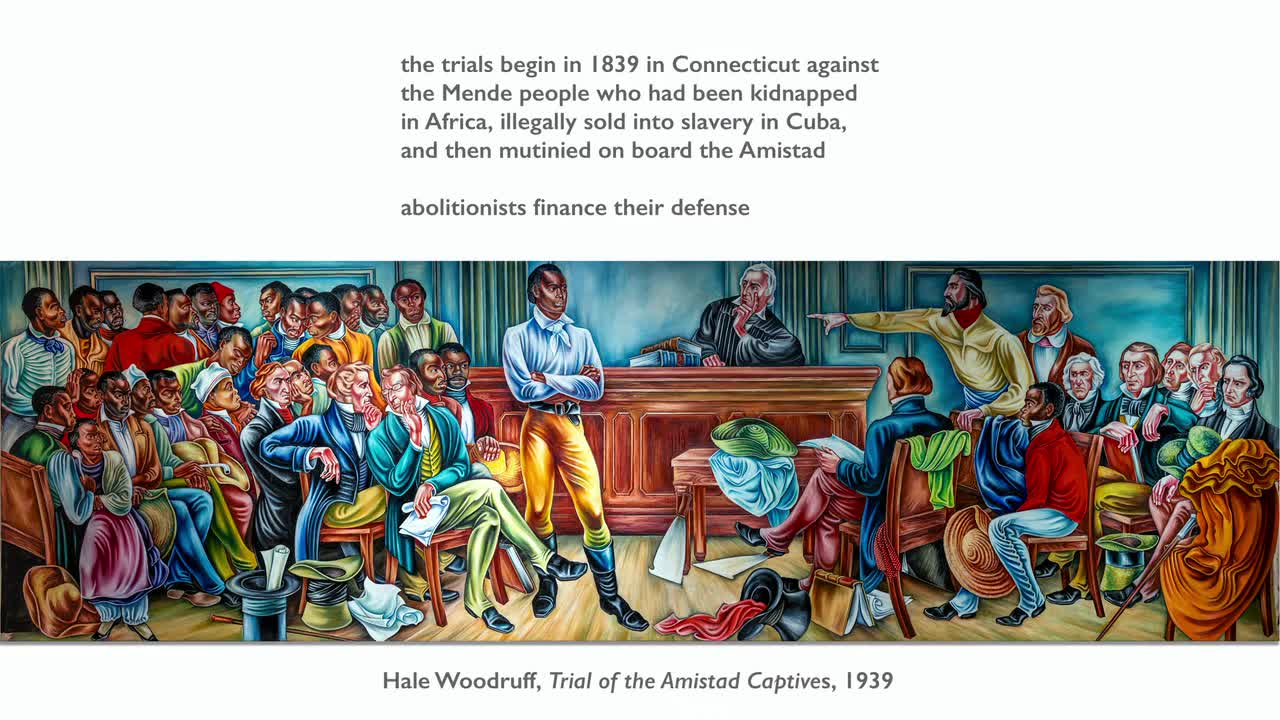
Were on the campus of Talladega College in their beautiful new museum, looking at a very large canvas by Hal Woodruff.
This is the second in a series of six.
Actually, three and three perhaps is a better way of stating it.
And the first set tells the story of the Amistad Rebellion and the aftermath.
The trial begins to talk about the abolitionists who come together to defend the African captives, the Mende people, who were brought from Mende land to Connecticut.
So this is the beginnings of the long court cases that lead to their ultimate return to Sierra Leone.
The transportation of people from Africa to the Americas had been outlawed in the United States, although slavery certainly continued here.
But that didn't mean that renegade sailors might not transport kidnapped Africans to the Americas, and that was certainly taking place, especially in the Spanish Americas.
In 1839, there was an uprising.
They killed the captain, they killed the cook and the ship was eventually sailed to the tip of Long Island.
And there a precursor to the American Coast Guard picked them up, arrested the Africans and brought them to Connecticut.
And so you begin to see all of the players.
The central character is Sinke, who is the leader of the African captives, standing center of the canvas and on the right side of him is Judge Smith Thompson of the US Supreme Court, who presides over the Circuit Court trial.
And Judge Thompson made two primary rulings.
No American court had jurisdiction over the murder and mutiny charges because the crimes had been committed on a Spanish ship in Spanish waters.
Second, the District Court of Connecticut would decide all the competing claims, including whether the African captives were property.
Ruiz and Montez are arguing that the Africans were their property.
The canvas also features Roger Baldwin, the future governor of Connecticut and the defense counsel for the Amistad trial.
Baldwin has two principal arguments.
The captives had been illegally taken from Africa to Cuba.
Second, the ownership papers carried by Ruiz and Montes were fraudulent because the captives were not Cuban-born enslaved persons, but African.
The other important figure is Arthur Tappan.
He and his brother, Louis Tappan, are the large support mechanism for the financing of the entire trial and the entire movement thereafter, and their motivation is to end slavery at a moment when slavery remains completely a part of Southern culture and slavery is just ending in the North.
That's right.
They understood through this work with the Mendecaptives that this work had to be done together as interracial partnership.
The way they formed the American Missionary Association later was with the intention for it to always be blacks and whites working together.
The next figure is Simeon Joselin, founding member of the Amistad Committee, which worked to solicit public donations for the defense and the living expenses for the captives.
He was a Congregationalist minister whose church was the first African American church in the city of New Haven, and he was the founder of New Haven's Anti-Slavery Society.
What I'm really struck by is that these are portraits.
The portraits of the captives are all reminiscent of Mende sculptural figures.
He is really pushing within these canvases all of what it is that he learned while he was in Paris, because he was there when so many artists are investigating the plastic beauty and the sophistication of African art.
And he's then taking that with the research that he did in the Yale archives, looking at sketches of these men and putting those together, this synthesis of this African identity, but also of the individuality of each of these people.
And look at Sinque standing in the center of this large, wide canvas absorbing the direct attack of the Spanish sailors.
Knowing himself, knowing the truth, he becomes this heroic figure and, in fact, a reminder that what Hal Woodruff is producing here is modern day history.
Painting in the likeness of Trumbull's The Declaration of Independence or of Jacques-Louis David's The Oath of the Tennis Court.
These are historical moments that shape a nation.
And Woodruff sneaks himself into the canvas.
He includes himself, interestingly, near Simeon Jocelyn.
I think that he felt a kinship towards Jocelyn.
Jocelyn was a true champion of the cause.
There's a connection that I think that Woodrow feels with Jocelyn.
Well, Jocelyn is rendered with a kind of fiery intensity.
His hair flies back almost as if it's flames.
The nose and the cheekbones and the focus of the eyes are all so steadfast.
The Africans are victorious at this trial.
They are found not to be property, to have been illegally kidnapped.
And the ruling is that they are free.
And ultimately, this case is retried in front of the US Supreme Court.
And so these men, although they were found to be free, languish in prison even longer.
Ultimately they are freed, but it takes this long because the American president is worried about his reelection and capturing the southern vote, and so wants these prisoners to be returned to Spain.
It also begins to uncover the commitment of the abolitionists to continue their work in the 1860s throughout the American South, which they met tremendous resistance.
And a leitmotif of their work, a thread that ties the captives all the way to the AMA's post-Civil War work, is education.
The AMA themselves, Baldwin and Jocelyn, the Tappan brothers.
They used the systems that they felt would allow them to achieve their ultimate goal to eradicate slavery and systems of caste.
So education became that focus.
They understood that that needed to be done through interracial communities in the form of schools.
I call them race relation laboratories.
And here we are on the campus of Talladega, one of the schools that the AMA helped to found.
And this painting is such a testament to that idea of an integrated society.
Gallagher and Crawford.
George Crawford, who is a graduate of Talladega Buell Gallagher, who's the president, commissioned Woodruff to paint these murals.
But importantly, they are building this memorial called Savory Library.
I call it a memorial to freedom.
It was during this time in which memorials throughout the South commemorating Confederate soldiers, the idea of the Lost Cause.
At the same time, the Savory Library Memorial to Freedom was also going up and being built by both black and white citizens of Talladega, and Savory Library is a testament to that partnership.