
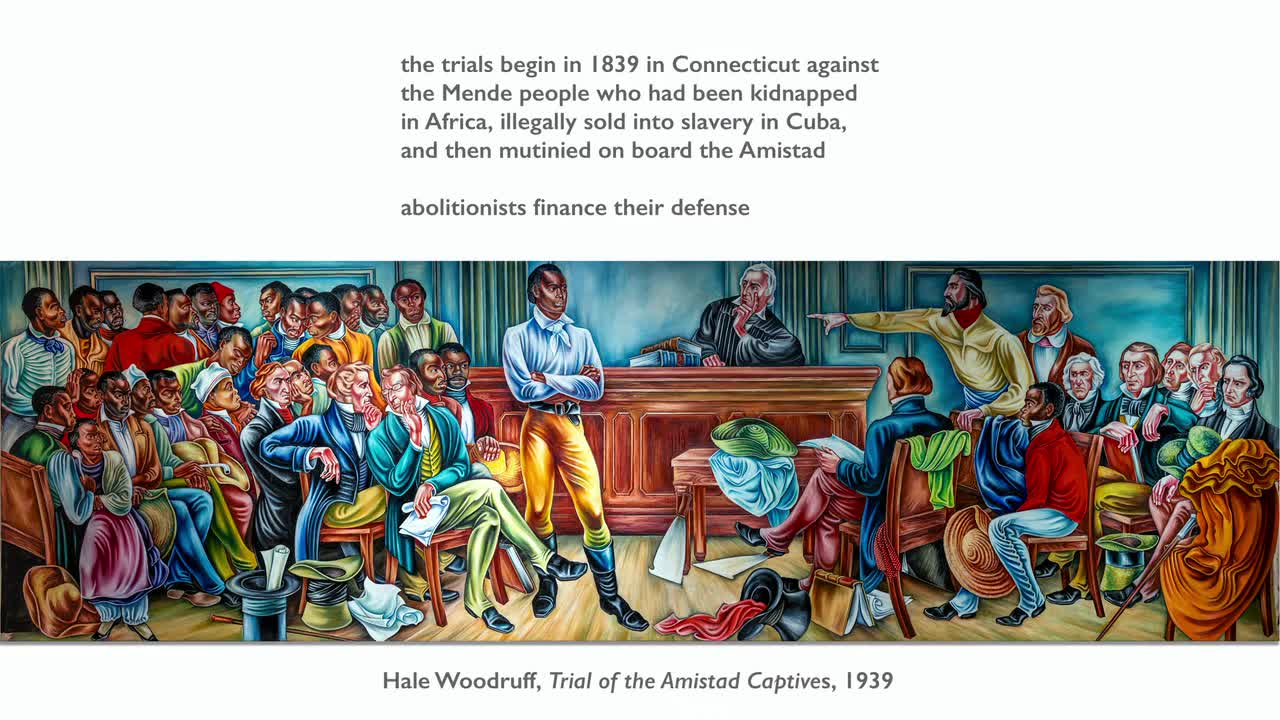
[The Amistad Rebellion and the Legacy of Hal Woodruff’s Murals: A Testament to Freedom and Education]-[Hale Woodruff, The Trial of the Amistad Captives]
📋 Summary
The Amistad Rebellion: Painting the Path to Justice
At the heart of Talladega College lies a profound artistic and historical narrative: a series of six monumental canvases by artist Hal Woodruff. Among these, the depiction of the Amistad Rebellion serves as a powerful historical record, documenting the struggle of the Mende people who were kidnapped from Mende land and transported to the Americas. This series acts as more than mere decoration; it is a "modern day history," mirroring the gravity of Jacques-Louis David’s The Oath of the Tennis Court or Trumbull’s The Declaration of Independence.
The Legal Battle for Human Agency
The central figure of the canvas, Sinke, stands as a heroic embodiment of truth and resistance. His presence at the center of the painting, absorbing the "direct attack of the Spanish sailors," crystallizes the core conflict of the Amistad trial. The narrative unfolds through the legal complexities of the era. Judge Smith Thompson of the US Supreme Court initially ruled that American courts lacked jurisdiction over the mutiny, as the acts occurred on a Spanish ship. However, the District Court of Connecticut, under the defense of Roger Baldwin, faced the crucial question: were the captives property, or were they human beings?
Baldwin’s defense pivoted on two decisive arguments: that the captives were "illegally taken from Africa to Cuba" and that the ownership documents presented by Ruiz and Montes were "fraudulent." Through these proceedings, the canvas highlights the individuals who fueled the abolitionist movement, including Arthur and Louis Tappan, who provided the "large support mechanism" for the legal defense. This era marked a shift toward an "interracial partnership," a philosophy that would later define the American Missionary Association (AMA).
Artistic Synthesis: African Identity and Modernity
Hal Woodruff’s artistic process was as meticulous as the history he depicted. Having studied in Paris, Woodruff was deeply influenced by the growing fascination with the "plastic beauty and the sophistication of African art." He synthesized this aesthetic with his research in the Yale archives, where he examined original sketches of the captives. The result is a series of portraits that are "reminiscent of Mende sculptural figures," imbuing each captive with unique individuality while maintaining a collective African identity.
Woodruff even inserted himself into the frame, placing himself near Simeon Jocelyn, a Congregationalist minister and founder of New Haven's Anti-Slavery Society. The depiction of Jocelyn—rendered with "fiery intensity" and "steadfast" eyes—reflects the profound "kinship" Woodruff felt toward those who championed the cause of freedom.
Education as a "Race Relation Laboratory"
While the Supreme Court ultimately ruled the captives free, the path to liberty was fraught with political obstructionism, as the American president sought to secure the "southern vote" by attempting to return the prisoners to Spain. This delay highlighted the deep-seated resistance to abolition. However, the movement did not end with the trial. A "leitmotif" of the abolitionist work, particularly that of the AMA, was the unwavering commitment to education.
These activists viewed education as the primary tool to "eradicate slavery and systems of caste." By establishing schools—which the author aptly terms "race relation laboratories"—they sought to foster integrated, interracial communities. The Savory Library at Talladega College stands as the physical manifestation of this ideal. Commissioned by President Buell Gallagher and graduate George Crawford, it serves as a "memorial to freedom." In a time when much of the American South was erecting monuments to the "Lost Cause" and Confederate soldiers, the construction of Savory Library by both black and white citizens of Talladega remains a enduring testament to the power of partnership and the ongoing pursuit of an integrated society.
Deep Learning with ListenLeap


