Hey, guys.
I'm Alex.
Thanks for clicking, and welcome to this lesson on causative verbs.
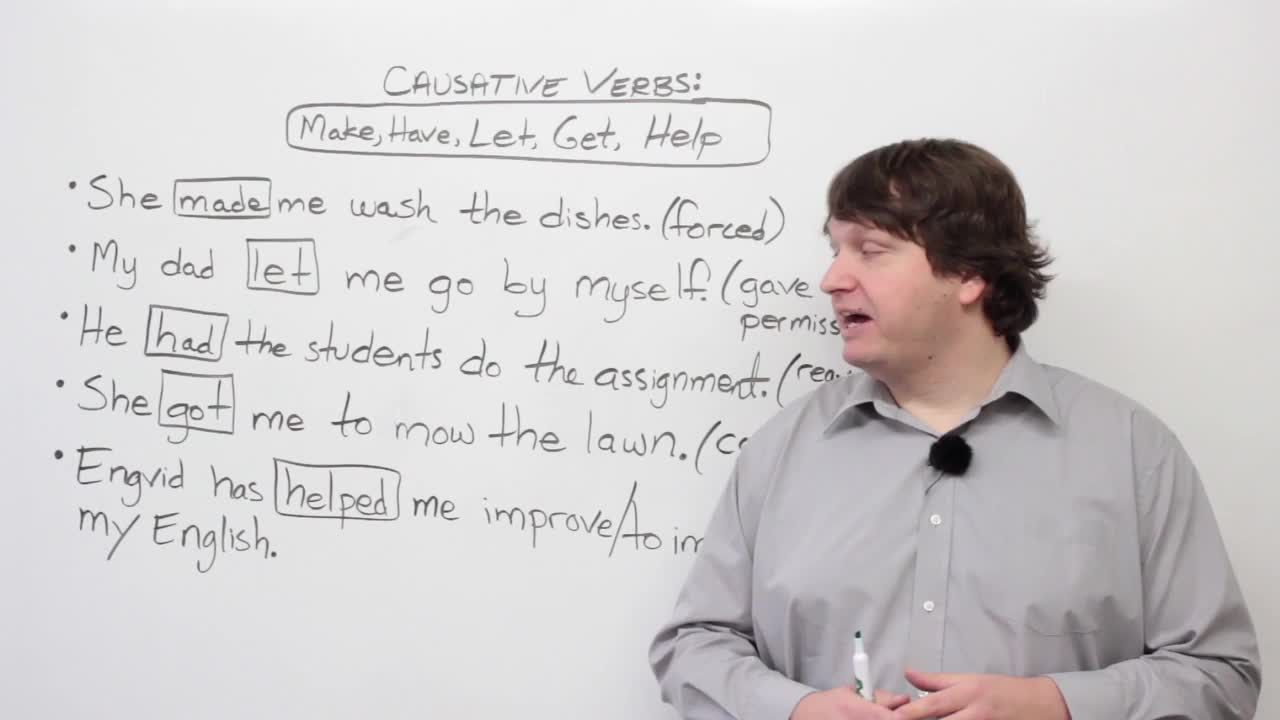
Specifically, we will be looking at the verbs make have let, get and help and how they are used and formed in a causative sentence structure.
So first, we have the sentence, She made me wash the dishes.
So the causative verb is make, and here we're using the past tense, and we will be using the past tense for all the examples today.
And, um, she made me wash the dishes.
Now, in this situation, the causative verb, make, in this context, made, means she forced me.
She didn't give me a choice.
So this could be your mother, for example, forcing you to wash the dishes.
Now, what we notice here is you have the subject.
I'm just going to do this for the first sentence and write a little S or what looks like an S.
You have your subject, the subject that is going to force the action or cause the action.
You have your causative verb, which we'll call your CV, and then you have me.
She made me.
And this will be your object.
Okay?
So, she made me wash the dishes.
She forced me to wash the dishes.
What you'll also notice is you have wash, we're using the base verb.
Okay?
So when you have the causative verb make, you have this structure of subject make object, base verb.
Base verb, base verb, base verb.
Okay?
Because not all of these causative verbs follow the same structure, as you'll see.
Okay.
The next sentence says, my dad let me go by myself.
So you wanted to go to a party or you wanted to go to a movie, and your dad let you go.
If you let someone do something, you give them permission.
You allow them to do it.
Okay?
Now, what you notice here is my dad... I'm just going to do quick underlines.
My dad let me And again, you have the base verb.
Okay?
So just like make, let also uses a base verb after for your main verb.
The next sentence, she had the students do the assignment.
So the teacher had the students do the assignment.
Now here the verb have basically means requested or asked.
Not really made them do it in the same way, but she made them do it in a polite way.
So if a teacher says, okay, please turn to page 25 and do the assignment on that page.
You know she's requesting, but really you don't have a lot of a choice because you have to follow the instructions.
So if you have someone do it or do something, you're requesting and asking them to do it, but really you're politely making them do it.
Okay?
So, same structure, she had, sorry, he had the students base verb.
Okay?
We're still using a base verb with make, let, and have.
The next one is get.
So simple past.
She got me to mow the lawn.
Mow the lawn means to cut the grass, you know, with a lawn mower.
So if someone gets you to do something, it means they persuade you to do something.
They convince you to do something.
So, she got me to mow the lawn.
Maybe she paid me $5 if this is my mom again.
All right?
So look at this structure, though.
We have she got me", and we don't say, she got me mow.
We say, she got me to mow.
So when you use get in this causative form, you have to use the infinitive phrase of to plus the base verb.
Okay?
To mow, to do, to make, to see.
Okay?
And finally, we have the causative verb, help.
So for example, EngVid has helped me improve or to improve my English.
I think you guys know the verb, help.
It just means to aid you in doing something.
So here we have EngVid. and we actually have a present continuous... Present continuous?
Present perfect sentence, and it has helped me.
And you can say, improve or to improve.
So the verb help in the causative form doesn't discriminate between the base form or the infinitive form.
You can use either one.
Both are 100% correct.
Okay?
All right, guys.
So again, what I want you to get from this is, number one understanding what these causative verbs mean.
So if you make someone do something, you force them to do it.
If you let someone do something, you give them permission to do it.
If you have someone do something, you request and ask them to do something.
If you get someone to do something, you convince them, persuade them, give them an incentive to do it.
And finally, if you help someone do something well, you know you give them aid, you give them help in doing it.
The second thing I want you to get is the structure.
So for make, let, have, always use the base form of the verb.
Okay?
The base form for your main verb.
Forget, it's always going to be the infinitive form of the verb and, for help, you can use either one.
So if you'd like to test your understanding of this material, as always, you can check out the quiz on wwwengvidcom.
Good luck, guys, and take care.