
[Mastering English Causative Verbs: A Comprehensive Guide]-[English Grammar: Causative Verbs: Make, Have, Let, Get, Help]
📋 Summary
Understanding Causative Verbs: Structure and Usage
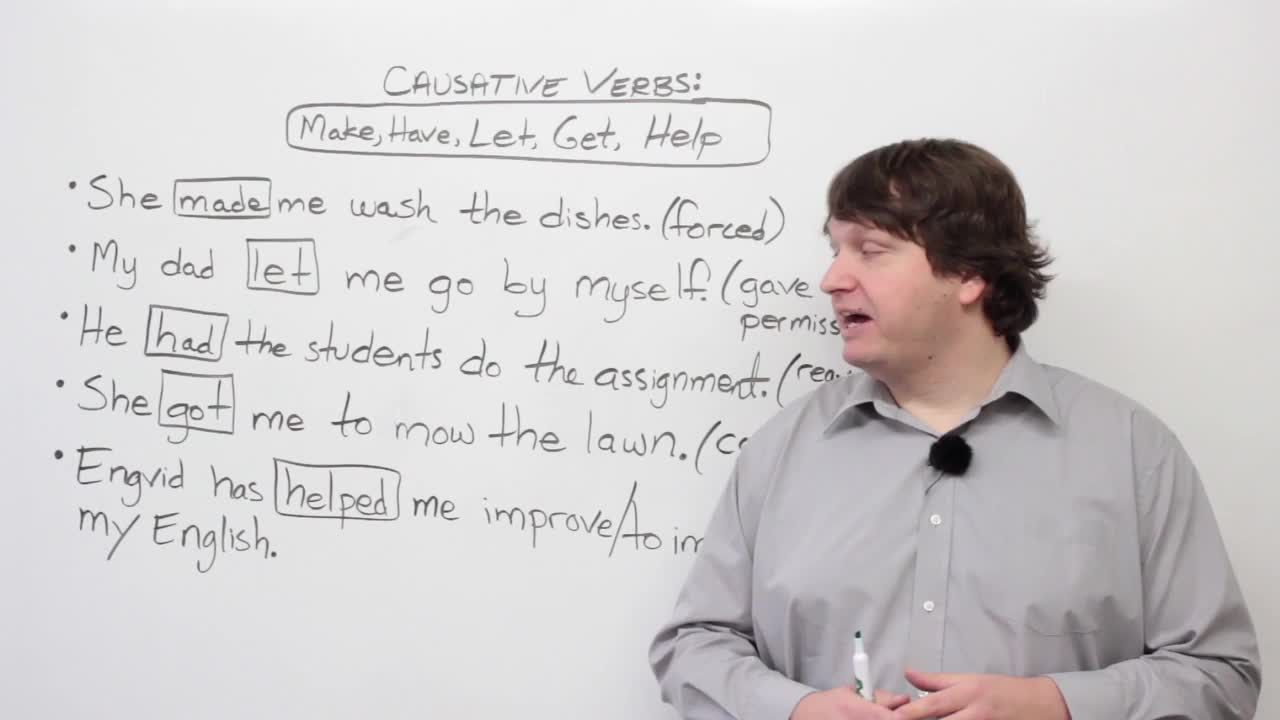
In this lesson, Alex provides an insightful breakdown of English causative verbs—specifically make, have, let, get, and help. These verbs are essential for describing situations where one person causes another to perform an action. Understanding both the nuance of meaning and the specific grammatical structure is key to using them correctly.
1. Verbs Requiring the Base Form: Make, Let, and Have
For a large group of causative verbs, the structure follows a standard pattern: Subject + Causative Verb + Object + Base Verb.
- Make: When you "make" someone do something, you are exerting authority. As Alex notes, "she made me wash the dishes" implies she "forced" the action, leaving the subject with no choice.
- Let: This verb signifies permission. When "my dad let me go," he is giving "permission" or "allowing" the action to take place.
- Have: This verb is used for requests or instructions. When a teacher "had the students do the assignment," they are "requesting" or "asking" them to perform a task. While it is a polite request, it often functions as a soft form of making someone do something.
In all three cases, the main verb following the object must be in its base form (e.g., "wash," "go," "do").
2. The Exception: Get
Unlike the previous verbs, get requires a different grammatical structure: Subject + Get + Object + Infinitive (to + base verb).
Alex explains that "get" implies persuasion or incentive. In the example "she got me to mow the lawn," the speaker is being "persuaded" or "convinced" to perform the action, perhaps through an incentive. Crucially, you must use the infinitive form, as saying "she got me mow" would be grammatically incorrect; it must be "to mow."
3. The Flexible Verb: Help
The verb help is unique because it offers flexibility. It is defined as giving "aid" in doing something. When using "help" in a causative structure, you have the option to use either the base verb or the infinitive form. For example, "EngVid has helped me improve" and "EngVid has helped me to improve" are both "100% correct."
Summary Table of Structures
| Causative Verb | Meaning | Structure | | :--- | :--- | :--- | | Make | Force | Subject + Make + Object + Base Verb | | Let | Permission/Allow | Subject + Let + Object + Base Verb | | Have | Request/Ask | Subject + Have + Object + Base Verb | | Get | Persuade/Convince | Subject + Get + Object + To + Base Verb | | Help | Aid | Subject + Help + Object + Base Verb / To + Base Verb |
By mastering these distinct structures and the subtle differences in meaning—ranging from forceful commands to polite requests and persuasive incentives—learners can significantly enhance their ability to describe causative actions in English.
Deep Learning with ListenLeap


