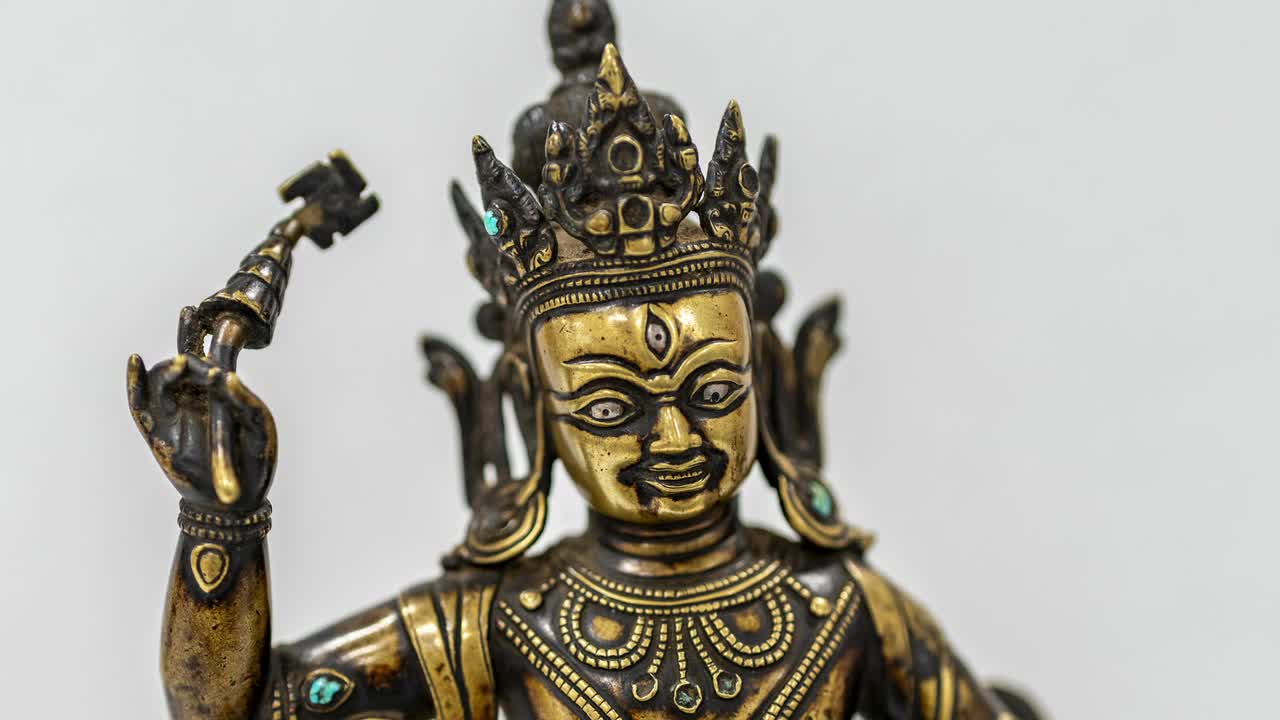
We're looking at a sculpture in the collection of the Rubin Museum of Art.
This is Drenpa Namka.
Drenpa Namka was the first historically documented Bun master who lived in the eighth century during this competition between Bun and Buddhism.
And the Bun religion is a collection of indigenous traditions in Tibet before Buddhism became the official religion in the eighth century.
And in the eighth century, he played a principal role in the competition between the two religions.
And he lost, but lost at least according to Buddhist texts, because the person he brought back to life turned out to be a ghost.
So, following the initial power struggle between Bon and Buddhism for influence, from the 11th century onward there was a more organized religion called Yunzhong Bon, and he's holding the Yunzhong at the top of his parasol, the most important symbol of the Bon religion, and it represents the indestructibility and eternal nature of the Bon religion.
So he's a very powerful figure, but he loses in this struggle.
But it's also thanks to him that the Bowen religion continues anyway.
Although the Tibetan emperor, who was presiding over the contest, forced him to convert to Buddhism, Tranpa Namkha is said to have propagated Bun secretly.
Basically, Tranpa Namkha argues that the two religions differed only by their outer appearance.
And so, by adopting Buddhism, Tranpa Namkha is credited with saving the teachings of the Bun tradition from total eradication.
And this ability to adapt to any religious situation to preserve bun made him a hero among bun practitioners, a tradition which continues today.
So in so many ways, he looks like a Buddhist siddha, an accomplished Buddhist practitioner.
So you can see that they share a common visual language.
For instance, the bone ornaments that decorate his chest, his wrists, his arms and his ankles are associated with the charnel grounds where Siddhas would practice, and also the tiger skin pelt wrapped around his waist and the third eye in the center of his forehead indicates his omniscience.
He has bulging eyes, emphasized by inlaid silver and a protruding belly, both of which are reflections of yogic accomplishments.
So they're outer manifestations of his inner spiritual power.
There's also an inscription at the bottom that helps identify him.
The inscription not only confirms the identity of the subject matter as Dronpananka, but it also confirms the context of the sculpture's creation.
The language here indicates that it was commissioned after the passing of a lama to fulfill his wishes.
The figure sits on a double lotus throne.
At the very bottom, we see five animals.
The five animals here are referred to in texts as the throne of animals.
There is a horse, a lion and an elephant on the front and on the back a dragon and a mythical horned bird which is quite important to the Bun tradition, the Kyung, which resembles the Indian Garuda or king of birds, and sometimes glossed as a horned eagle.
And I'm noticing how large his head seems.
This kind of disproportionately large head is typical of earlier Tibetan sculpture, as is the high top knot and the ribbons that float to either side of his head.
He's very animated.
His mouth is open.
You can see his teeth.
He appears, even though he's seated, to be quite energetic.
Not only do we have the inlaid silver, which draws attention to his eyes, but we also see inlaid turquoise in one of his earrings and in one part of the crown.
But I imagine there was much more turquoise originally.
Turquoise is one of the most common semi-precious stones used in ornamentation both on jewelry and also inlay into images.
And you can see that he only maintains a few in one earring and on one armlet.
And you can see that empty bezels where other lost turquoise pieces in his crown and his arms would have once been.
You can see that not only is he an important early bun master, but the Buddhists also claim him as one of the 25 disciples of Padmasambhava.
And you can see that he shares many features with Padmasambhava.
Not only did he live in the 8th century, but he also practiced magic and also hid texts known as treasures or terma, to be discovered at appropriate times in the future.