
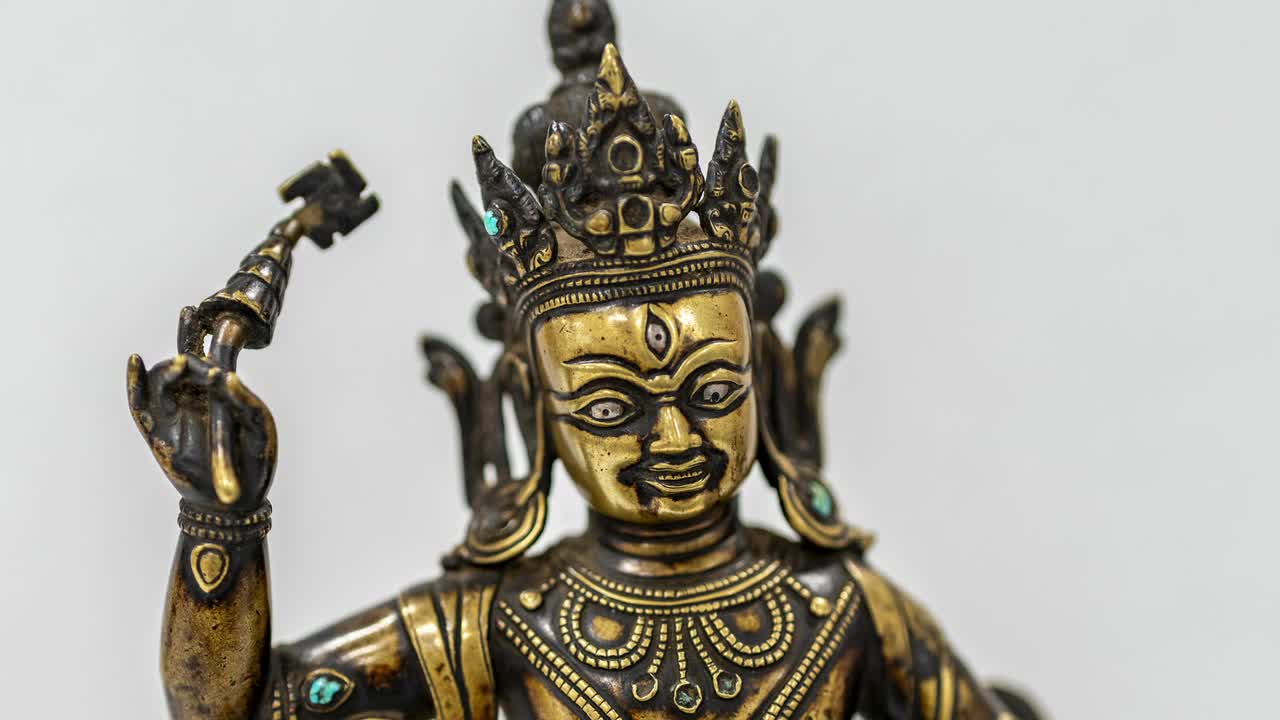
[Drenpa Namka: The Resilience and Syncretism of the Bon Tradition]-[Drenpa Namkha, Bon Teacher]
📋 Summary
The Legacy of Drenpa Namka: A Bridge Between Traditions
The sculpture of Drenpa Namka, housed in the Rubin Museum of Art, serves as a profound historical and artistic artifact representing the complex transition of religious power in 8th-century Tibet. Drenpa Namka stands as the first historically documented Bon master, a figure who navigated the intense "competition between Bon and Buddhism" during a period when Tibet’s indigenous "Bon religion" faced the encroaching influence of Buddhism.
The Struggle for Survival and Religious Synthesis
Historical narratives, particularly those from Buddhist texts, recount that Drenpa Namka lost in a power struggle against Buddhist practitioners, famously failing to prove his magic when he attempted to bring someone back to life, only to reveal a "ghost." Despite this defeat and the subsequent mandate from the Tibetan emperor to convert, Drenpa Namka is celebrated for his strategic genius. He is credited with "saving the teachings of the Bon tradition from total eradication" by propagating them in secret.
His philosophy—that the two religions "differed only by their outer appearance"—allowed him to adopt Buddhist practices while maintaining the core of the Bon tradition. This adaptability solidified his status as a hero among Bon practitioners. Interestingly, this syncretism is so profound that Buddhists also claim him as one of the "25 disciples of Padmasambhava," noting that he practiced similar arts such as hiding "treasures or terma" to be discovered in the future.
Iconography and Spiritual Manifestation
Visually, the sculpture illustrates the shared "common visual language" between Bon and Buddhist tantric practitioners. Drenpa Namka is depicted with traits typical of a "Buddhist siddha," or an accomplished practitioner. His "bone ornaments" on his chest, wrists, and ankles evoke the "charnel grounds" where such figures practiced. Furthermore, the "tiger skin pelt" around his waist, the "third eye" indicating "omniscience," and his "bulging eyes" and "protruding belly" are all "outer manifestations of his inner spiritual power" and yogic accomplishments.
At the peak of his parasol, he holds the "Yunzhong," the most critical symbol of the "Yunzhong Bon" tradition, representing the "indestructibility and eternal nature" of the religion. The base of the sculpture features a "throne of animals," including a horse, lion, elephant, dragon, and the "Kyung," a "mythical horned bird" essential to Bon identity, often compared to the Indian Garuda.
Artistic Context and Materiality
The sculpture’s physical characteristics provide insight into early Tibetan artistic conventions. The "disproportionately large head," "high top knot," and "floating ribbons" are indicative of early regional styles. The artist employed "inlaid silver" to accentuate his intense, animated expression, and "inlaid turquoise" for ornamentation. While the piece is now missing several stones—evidenced by "empty bezels" on his crown and arms—the remaining turquoise highlights the historical importance of this semi-precious stone in Tibetan iconography.
Finally, the "inscription at the bottom" acts as a vital historical anchor, confirming not only the subject’s identity as Drenpa Namka but also the sculpture's purpose: it was "commissioned after the passing of a lama to fulfill his wishes." Through this combination of text and form, Drenpa Namka remains a testament to the resilience of the Bon tradition and the fluid, often overlapping boundaries of ancient Tibetan spirituality.

Deep Learning with ListenLeap


