Hey, everyone.
I'm Alex.
Thanks for clicking, and welcome to this lesson on five more common English learner mistakes.
So if you have watched my other video on five common English learner mistakes, this is a follow-up to give you five more.
So let's not waste time and get right to it.
Here we go with number one.
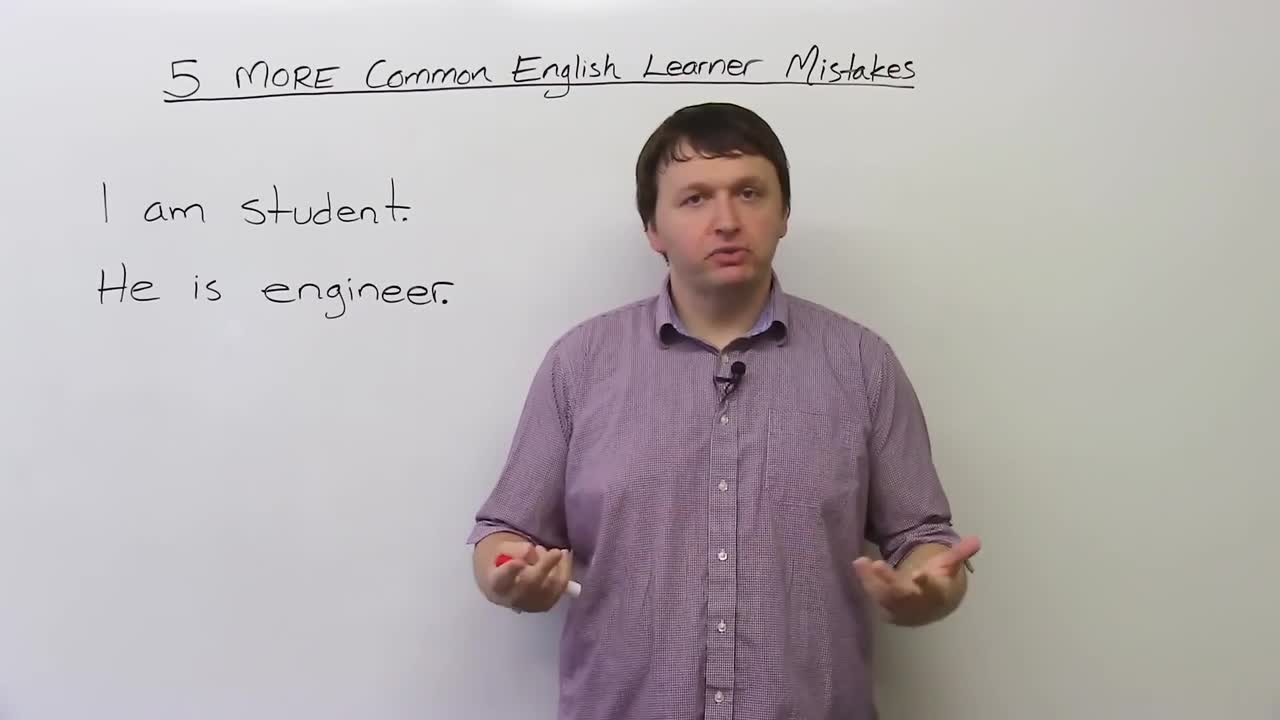
So this first mistake is common, because in many languages, when you discuss jobs or your station in life, you don't use articles, even if you come from a country where there are articles in the language.
So for example, I am student.
He is engineer.
If I ask you, what do you do?
You need to use an article, because student is countable.
It's singular.
Engineer is countable, and it's singular.
So you have to say, I am a student.
He is an engineer.
Now, let's move on to number two.
Okay.
Here, we have two sentences on the board.
We have, I am agree.
Are you agree?
So in this situation, agree is a verb.
We don't say, I am agree. you can just say, I agree.
If it's negative, I don't agree or I disagree.
And the question is not, are you agree?
It's, do you agree?
Now, if you are set on wanting to say I am and use agree in some way, you would have to say I am in agreement.
This is very formal, but it is possible.
Otherwise, just say, I agree or I disagree, and do you agree?
Now, let's move on to number three.
This next mistake is about the use of the past tense.
For new English speakers because they can't form the past tense.
Sometimes they use the verb to be with a verb.
So I have heard, I'm go downtown yesterday."
Or, he was see his cousin.
If you are speaking in the past, make sure you simply use the past simple verb.
In this situation, we don't say, I'm go.
The past of go is went.
I went downtown.
We don't say, he was see. the past of C is saw.
So this is about using the past simple form of the verb to speak about the past.
Never say, I'm go, I'm do, I'm make.
I saw, I made, I did, I played.
Okay?
Now, let's move on to number four.
Now, this mistake is about using negatives.
In many languages, whether they're European or Latin, Spanish, I hear this mistake very frequently.
So you might hear, he no have money or they no like chocolate.
So if you are making you know, a sentence in the present simple and you want to make it negative, you have to use doesn't and don't.
So not he no have, but he doesn't have.
Okay?
Not they no like chocolate, but they don't. like chocolate.
So make sure you learn how to make negative sentences.
He doesn't.
I don't.
We don't.
They don't.
Not he know, she know, I know.
All right?
Now, let's move on to number five.
Finally, here we have a word choice error.
And this is because, you know, many speakers translate from their own language.
And many languages.
You can use the verbs meet or know to talk about going to places and getting to know cities and towns, for example.
So, I want to meet the city or yesterday I knew downtown.
Now, in English, we don't really use the verbs know and meet to talk about getting to know a place.
You can use the verbs explore or get to know or visit.
So you can say, you know, I want to explore the city.
I want to go around the city.
Yesterday, I knew downtown.
Yesterday, I travelled around downtown.
And you can also use terms like get to know a place.
You can visit a place.
You can explore a place.
Okay?
But you can't meet a park.
You can meet a person, but you can't meet a place.
Now, let's review all five of these mistakes one more time.
All right.
So to review, number one, I am a student.
If you want to talk about your status in life are you a student, an engineer, are you a teacher, etc.
You need to use an article to talk about jobs professions, talk about your station in life.
Number two, I agree, not I am agree, Do you agree?
Not are you agreeing?
Number three, I went downtown.
I saw my cousin.
Remember, memorize those past tense verbs.
Not I was go or I am go.
I went.
I saw.
I did.
All right?
Number four, he doesn't have money.
Memorize your negatives, especially in the present simple and past simple.
I don't have.
He doesn't have.
We don't have.
They didn't have in the past.
And finally, I want to get to know the city.
I want to visit the city.
I want to explore the city, walk around the city.
Not I want to meet the city or I want to know the city intimately.
So if you want to test your understanding of this material, as always, you can check out the quiz on wwwengvidcom.
And don't forget to subscribe to my YouTube channel.
Thanks, guys.
Bye.