
[Mastering English: Overcoming Five Common Learner Mistakes]-[Don't make these mistakes in English!]
📋 Summary
Enhancing English Proficiency: Correcting Five Frequent Errors
Language acquisition is a journey marked by trial and error. In this guide, we dissect five common mistakes that English learners frequently encounter, providing clarity on grammatical structures and usage nuances to help you refine your fluency.
1. The Necessity of Articles for Professions
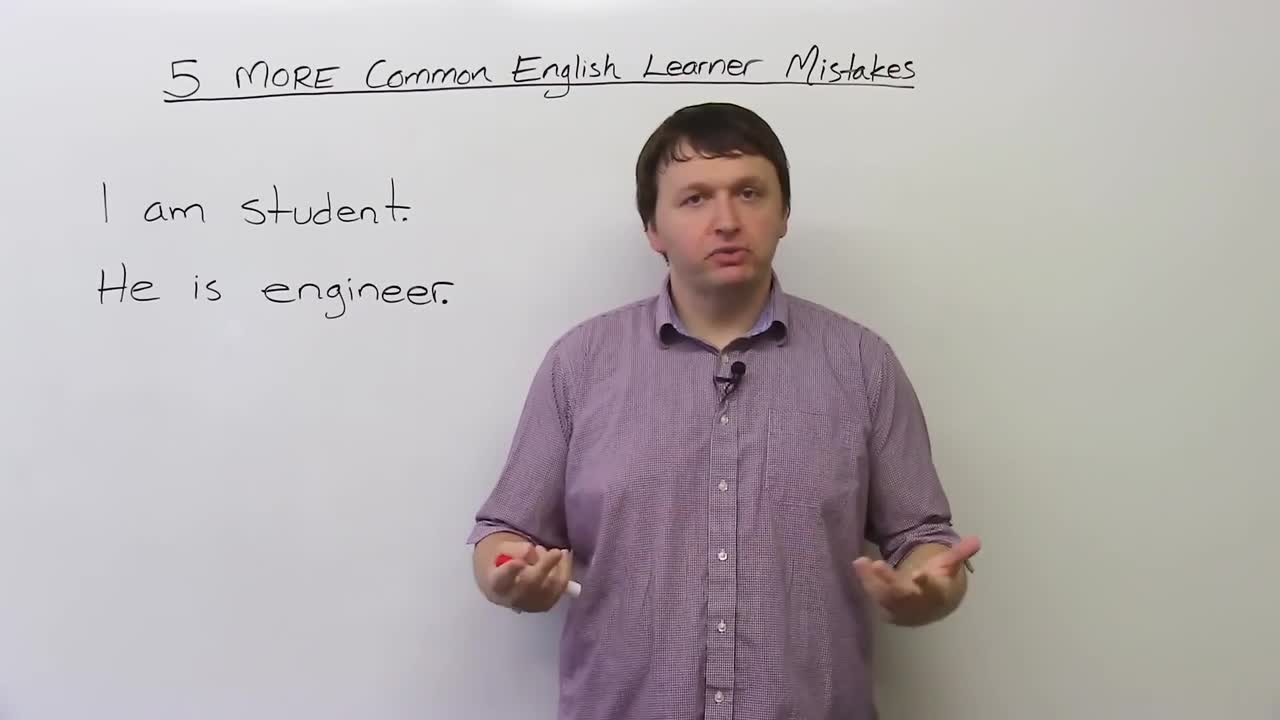
One of the most persistent errors occurs when discussing one's "station in life" or occupation. Learners often omit articles, saying things like "I am student" or "He is engineer."
The Correction: Because "student" and "engineer" are countable, singular nouns, they require an article. You must state, "I am a student" or "He is an engineer." Omitting these articles is a common pitfall, even for speakers whose native languages utilize them.
2. Correcting 'Agree' Usage
Many learners incorrectly treat the verb "agree" as an adjective, leading to phrases like "I am agree" or questions like "Are you agree?"
The Correction: "Agree" is a verb. Therefore, the correct present simple forms are "I agree" or "I disagree," and the question format is always "Do you agree?" While "I am in agreement" is grammatically possible, it is considered very formal and rarely necessary in casual conversation.
3. Mastering Past Simple Tense
New English speakers often struggle with forming the past tense, frequently defaulting to using the verb "to be" alongside a base verb (e.g., "I'm go downtown yesterday").
The Correction: To speak about the past, you must use the past simple form of the verb. Never combine "I am" or "he was" with a base verb. Instead of "I'm go," use the past form: "I went downtown." Instead of "he was see," use "he saw his cousin." Memorizing the past simple forms of common verbs like "did," "made," and "played" is essential for accurate communication.
4. Proper Negative Sentence Construction
In many European and Latin languages, negation is formed simply by placing a negative particle before the verb. This leads learners to say "he no have money" or "they no like chocolate."
The Correction: In English, you must utilize auxiliary verbs to form negatives in the present simple. The correct forms are "he doesn't have" and "they don't like." Mastering the distinction between "doesn't" (for third-person singular) and "don't" (for the rest) is vital for grammatical accuracy.
5. Precise Word Choice: Meeting vs. Exploring
Translating directly from a native language often results in word choice errors, particularly regarding locations. Learners might mistakenly say, "I want to meet the city" or "I knew downtown."
The Correction: In English, you can "meet" a person, but you cannot "meet" a place. When discussing getting familiar with a location, use verbs such as "explore," "visit," "get to know," or "travel around." For example, say "I want to explore the city" rather than "meet the city." Choosing the right verb ensures your intended meaning is conveyed naturally.
Summary Checklist
- Professions: Always use an article (e.g., "I am a teacher").
- Agreement: Use "I agree" or "Do you agree?"—never "I am agree."
- Past Tense: Use the past simple form (e.g., "I saw," "I went").
- Negatives: Use "don't" or "doesn't" (e.g., "He doesn't have").
- Places: Use "explore" or "get to know" instead of "meet."

Deep Learning with ListenLeap


