Okay.
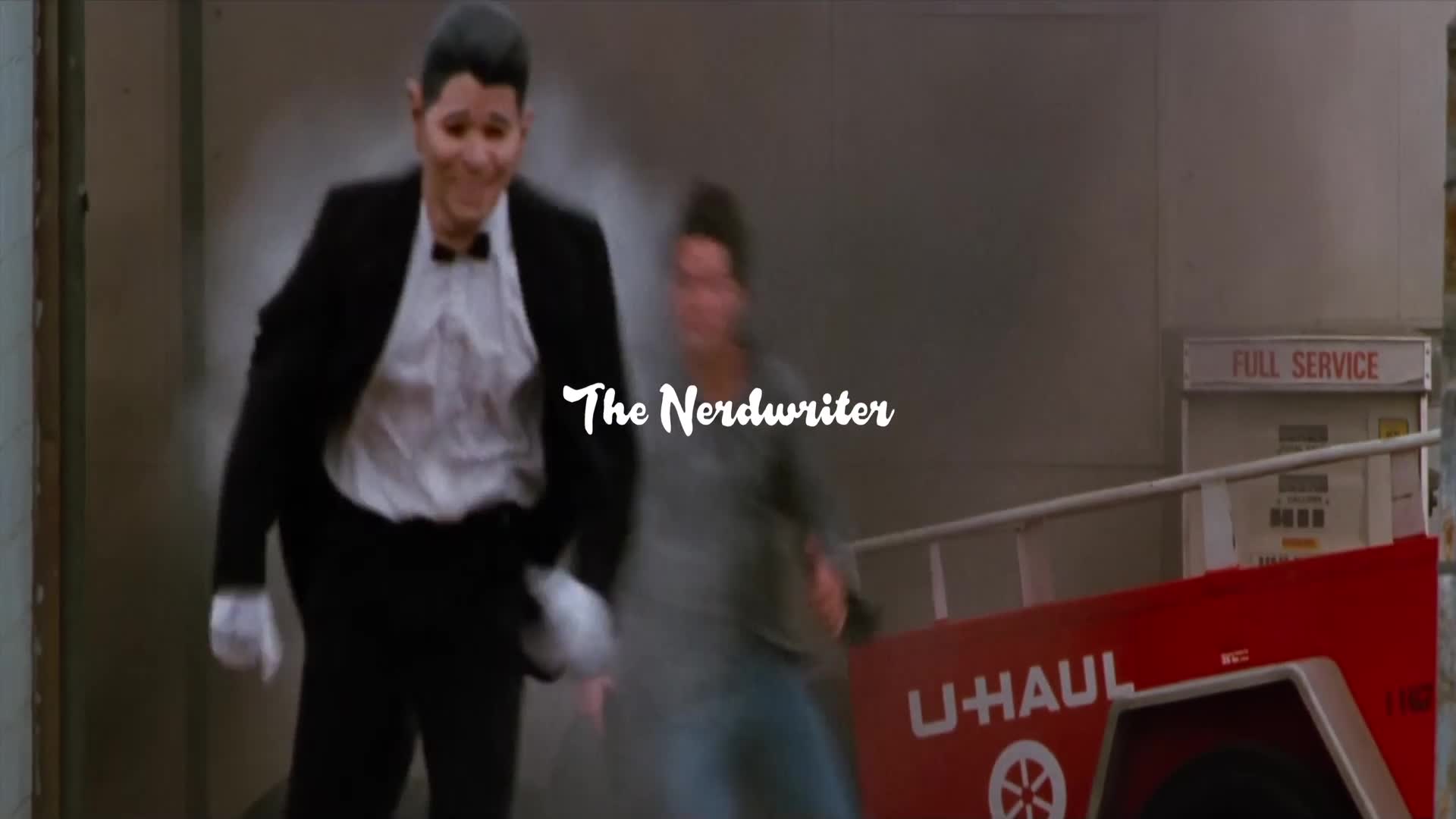
So in the iconic chase scene in catherine bigelow's point break, there's a blink and you'll miss it.
Moment of camera work that is just so fascinating to me there, did you see it?
No okay, let me let me back up right here.
This half second moment of pause before the camera pans to the right to follow keanu.
What is that?
What kind of information does that communicate to the viewer?
In this earlier shot, you can see that the camera is clearly objective and impersonal.
This shot, on the other hand, of Patrick Swayze could conceivably be a POV of Keanu who is coming up from behind him.
But this shot has to be objective because no character is following here.
And yet this is a moment of subjectivity, as if the camera itself had to think for a second before turning right.
It's a small thing with a big impact.
Bigelow uses the formal language of POV to activate a sense of immediacy in the viewer.
The same principle is at work in a handheld whip pan like this.
It's designed to mimic the turn of a head.
To achieve these fast pans, to enable an incredible cameraman like J Michael Miro to run at the same speed as the actors through cramped, complicated environments, you need a rig that is small and light.
That's easier said than done with a 35 millimeter camera.
So Bigelow and her team created something they called the PogoCam, essentially a 35 millimeter camera attached to a stick with a gyro stabilizer on the bottom.
And the results speak for themselves.
I mean, just look at this.
Bigelow is a pioneer and virtuoso of action cinematography.
You can see the direct influence of this chase scene on movies like Inception, the Jason Bourne movies and Casino Royale, to cite just a few examples.
And all these films had better technology and smaller cameras.
My intent was to put the audience in as close to an experiential situation as possible.
In other words, I wanted it all to be shot with as much sort of movement as possible so that you're actually feeling the velocity that those people are feeling.
So we had to technically figure out how to do it and how to put the cameraman in the same situation as the actors are, in giving you as realistic a sense as possible.
The funny thing about that quote is that Bigelow is actually talking about the astonishing skydiving scene later in the movie, but the sentiment applies to all her action set pieces.
The chase is designed to make us feel the velocity of the sprinting characters.
The handheld camera does that, but so does the environment and the lens.
As a general rule, a wide-angle lens makes a moving image move faster, and that is accentuated when you're running in tight spaces like alleys, narrow streets and living rooms.
And constructing the chase like a maze allows Bigelow to throw all kinds of fun and dangerous obstacles at the characters.
Don't worry, that's a fake dog.
In fact, an inspiration for this chase was the classic Disneyland ride, Mr Toad's Wild Ride, in which you're in a car careening recklessly through the streets of London, taking sharp turns left and right, dodging pedestrians, cars and other obstacles.
This is what Bigelow means by putting the audience in an experiential situation.
The chase should feel like a ride.
And this brings us back to POV.
Bigelow clearly has a fascination with the experiential power of POV shots, especially moving POV shots, to bring you into the action like you're sitting in that car in Mr Toad's Wild Ride.
Later in the movie in the final bank heist Bigelow uses this tool again and puts us behind the eyes of Keanu's character, Johnny Utah, as he storms into the bank with the ex-presidents.
But Bigelow took her experimentation with POV much further in her next film, the criminally underappreciated Strange Days, a cyberpunk sci-fi movie that features a technology called SQUID.
Superconducting quantum interference device SQUID, which allows you to experience other people's memories.
Bigelow films these scenes entirely in POV.
The film starts with an incredible three-minute-long take POV shot of a group of criminals robbing a Chinese restaurant.
For this sequence, even the 16-pound PogoCam wasn't light enough.
For months in pre-production, Bigelow worked with camera technicians and her ex-husband and frequent collaborator, James Cameron, to develop a camera that weighed just eight pounds.
Now eight pounds might sound a little funny today in the world of GoPros and action cameras that weigh the tiniest fraction of that.
These days, you can get a POV of, well, anything.
YouTube is filled with first-person parkour chase scenes on city rooftops and POVs of dogs running on the beach.
In 2015, Russian director Ilya Naishuller made an entire movie in POV called Hardcore Henry, and then a POV music video for The Weeknd, both of which owe a debt to the pioneering work of Kathryn Bigelow.
But even though the tech has gotten better, the point-break chase, all the action in that movie, still holds up 33 years later.
It's just as exciting now as it was in 1991, and that will be true 33 years from now, too.
That is, if we're still watching movies on a flat screen.
Who knows?
Maybe all the entertainment of the future will be experienced as POV.
Hey everybody, thank you so much for watching.
This episode was brought to you by Squarespace, the all-in-one website platform for entrepreneurs to stand out and succeed online.
Whether you're just starting out or managing a growing brand, Squarespace makes it easy to create a beautiful website.
And now you can make a completely personalized website with their new guided design system, Squarespace Blueprint.
Choose from professionally curated layout and styling options to build a unique online presence from the ground up, optimized for every device and with optimized SEO tools, so you show up more often to more people.
You can upload your video content.
You can even sell access to your video library all from within Squarespace.
Basically, a Squarespace site is going to make whatever you're sharing or selling look professional.
And that's going to help you get the word out, whatever that word actually is.
Head over to squarespace.com for a free trial.
And when you're ready to launch that site, go to squarespacecom.
Slash nerdwriter for 10 off your first purchase.
Thanks, guys.
I'll see you next time.